


Harmful Ingredients in Toothpaste: 6 Formula Patterns Worth a Second Look
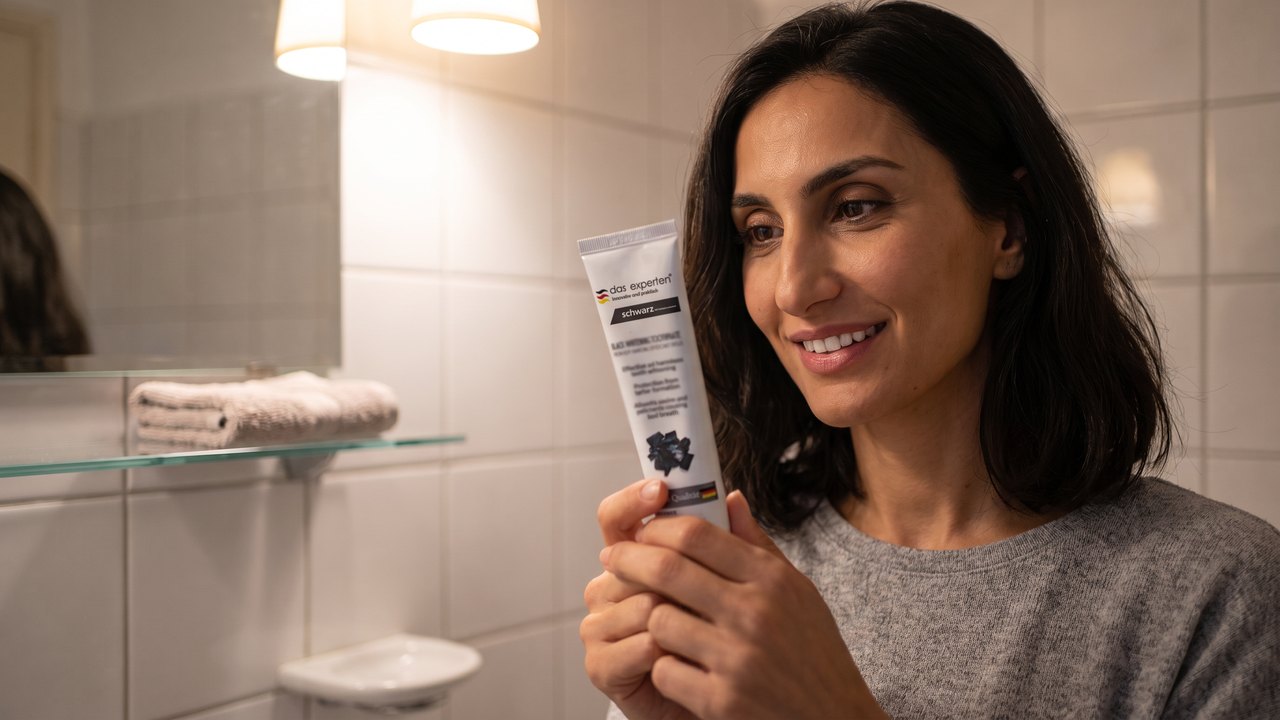
Search for harmful ingredients in toothpaste and you get two kinds of lists. One says everything in the tube is poison. The other says nothing is. Both are easy to write, and neither helps you at the bathroom shelf. The useful question is narrower: which formula, in which mouth, at which dose. A single ingredient is rarely the problem on its own. A pattern is: the wrong formula meeting the wrong mouth.
Below are six such patterns. Each has a mechanism you can picture, a group of people it matters for, and published evidence we read for this article. We name no brands. Das Experten makes toothpaste too, and the same questions apply to our tubes; you will find them answered at the end.
1. A highly abrasive whitening paste on exposed roots
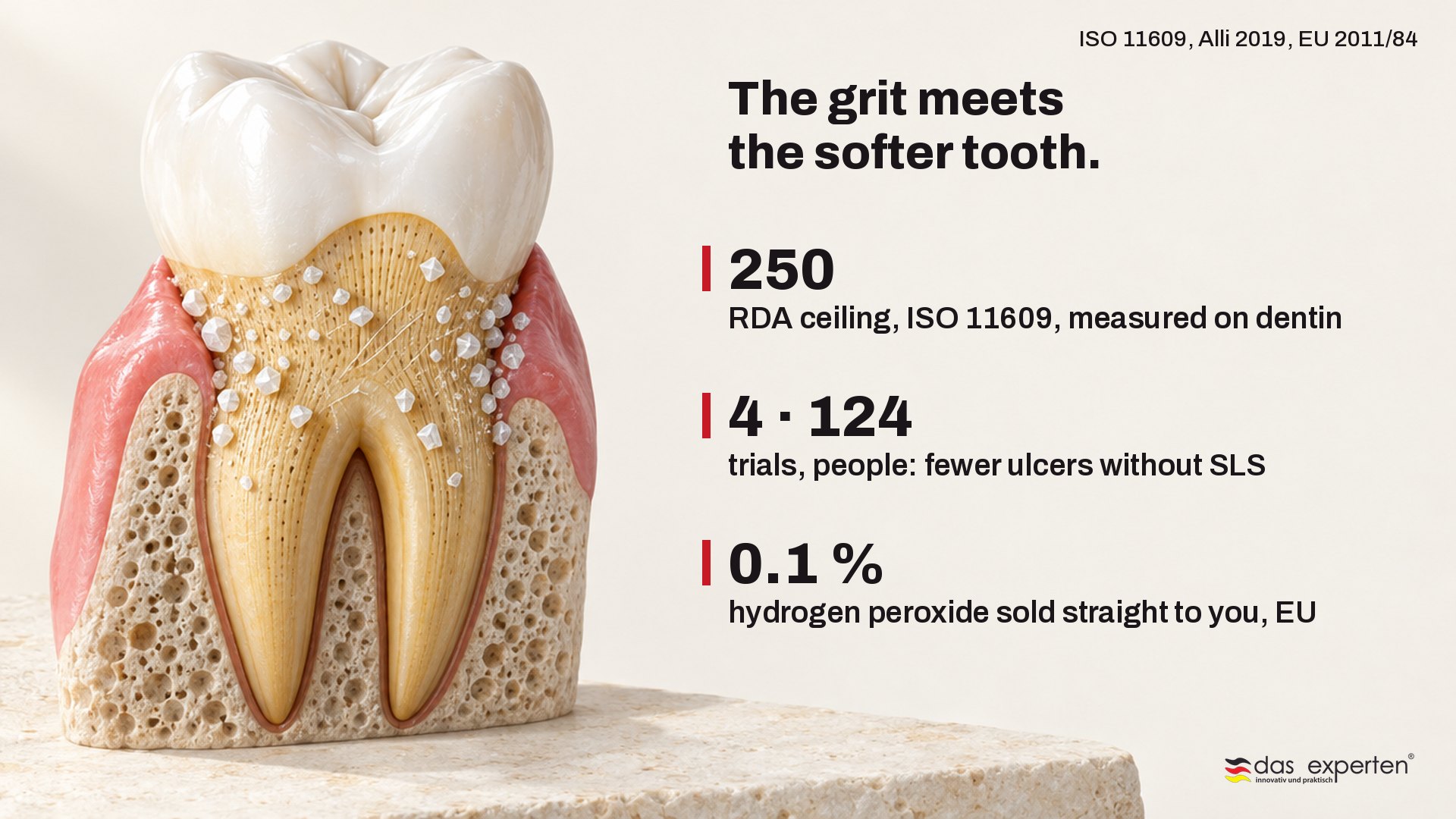
Toothpaste cleans partly by grinding. The figure that rates the grit is RDA, relative dentin abrasivity, and it is measured on dentin, the softer, yellower tissue under the enamel. The international standard for toothpaste, ISO 11609, sets the ceiling at 250. In a healthy mouth dentin is covered and the number matters little. Where the gum has receded, the brush meets dentin directly, and a strong whitening grit works on exactly the tissue it was measured on. Who should care: people with receding gums, sensitive tooth necks, or a heavy brushing hand. What instead: a paste that declares its RDA, a low one if your roots show, and a soft brush. We took the number apart in our piece on hydrated silica and RDA.
2. Charcoal powders sold with detox promises
In 2017 a review in the Journal of the American Dental Association went looking for the evidence behind charcoal toothpastes and powders. Of 118 potentially eligible articles, not one trial of brushing with charcoal met the bar of a controlled study lasting three months or longer. Three studies reported harm: more caries, enamel abrasion, an unquantified negative effect. The authors also examined the first 50 charcoal products they found on Google and Amazon. The advertising promised antibacterial, antifungal, antiviral and detox effects that no study supported, and a third of the products contained bentonite clay. Their verdict: not enough clinical or laboratory data to back the safety and efficacy claims. The pattern is an unmeasured black grit with a health promise attached. What instead: if you like charcoal, choose a paste that states its abrasivity and promises no detox. The history of the idea is older than you think; we told it in charcoal toothpaste since 1577.
3. An adult amount of fluoride paste on a small child’s brush
Fluoride is the best supported protection against cavities we have, and this item is not against it. The problem is the dose. A 2014 systematic review for the American Dental Association found that fluoride toothpaste controls caries in children under six, and that swallowing a pea sized amount or more can lead to mild fluorosis: white flecks in enamel that is still forming. The advice that came with it is simple. Under three years, a smear the size of a grain of rice. From three to six, no more than a pea. Teach the child to spit as early as they can. Who should care: parents and anyone who brushes a small child’s teeth. What instead: the same paste, measured, with an adult watching.
4. SLS for people who keep getting mouth ulcers
Sodium lauryl sulfate, SLS, is the detergent that makes toothpaste foam. For most mouths it is a non issue. For people with recurrent aphthous ulcers, the small painful canker sores that come back again and again, it may not be. A 2019 systematic review pooled double blind crossover trials, 4 of them with 124 participants in total. Paste without SLS reduced the number of ulcers, how long they lasted, how often they came back and how much they hurt. The authors call the evidence limited, and an earlier London trial found no difference at all; we laid out both sides in what SLS does in toothpaste. What instead: if ulcers keep returning, try a few weeks with a paste without SLS and keep count.
5. Home whitening above the legal peroxide line
In the European Union a product sold straight to you may contain or release up to 0.1 % hydrogen peroxide. Between 0.1 and 6 % it may be sold only to dental practitioners; the first use in each cycle happens with a dentist, and it is not used on anyone under 18 except to treat or prevent disease. Above 6 % it is prohibited for cosmetic use. That is Directive 2011/84/EU, and the United Kingdom’s dental regulator states the same limits. The pattern is an online kit that prints no concentration at all. What instead: read the percentage on the pack. If it is not printed, do not guess in its favour.
6. A tube nobody can trace
In June 2007 the US Food and Drug Administration advised consumers to avoid toothpaste containing diethylene glycol, a chemical it had found in imported toothpaste, and to check labels for the words diethylene glycol or diglycol. The agency knew of no poisonings in the United States from toothpaste, but it was concerned about long exposure, and about children and people with kidney or liver disease in particular. The pattern is not one ingredient. It is a tube with no traceable maker, no full ingredient list, from a seller who cannot say where it was made. What instead: buy where the maker and the complete ingredient list are printed on the box.
What the six have in common
None of them says toothpaste is poison. Each is a mismatch: a strong grit on a bare root, a promise without a trial, an adult dose in a small mouth, a foam for a mouth that ulcerates, a concentration above the line, a tube without an address. Every one of them can be caught by reading the back of the tube.
Our own tubes answer to the same list. SCHWARZ, our charcoal paste, declares RDA 79 on its product card, foams with sodium lauroyl sarcosinate instead of SLS, and contains no fluoride. That is a description of the label, not a ruling on your mouth: if your dentist has told you that you need fluoride, follow your dentist.
A harmful toothpaste is rarely one ingredient. It is the wrong formula in the wrong mouth, and the back of the tube is where you find out.