





Hydrated Silica in Toothpaste: RDA Rates Dentine, So It Counts Where Dentine Is Exposed
You have been putting a mineral abrasive in your mouth twice a day since you were old enough to hold a brush, and nobody has ever told you how hard it is. The white grit in the tube is hydrated silica. Fluoride does chemistry. Surfactants make foam. Silica is the only thing in there that physically removes material from the surface of a tooth — which makes it the only ingredient with the power to take away something that does not grow back.
At some point you may have looked up an RDA chart. Most people who care about their teeth eventually do. A tidy list: pastes ranked by one number, a line drawn near a hundred, a reassuring note that anything under 250 is permitted. Here is what the chart does not say. That number was never measured on your enamel. It was measured on dentine, the softer tissue underneath. A healthy mouth exposes no dentine; it comes bare wherever the enamel over it has gone — usually a receded gum line, but also a biting surface ground flat, an eroded patch, a chip.
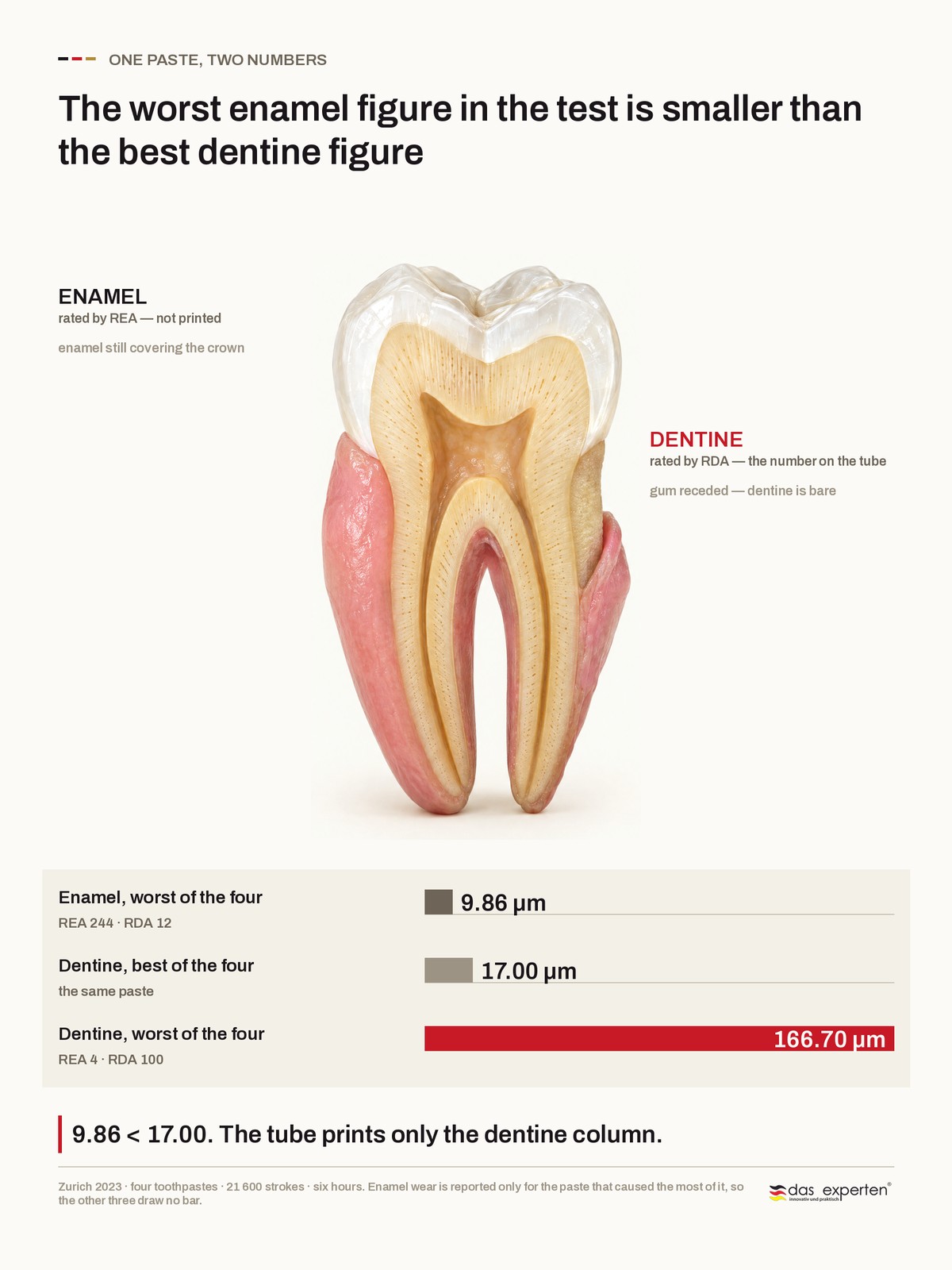
Which splits the readers of this page into two groups. If no dentine is exposed anywhere in your mouth, that column is close to irrelevant to you, and changing paste on the strength of it buys almost nothing. If any of it is — a bare root, a worn biting surface, an eroded patch — it is the single most useful number on the tube. The tests below give you the size of the gap: the same brushing, in the same hours, took hundredths of a micrometre off enamel and up to 166.70 µm off exposed dentine.
The number on the tube rates a tissue most mouths never expose.
RDA stands for relative dentin abrasivity. The method sits inside ISO 11609, the international standard for dentifrices, which puts the ceiling at 250. Dentin — dentine, in British spelling — is the softer, yellower tissue underneath enamel. In a healthy mouth it is not exposed at all. It becomes exposed wherever the enamel over it is lost — a receded gum line, a biting surface worn through, an eroded or fractured patch. So the one abrasivity figure the industry publishes describes the wear of a surface that, in most mouths, the brush never reaches.
The grit is not exotic. In 2023, on model pastes at 2.5, 5.0, 7.5 and 10.0% hydrated silica by weight, a German group showed the obvious thing cleanly: abrasion climbed step by step with the percentage, and tracked the RDA measured on the same formulations. That is the mechanism: how much grit, how hard, how sharp. Those authors work inside a company that sells toothpaste, which is worth knowing and does not by itself make them wrong.
The experiment that should have changed the chart
In 2023 a group in Zurich brushed bovine enamel and dentine for six hours — 21 600 strokes at 2.5 N — with four commercial pastes. They picked those four deliberately, for a mismatch between RDA and its forgotten twin, REA: relative enamel abrasivity, the same test run against enamel instead of dentine.
One paste carried REA 244 against RDA 12. By the chart, that is the gentlest thing you could put in your mouth. It caused the highest enamel wear of the four, a median of 9.86 µm, and the lowest dentine wear, 17.00 µm. Another paste, at REA 4 and RDA 100, did the exact reverse: 166.70 µm of dentine gone, and almost nothing taken off the enamel. The two figures are not two views of one property. They are two different properties of the same paste, and only one of them is printed.
This is not only a laboratory artefact. In 2004, volunteers wore polished human enamel blocks fixed into their dentures for twenty-eight days and brushed them twice a day. A paste at RDA 189 — high enough to be flagged red on any chart — moved the enamel by 0.01 µm, which is to say it did nothing. A paste at RDA 132 with REA 42.7 removed 0.48 µm. The lower RDA did the damage.
Now the part a brand would normally leave out
The laboratory exaggerates. In a companion study the following year, enamel and dentine inserts worn inside real mouths showed that among conventional toothpastes whose RDA values differed by more than a factor of two, the rates of wear were not generally significantly different from one another. A 2013 review of the whole method is blunter: RDA is a reasonable tool for ranking abrasives relative to each other, and it is inappropriate to use RDA alone to decide clinical safety, because wear in a living mouth is multifactorial and the paste is one variable among several.
Five of the seven papers behind this article were written inside companies that sell toothpaste or its ingredients. That is ordinary in this field and it is not hidden, but you should hear it from us rather than discover it yourself.
So what is a real, badly labelled, routinely over-read number worth?
Treat it the way you treat any risk whose two mistakes cost different amounts: look at magnitudes, not rankings. Across every test here, enamel wear is counted in hundredths and tenths of a micrometre, occasionally single units. Dentine wear, from the same brushing in the same hours, ran to 166.70. That is not a difference of degree between two products. It is a difference between two tissues.
And there is the asymmetry. The same column is theatre for one reader and the most important number on the tube for the other, and nothing on the box tells you which reader you are. Your dentist can, in about four seconds.
The finding worth more than the chart
In 2010 the same laboratory measured what happens as the paste dilutes with saliva while you brush. About half of all dentine wear happens in the first 20 seconds. The slurry is at full strength when you start and nearly spent by the time you finish.
That hands you an instruction that costs nothing and that almost nobody gives you. Do not start on exposed dentine. Start where the enamel is still whole, spend the strong first twenty seconds there, and arrive at the bare spot last, when the paste is already weak. Same paste, same two minutes, most of the abrasive dose spent on the tissue that can take it.
What our own labels say, and what they do not
The same thing everyone's labels say. SCHWARZ declares RDA 79. DETOX declares below 49. INNOWEISS declares below 30. Those are dentine figures, produced the way ISO 11609 says to produce them, and they are honest about the tissue they describe — which is the tissue that begins to matter to you once any of it is uncovered.
We do not publish REA. As far as we can establish, neither does anyone else. The Zurich authors asked the industry to declare both, and until that happens every abrasivity chart in circulation, including the figures above, is describing half of a tooth.
You cannot fix that half with a purchase. You can fix most of it with a hand. The number on the tube sets a ceiling on how much damage is available; your pressure, your angle, and the twenty seconds you spend where the dentine is bare decide how much of that ceiling you actually spend. Tonight, notice which tooth you start on. That is the variable you own.