





Guides · Enzyme Toothpaste Guide
Best Enzyme Toothpaste for Humans: Compare & Buy
Looking for enzymatic toothpaste for humans, not pet oral gel? Compare finished product evidence, RDA and fluoride first, then see your local INNOWEISS price.
Enzyme toothpaste contains enzymes or enzyme and protein systems added for a defined oral care mechanism. Papain and bromelain are proteases; glucose oxidase and related systems are used in some formulas to support salivary antimicrobial pathways; dextranase targets dextran under suitable test conditions. These mechanisms are plausible, but they do not make all enzyme toothpastes equivalent, and they do not replace evidence for the complete product.
What does the clinical evidence support?
A 2025 systematic review found promising reductions in plaque, gingival inflammation and bleeding for specific enzyme and protein toothpastes. The important limitation: only three human studies met the review criteria, the tested systems were not identical to every product sold as enzyme toothpaste, and an effect on extrinsic black stains was not substantiated.
In other words, category evidence is a reason to investigate a formula, not permission to promise that every enzyme paste whitens, prevents wear or outperforms fluoride toothpaste.
How to compare enzyme toothpaste
- Finished product evidence: distinguish human clinical outcomes from laboratory mechanism tests.
- Claim and endpoint: plaque, gum health and surface stain removal are different outcomes.
- Abrasivity: look for a disclosed RDA value instead of assuming “enzyme” means non abrasive.
- Fluoride: enzyme toothpaste is not automatically fluoride free. If it is, weigh that choice against your individual caries risk.
- Formula fit: check other ingredients, directions and tolerability, not enzyme count alone.
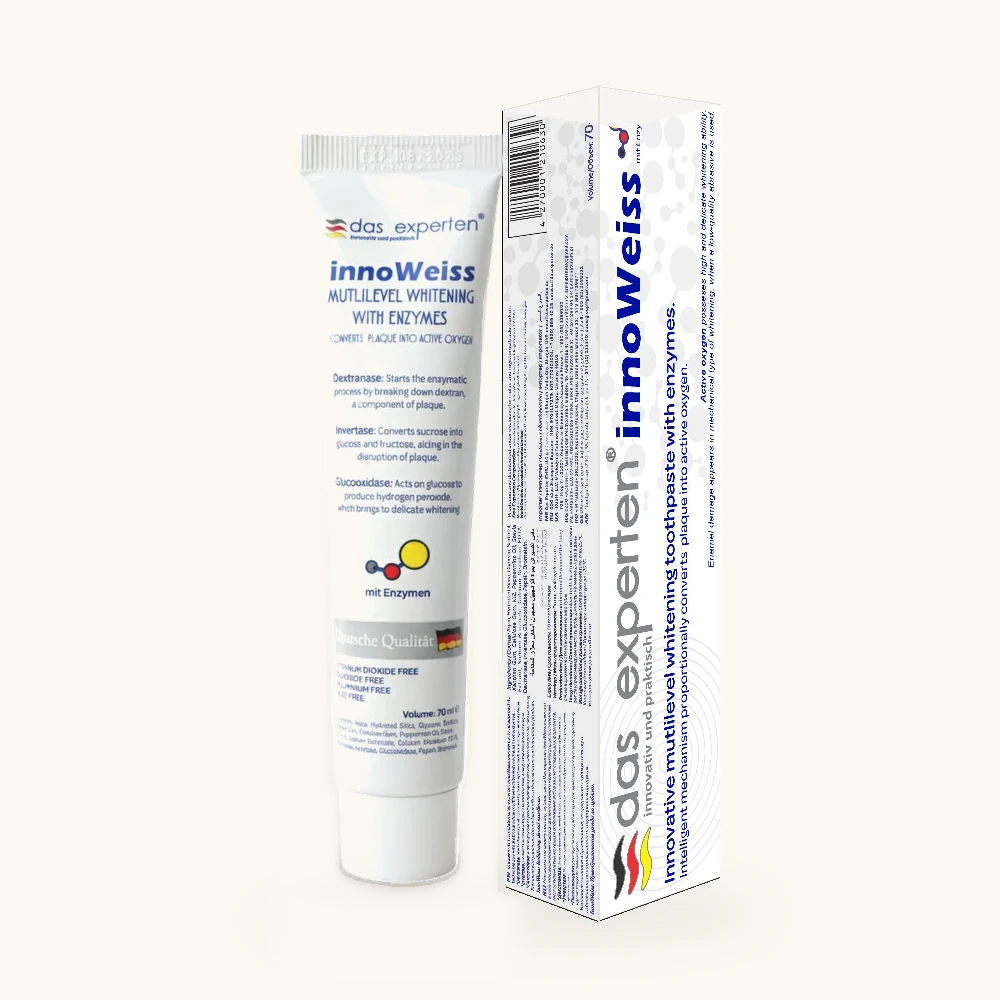
INNOWEISS combines Dextranase, Invertase, Glucose oxidase, Bromelain and Papain. Its disclosed product measures are RDA <30 and 52 to 69% biofilm removal in vitro. That laboratory result supports a mechanism; it is not a guaranteed whitening or clinical outcome. The formula is fluoride free, so shoppers with meaningful caries risk should discuss that trade off with a dentist.
Review the formula and current price nowFAQ
What is enzyme toothpaste?
Enzyme toothpaste contains enzymes or enzyme and protein systems added for a specific oral care mechanism. Formulas differ, so the enzyme names, fluoride content, abrasivity and evidence for the finished product matter more than the category label alone.
Does enzyme toothpaste work?
A 2025 systematic review found promising gum health and plaque results for specific enzyme and protein toothpastes, but only three studies met its criteria. Those findings cannot automatically be transferred to every enzyme formula.
Does enzyme toothpaste whiten teeth?
That depends on the finished formula and the type of staining. The 2025 systematic review did not substantiate an effect on extrinsic black stains, so an enzyme label alone is not proof of whitening.
Is enzyme toothpaste safe for sensitive teeth?
Do not infer sensitivity safety from the word enzyme. Check the finished product's abrasivity, fluoride content, other ingredients and directions; persistent sensitivity needs a dental assessment.
Are enzyme toothpastes fluoride free?
Not necessarily. Some are fluoride free, while the enzyme and protein toothpastes in several clinical studies also contained fluoride. If you are at risk of tooth decay, discuss a fluoride free choice with your dentist.