




Is Charcoal Toothpaste Good for Your Teeth? The Aztecs Knew
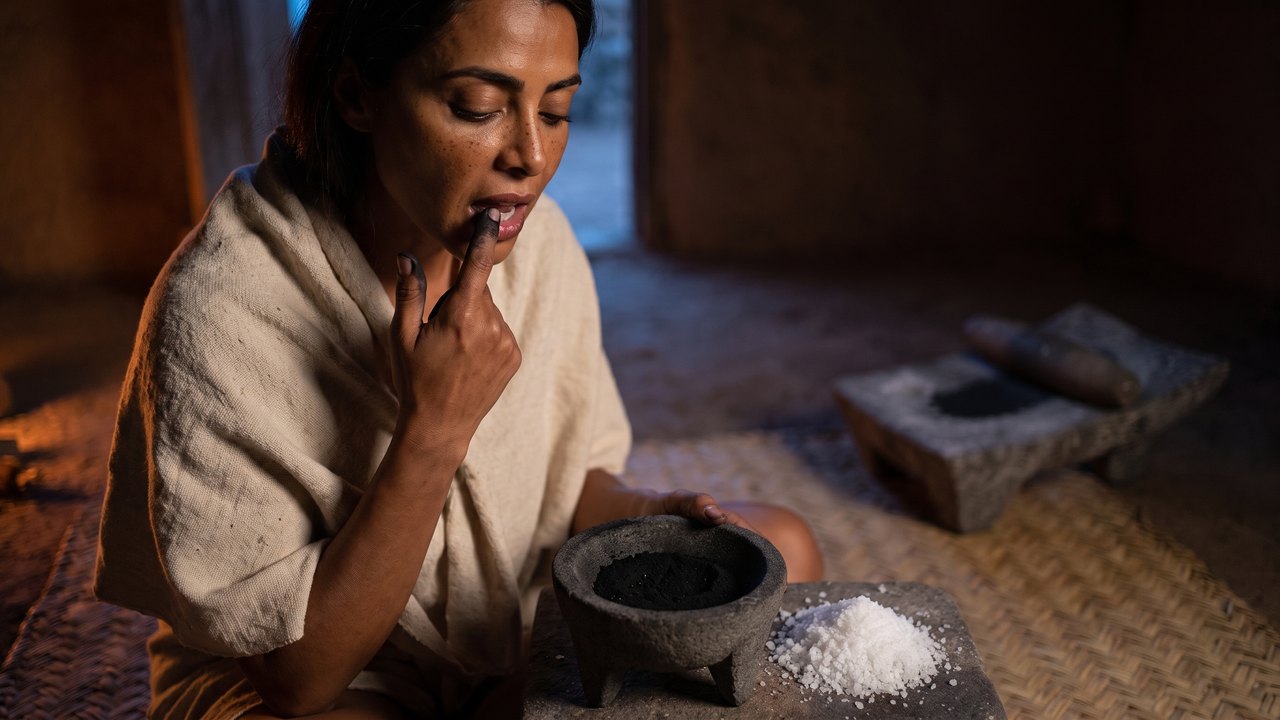
It is still dark over the lake, and the woman has already been to the hearth. She takes a lump of last night's charcoal, cold now, and crushes it on a stone until it is a fine black dust. She wets a fingertip, presses it into the dust, adds a pinch of salt, and puts her finger in her own mouth. She works it along the outside of the teeth, then the inside, the way she was taught, the way she will teach the child asleep behind her.
The grit bites. The salt bites harder. She spits, rinses with cold water, and the teeth her tongue runs over are smooth in a way they were not two minutes ago.
She will do this again after the midday meal, and again in the evening. So will her husband. So will most of the city, because in Tenochtitlan a mouth that smells is a mouth that has told on you, and there is a named specialist you go to when it gets worse than that.
Nobody in the city has a word for bacteria. Everybody in the city has the powder.
The year Europe was scrubbing with brick
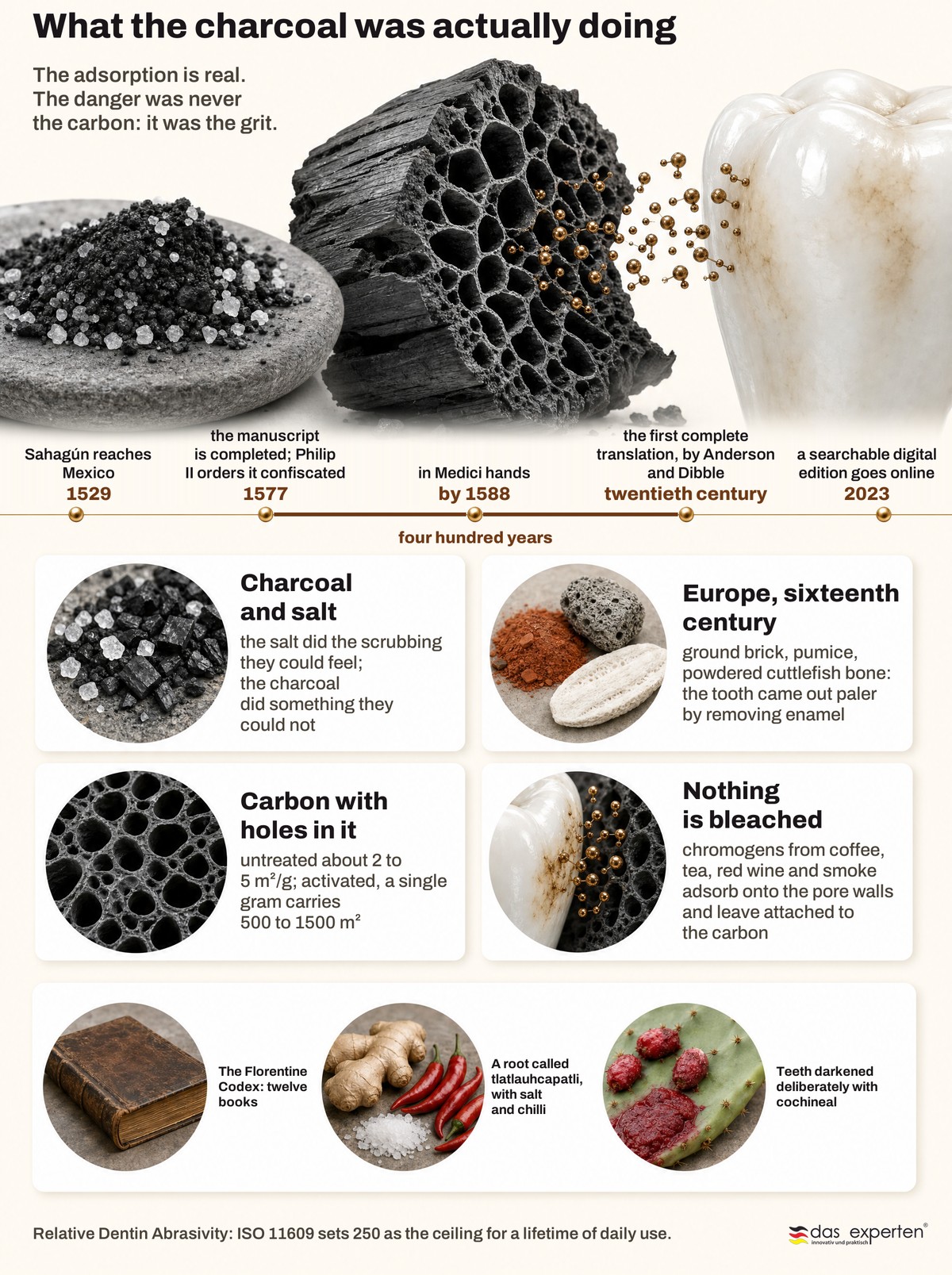
Across an ocean that had been crossed only a handful of times, the answer to a dirty tooth was harder and stupider. European tooth powders of the sixteenth century ran to ground brick, pumice and powdered cuttlefish bone, rubbed on with a cloth and sometimes wetted with vinegar. They worked, in the sense that the tooth came out paler, by removing enamel, which does not grow back, and no instrument on the continent could notice.
Both hemispheres were rubbing something hard against enamel that morning. Only one of them was also rubbing something that adsorbs.
How do you get the right answer for the wrong reason
The Mexica were not adding an adsorbent. They were adding the black thing from the fire, because a mouth felt cleaner afterwards and nobody needed a better justification than that. The salt did the scrubbing they could feel. The charcoal did something they could not.
They were thorough about the rest of it, too. The same record that describes the charcoal describes washing the teeth with cold water, cleaning with salt, rinsing with a root called tlatlauhcapatli mixed with salt and chilli, and darkening the teeth deliberately with cochineal. It names practitioners who scraped tartar, treated cavities and pulled teeth. This was not folklore. It was a protocol, held in a household and repeated three times a day.
Here is the part that makes this story different from every other lost remedy. Usually the knowledge vanishes because nobody wrote it down. This one was written down, immediately, in enormous detail, by a European, while the people who practised it were still alive to be asked.
The book that was finished and seized in the same year
Bernardino de Sahagún was a Franciscan friar who reached Mexico in 1529, eight years after Tenochtitlan fell. He spent the rest of his life doing something almost nobody else in the conquest did: asking. He assembled panels of Nahua elders, worked with trained Nahua scribes, and recorded their answers in Nahuatl, in their own phrasing, alongside a Spanish column of his own. The result runs to twelve books and roughly two thousand illustrations. Book Ten is about people, trades, classes, bodies, and in its twenty eighth chapter, ailments and their cures. The teeth are in there.
The manuscript was completed in 1577. In 1577, Philip II ordered Sahagún's work confiscated. Recording an indigenous world in its own language had stopped looking like scholarship and started looking like preserving what the Crown was replacing.
The manuscript survived, and the way it survived is the joke. It travelled to Italy, passed into Medici hands no later than 1588, and ended up in the Biblioteca Medicea Laurenziana in Florence, which is why we call it the Florentine Codex. It has been sitting in a European library ever since.
Europe owned the answer. Europe filed it, catalogued it, and kept it safe for four hundred years. What Europe did not do was read the Nahuatl column, because the Nahuatl column is the detailed one and almost nobody in Europe could read Nahuatl. The first complete translation of that text into any language was made by Arthur Anderson and Charles Dibble in the twentieth century, published across three decades. A searchable digital edition went online in 2023. That is the gap: not a burnt library, not a suppressed healer. A book on a shelf, in a language the shelf's owners never bothered to learn.
What the charcoal was actually doing
Charcoal is carbon with holes in it. Untreated, it carries a surface area of roughly 2 to 5 m²/g. Activate it, steam or heat, driving out everything that is not carbon, and the internal pore network opens until a single gram carries 500 to 1500 m² of surface. That is the whole mechanism, and it is physical, not chemical. Chromogens, the coloured molecules that coffee, tea, red wine and smoke leave behind on enamel, adsorb onto those pore walls and leave the mouth attached to the carbon. Nothing is bleached. Nothing is dissolved. The stain is picked up and carried out.
Which means the honest answer to is charcoal toothpaste good for your teeth has always had two halves, and the industry keeps publishing only one of them. The adsorption is real. The danger was never the carbon, it was the grit. A fingertip loaded with salt crystals and coarse hearth charcoal is sandpaper, and the woman at the lake was paying for her clean teeth in enamel without knowing the price. That is measured now: the Relative Dentin Abrasivity scale, with ISO 11609 setting 250 as the ceiling below which a paste is considered safe for a lifetime of daily use.
You have probably already had this argument with yourself, standing in a pharmacy aisle holding a black tube, wondering whether the thing that promises to whiten your teeth is quietly sanding them. The instinct is right. The target is wrong.
Which is the argument for SCHWARZ from Das Experten. The active is activated charcoal from coconut shell, Cocos nucifera, ultra purified and micro milled, which is the same adsorbent the hearth was supplying and none of the sandpaper. It sits at RDA 79, inside the safe daily band and nowhere near the 250 ceiling. Over 4 weeks it measures +6 SGU on the Vita shade guide with no peroxide anywhere in the formula, and 30% plaque reduction against baseline. It is fluoride free and SLS free, using sodium lauroyl sarcosinate as a mild surfactant instead. Delicate charcoal care, done at a grit somebody actually measured.
Tomorrow morning you will pick up a tube and rub carbon on your teeth, exactly as she did, for exactly the reason she did. The only thing five hundred years bought you is knowing how hard to press.
Europe did not lose this knowledge. Europe took it, shipped it to Florence, kept it under glass for four centuries, and never learned the language it was written in.