





What Is SLS in Toothpaste? It Is Not There to Clean Your Teeth
Look at your tube. Past the water and the sorbitol, somewhere mid-list, sits a detergent. In most of the world’s toothpaste it is sodium lauryl sulfate — SLS on the label. It has been in dentifrice since the 1930s, and almost nobody who brushes twice a day could tell you what it is doing there.
It makes the foam.
That is not the whole story, but it is the half everybody has backwards. The foam is not cleaning your teeth. The abrasive is cleaning your teeth — silica, measured in RDA — together with the bristle and the few centimetres your hand actually travels. The detergent drops surface tension, carries the paste into places the bristle never reaches, and lifts what is oily. Along the way it fills your mouth with lather that feels exactly like clean.
Foam is a sensation. Abrasion is a mechanism. Only one of the two has ever had a marketing budget.
Thirty years, one detergent, no agreement
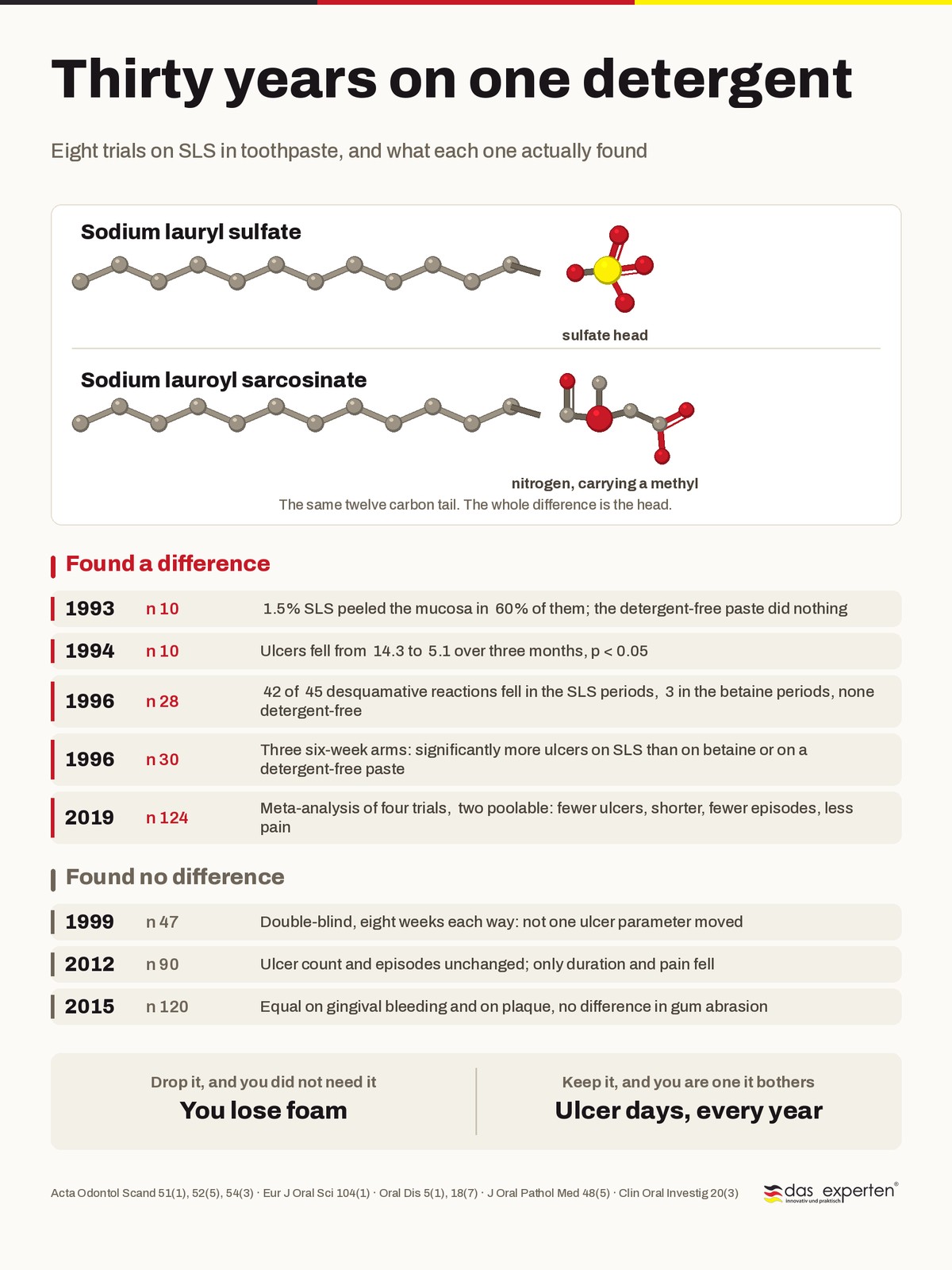
In 1993 two researchers in Oslo did something unusually direct. Brokstad Herlofson and Barkvoll made five toothpastes identical except for their SLS content — 0.0% to 1.5% — and held each against the palate of ten volunteers in a cap splint, twice a day, two minutes, for four days. The paste with no SLS produced no reaction. The paste with 1.5% SLS peeled the mucosa in 60% of them (Acta Odontologica Scandinavica 51(1):39–43).
Three years later they ran it at size. Twenty-eight women, seven pastes differing only in detergent and dose: SLS at three strengths, cocamidopropyl betaine at three strengths, and a detergent-free control. Forty-five desquamative reactions in twenty-one of the twenty-seven analysed. Forty-two of those forty-five fell in the SLS periods. Three fell in the betaine periods. The detergent-free paste produced none (European Journal of Oral Sciences 104(1):21–26).
Then they went after what patients actually complain about. Ten people with frequent aphthous ulcers — canker sores — brushed for three months with a 1.2% SLS paste and three months without. Ulcers fell from 14.3 to 5.1, a drop of 9.2, at p < 0.05. A double-blind crossover in thirty patients, three six-week arms, found the same direction: significantly more ulcers on SLS than on betaine or on a detergent-free paste.
At which point the matter looks closed. It is not.
The trials nobody quotes
In 1999 a London teaching hospital put forty-seven ulcer patients through eight weeks of SLS paste and eight weeks of SLS-free, double-blind, with a two-week washout between. Ulcer days, total pain, episodes, number of ulcers, duration, size. Not one of the parameters moved (Oral Diseases 5(1):39–43).
In 2012 a Seoul group ran ninety patients through the same design. The number of ulcers did not change and neither did the number of episodes. Two things did: the ulcers healed faster and hurt less (Oral Diseases 18(7):655–660).
A 1997 paper asked how long the detergent is in contact with you at all. After brushing, 86% of the SLS in the paste was recovered from the mouth within ten minutes in healthy subjects and 89% in ulcer-prone ones; after rinsing, 96% came back within two minutes (Journal of Clinical Periodontology 24(5):313–317). Contact time: very short. Two of that paper’s authors worked for a toothpaste manufacturer — worth knowing, and not by itself a refutation.
What the pooled evidence says
A 2019 systematic review with meta-analysis found four double-blind randomised crossover trials — 124 participants between them — of which only two could be pooled. On those two, SLS-free dentifrice significantly reduced ulcer number, duration, episodes and pain, and the direction of effect held across all four (Journal of Oral Pathology & Medicine 48(5):358–364). The authors conclude carefully: patients with recurrent aphthous stomatitis may benefit, and better trials are still needed. A 2022 scoping review reached the same verdict. A 2023 review of forty papers titled itself The Yin and Yang of Sodium Lauryl Sulfate and set benefits against harms — better solubilisation of actives, better plaque control, less bad breath, against slower wound healing and a risk signal for ulcers.
Thirty years, a dozen trials, and the honest summary is that the effect is probably real, probably small, and probably confined to people who are already prone. That is unsatisfying. It is also correct, and anybody handing you a cleaner answer is selling something — including anybody selling toothpaste.
Why the answer does not matter
The move that matters here is not a scientific one; it is a question about payoffs. You do not need to know whether SLS causes ulcers in the population — you need to know what it costs you to be wrong in each direction. A 2015 trial of one hundred and twenty people measured what you give up by dropping it: across eight weeks the SLS-free paste was equally effective on gingival bleeding and on plaque, with no significant difference in gum abrasion. The participants rated the SLS paste significantly higher on taste, freshness and foam (Clinical Oral Investigations 20(3):443–450).
The two errors are not symmetrical. Drop the detergent and turn out not to have needed it, and the cost is lather. Keep it and turn out to be one of the people it bothers, and the cost is counted in ulcer-days, every year, for as long as you keep brushing. The population answer is genuinely unknown. The decision is not close.
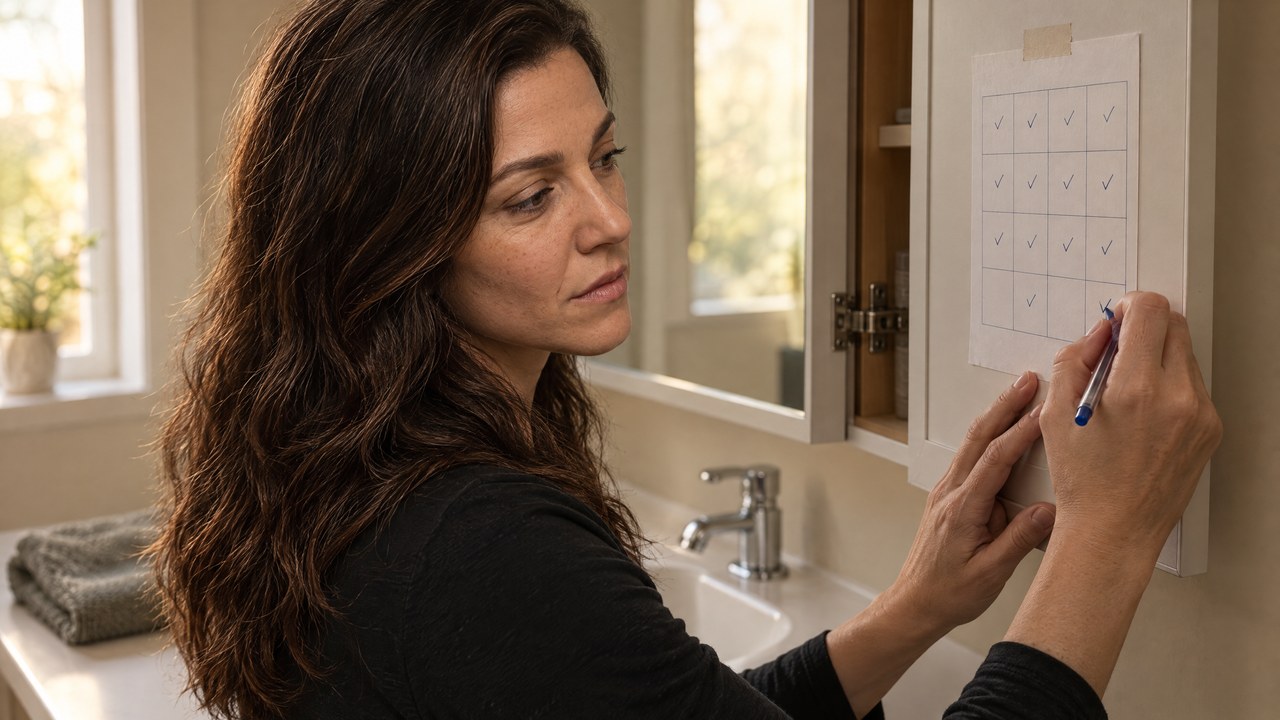
This is one of the few questions in oral care you can settle yourself, in eight weeks. Brush with a paste that carries no SLS for two months and count — not impressions, a number. If nothing changes, you have learned that this ingredient is not your problem — worth knowing, and almost free to find out. If the count falls, no meta-analysis on earth has standing against your own arithmetic.
What is in our tube, and what we cannot tell you about it
There is no SLS in any paste Das Experten makes. Six of them name Sodium Lauroyl Sarcosinate on the INCI — SCHWARZ, DETOX, GINGER FORCE, COCOCANNABIS, SYMBIOS and EVOLUTION — written LS30 on three of those cards, the same surfactant at 30%. A seventh, TERMO 39°, names Sodium Sarcosinate. Two carry no detergent at all: BUDDY MICROBIES and INNOWEISS.
Now the part a brand is not supposed to write. Sarcosinate has never been tested against SLS in an ulcer trial. The arms that beat SLS in the Oslo work were cocamidopropyl betaine and a detergent-free paste — not sarcosinate. We can tell you what is on the label, and that it is not the molecule those trials indicted. We cannot tell you it will do for your mouth what betaine did in 1996, because nobody has run that study. Saying it anyway would be the precise thing this article is complaining about.
The foam was never the point. Turn the tube over tomorrow morning and read the line — then find out, on yourself, whether it matters.