


Glycerin in Toothpaste Was Never the Danger. Fake Glycerin Was

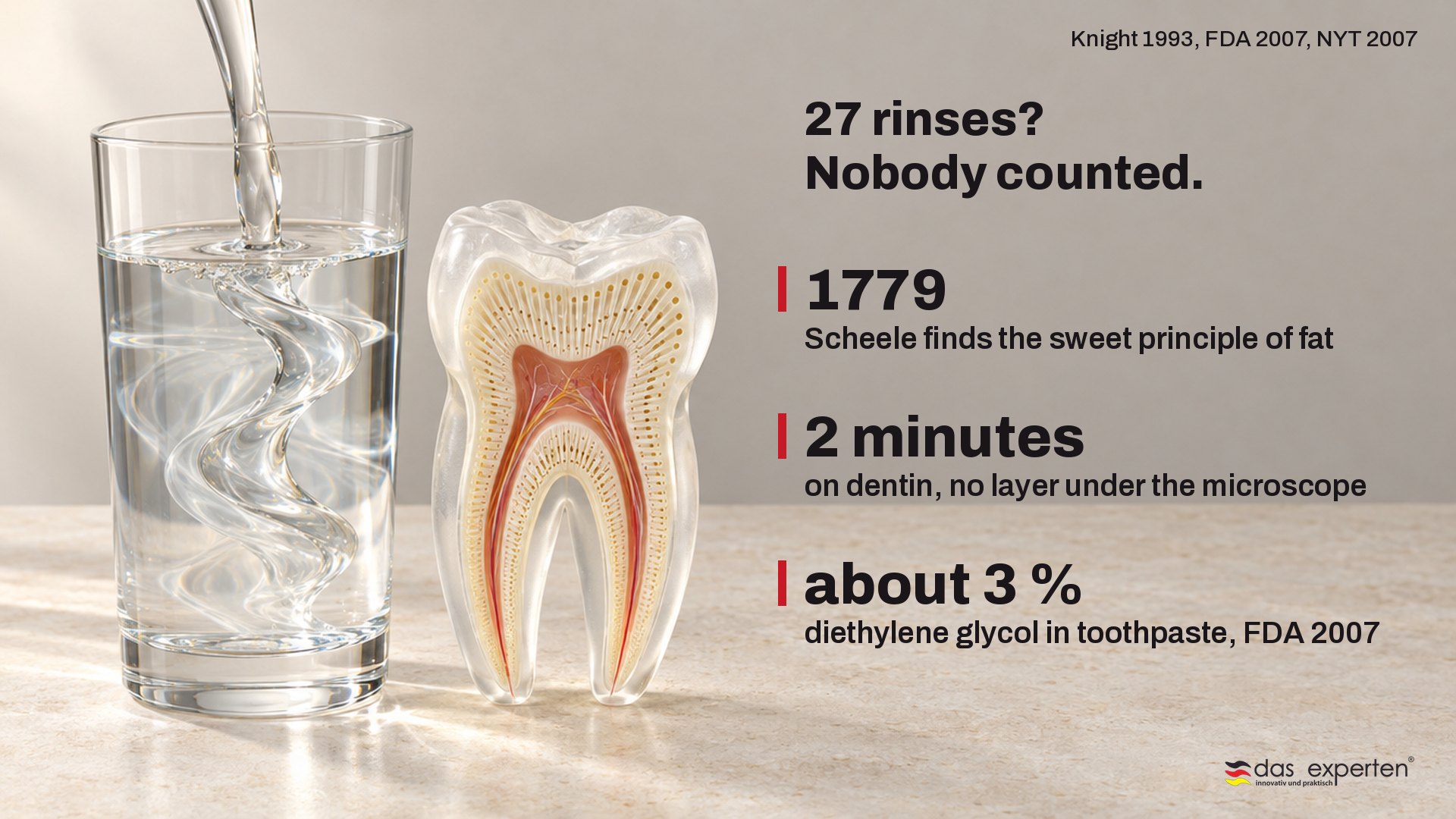
In 1779, in a pharmacy in the small Swedish town of Köping, Carl Wilhelm Scheele boiled olive oil with litharge, a yellow oxide of lead. When the fat had turned to soap, the water left behind tasted sweet. Scheele called the syrup the sweet principle of fat. Decades later the French chemist Michel Eugène Chevreul gave it a name built on the Greek word for sweet: glycerine.
Turn your toothpaste around. Glycerin is probably the third or fourth word on the back, and since the late 1990s it has carried a rumour: it coats your teeth like varnish, it takes 27 rinses to wash off, and while it sits there your enamel cannot repair itself. You may have met the rumour on a label that says “glycerin free”, or in a short video filmed over a bathroom sink.
The short answer comes first. Nobody ever counted the 27 rinses. Glycerin dissolves in water completely, and the one laboratory test that left it on a bare tooth for two minutes found nothing to see. The glycerin scare that really belongs in a toothpaste story is a different one, and it killed people: a liquid sold as glycerin that was not glycerin at all.
Where the 27 rinses came from
The number traces back to Gerard F. Judd, who described himself as a chemist and published his own book, Good Teeth, Birth to Death, in the late 1990s. His claim was that glycerin is so sticky it needs 27 washes to come off, and that the film blocks minerals from returning to enamel. The book offers no experiment behind the figure. Dentists who went looking for a study that supports it say they never found one.
The chemistry is less dramatic. Glycerol, the chemist’s name for glycerin, mixes with water in any proportion. It does not sit on top of water the way oil does, and it does not set into a skin. In your mouth it meets saliva, which you produce all day, and the first spit carries it out with the foam.
What a microscope saw on the tooth
In 1993 a team from the University of Bergen tested what really closes the open tubules of exposed dentin, the tiny channels that make teeth sensitive. Each agent stayed on the dentin for two minutes, then the surfaces went under a scanning electron microscope. A light cured dental resin sealed the tubules most completely. Glycerin had no effect at all; neither did the fluoride agents in the same test (Knight et al. 1993).
That is what a coating looks like under magnification: the resin. Glycerin left nothing behind to photograph. If you have ever paid extra for a tube because it promised to spare your teeth a film, this is worth knowing. The film was never found.
There is a quieter fact underneath. A healthy mouth already trades in glycerol. In 2023 researchers in Oregon showed that Corynebacterium durum, a common bacterium of healthy dental plaque, releases glycerol, and Streptococcus sanguinis, one of the streptococci associated with oral health, feeds on it; when the gene it needs for that was switched off, the partnership weakened (Treerat et al. 2023).
The glycerin that killed was not glycerin
In September 2006 people in Panama began to fall ill after taking a cold medicine mixed by government officials. Its “glycerin” had travelled from a factory in China through traders in Beijing and Barcelona, with a certificate promising 99.5 percent purity. It was diethylene glycol, a cheaper industrial liquid. By May 2007 The New York Times counted 365 deaths reported by families, 100 of them confirmed. The FDA found that the liquid sold as glycerin was a blend of sorbitol and diethylene glycol with less than 1 percent glycerin in it.
That same May, Panama found diethylene glycol in toothpaste made in China. On 1 June 2007 the US Food and Drug Administration told consumers to avoid toothpaste made in China, and it detained a shipment that held about 3 percent diethylene glycol by weight. The lesson is not about the molecule on your label. The danger was a cheaper liquid wearing glycerin’s name, and the protection against it is a laboratory test of the raw material, not a tube without glycerin.
What glycerin actually does in your tube
It is a humectant: it holds water, so the paste stays soft and does not dry into a crust at the nozzle. It gives the paste body and a faint sweetness. It works beside sorbitol, the other humectant on most labels, which we looked at in sorbitol in toothpaste.
Seven of our nine toothpastes list glycerin, between second and fourth place in the ingredient list; GINGER FORCE and INNOWEISS do not list it. That is a statement about the formula, not a promise of an effect.
The next time a label sells you “glycerin free”, read it for what it is: the removal of a danger nobody measured. The questions worth asking of any tube are older and duller. Does the label tell the truth about what is inside, and do you brush long enough for any of it to matter?
Glycerin never coated anyone’s teeth. The only glycerin that ever hurt anyone was the kind that was not glycerin.