


Sorbitol in Toothpaste: Bacteria Ferment It Slowly. Unless a Dry Mouth Gives Them Time
Pick up your toothpaste and read the ingredient list. Not the front of the tube, the small print on the back. The first word is usually water. The second, on many of the tubes in a European bathroom, is a word nobody advertises: sorbitol. You have put it in your mouth twice a day for years. You have probably never once asked what it is doing there.
The order is not decoration. In the European Union the law says a cosmetic lists its ingredients in descending order of weight; only those below 1% may follow in any order. So the hero of the advertising, the extract, the enzyme, the probiotic, usually sits far down the list, and the thing you actually swallow a trace of every morning sits near the top. The label tells you what the tube is made of. The front tells you what it would like to be.
Sorbitol in toothpaste: a sugar from a bitter berry
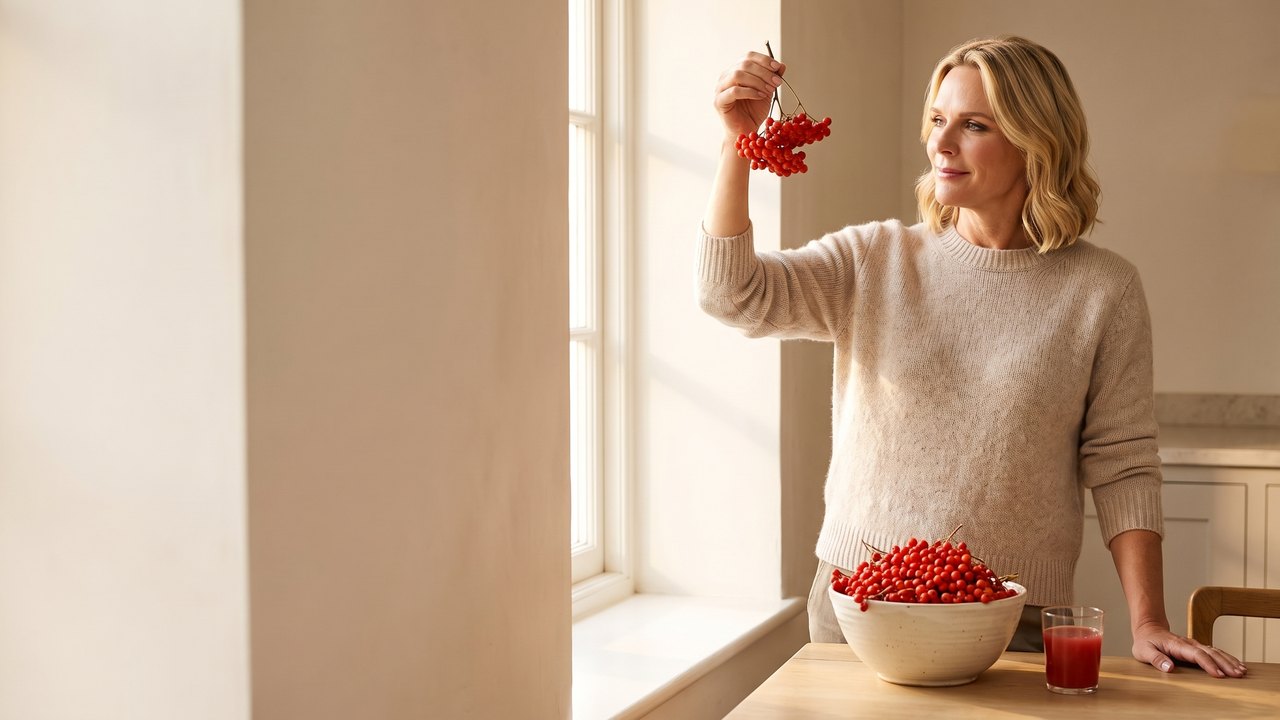
In 1872 the French chemist Jean Baptiste Boussingault pressed the juice of rowan berries, the bitter red clusters of Sorbus aucuparia that ripen in autumn, and pulled out a sweet substance no one had described. He named it after the tree: sorbite. In English it became sorbitol. It is a sugar alcohol: a molecule built like a sugar, which tastes sweet, but is not the sugar your bacteria live on.
In a toothpaste it does two quiet jobs. It holds water, so the paste does not dry into a crust in the tube, and it makes the paste taste mildly sweet without adding sugar. That is all. It is not there to treat anything. Which raises the only question that matters about an ingredient with no promise attached: what does it fail to do?
What sorbitol does not do. and why that is the point
Sugar is dangerous in the mouth for one reason: bacteria in dental plaque ferment it fast and turn it into acid, and acid takes mineral out of enamel. Sorbitol is fermented too, but slowly, and by fewer of them. A Swedish review of sugar substitutes in 1985 found it is used by certain groups of oral bacteria, not by the plaque community as a whole; reviews of chewing gum studies describe sorbitol as slowly converted to acid, without the critical drop that sugar produces. American food law draws its line in the same place: sorbitol is on the list of sugar alcohols that may carry the claim that they do not promote tooth decay, and the test is that plaque pH must not fall below 5.7 during eating or up to 30 minutes after.
This is the via negativa of an ingredient. We like to judge a molecule by what it adds. Most of what keeps a mouth healthy is what does not happen in it: the acid that never forms, the sugar that never arrives. Sorbitol earns its place in the second line not by doing something, but by standing where sugar would otherwise stand and doing almost nothing.
Sorbitol vs xylitol: the number that keeps it honest
Almost nothing is not nothing. The cleanest test we have comes from chewing gum, where people used one sweetener for months and dentists counted new cavities. In 2008 Amol Deshpande and Alejandro Jadad pooled 19 articles covering 14 study populations, each comparing a gum with no gum at all. Sorbitol gum prevented 20.01% of new decay. Xylitol gum prevented 58.66%.

Read those two numbers slowly. Both gums beat no gum, chewing itself pulls saliva, and saliva is a defence. But xylitol is fermented by very few of the bacteria, and sorbitol by some of them, and the gap between 20.01% and 58.66% is most likely the price of that difference. Sorbitol is not a protector. It is a substitute that does far less harm than the sugar it replaced.
Is sorbitol bad for teeth? The mouth that changes the answer
Now the uncomfortable part, the one the label cannot tell you. Bacteria adapt. In 1990, researchers in Malmö asked 23 people, 12 with low saliva flow and 11 with normal flow, to rinse often with a 10% sorbitol solution for 4 weeks. Afterwards their plaque held more sorbitol fermenting bacteria and more mutans streptococci, and its pH fell further after a sorbitol rinse than before. The fall was deeper in the people whose mouths were dry. The authors drew the conclusion themselves: where the natural protection is weak, the cariogenic potential of sorbitol should be considered in products used often.
Here is the asymmetry. For a mouth with plenty of saliva, sorbitol is close to neutral. For a dry mouth, common with age and with many medicines, the same molecule, met many times a day, slowly trains a plaque that can eat it. The risk was shown with rinses and gum used again and again, not with a paste brushed for two minutes twice a day and spat out. But risk lives in frequency. Count how many sweet sugar free things pass through your mouth before noon, mints, gum, lozenges, syrups, and you will know which of the two mouths you are building.
In 8 of our toothpastes sorbitol stands first or second in the ingredient list, in seven of them right after water. It is there for the reasons above: it keeps the paste soft and makes it pleasant to brush with. It is not there to protect your teeth, and we do not claim it does. What protects them is what you do with the brush, and how rarely anything sweet reaches your teeth between brushings.
Tonight, turn the tube around and read the second word. Then think about the sweet things you will not eat tomorrow. That list matters more than anything on the label.
The best thing an ingredient can do in your mouth is almost nothing, and the rowan berry has been doing it since 1872.