


Menthol in Toothpaste: Your Mouth Feels Cold, but Nothing in It Got Colder

Spit, breathe in through your mouth, and the air feels like January. Your teeth feel polished, your breath feels new, and you put the brush down. Nothing in your mouth got colder. A thermometer under your tongue would still read about 37 °C. What changed was a message: a molecule called menthol told a nerve that the temperature had dropped, and your brain believed it.
Menthol in toothpaste is the most persuasive ingredient in the tube and one of the least important for your teeth. That is not a scandal. It is a design choice worth knowing about, because it decides the moment you stop brushing.
How menthol makes a warm mouth feel cold
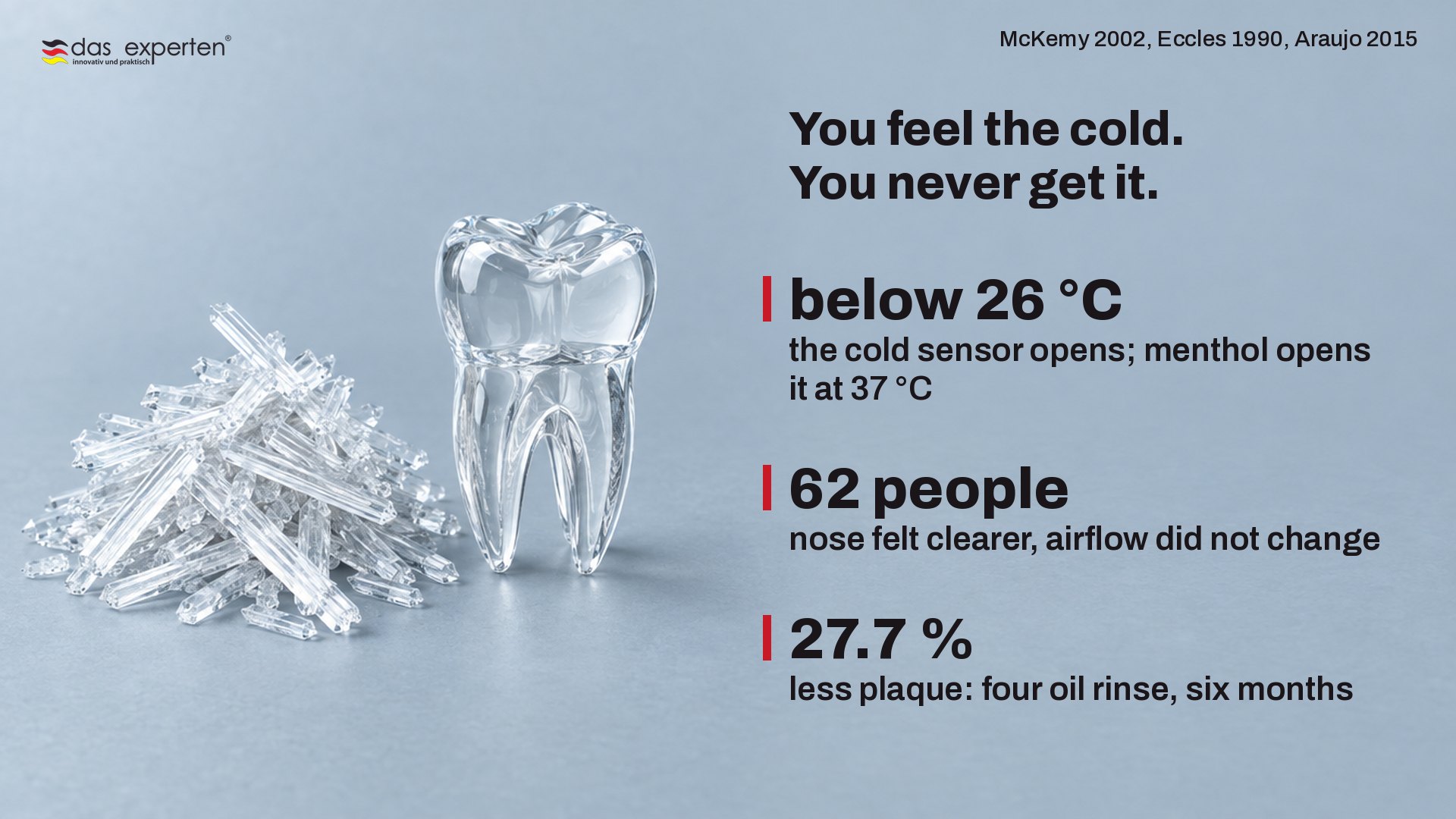
In 2002 two laboratories, working apart, found the sensor that menthol speaks to. David McKemy, Werner Neuhausser and David Julius in San Francisco (Nature) and the team of Ardem Patapoutian in San Diego (Cell) used menthol as bait and pulled out the same protein, now called TRPM8. It sits in the endings of the sensory nerves of the face and mouth, and it opens when tissue cools below about 26 °C. Menthol opens it at body temperature. The nerve sends the cold signal, and there is no cold. On 4 October 2021 Julius and Patapoutian shared the Nobel Prize in Physiology or Medicine for finding the sensors of temperature and touch.
So the fresh feeling after brushing is not a reading of how clean your teeth are. It is a reading of how much menthol reached the receptor.
Feeling better is not working better
The clearest test of that gap was done on noses, not teeth. In 1990 Ron Eccles and colleagues in Cardiff gave 62 people with a blocked nose from a common cold either a lozenge with 11 mg of menthol or a sweet placebo, in a double blind randomised trial. They measured the resistance to airflow with rhinomanometry, pressure sensors that record how hard air has to push through the nose, and they asked how open the nose felt. Ten minutes after the lozenge the menthol group felt clearly freer. The instruments found no difference between the groups at any point in two hours.
The nose felt open and stayed exactly as blocked. Your mouth reports through the same family of nerves. A strong chill after brushing tells you that the menthol arrived, not that the plaque left.
Does menthol in toothpaste clean anything?
The honest answer has two halves. Menthol is one of four plant compounds in essential oil mouthwashes, beside thymol, eucalyptol and methyl salicylate. A 2015 meta analysis in the Journal of the American Dental Association pooled 29 trials that lasted at least six months: people who brushed and used such a rinse had 27.7 % less plaque and 16.0 % less gingivitis than people who only brushed (Araujo et al. 2015). Two cautions stand beside those numbers. Every one of the trials was sponsored by industry, and the result belongs to a mixture of four oils held in the mouth as a rinse, not to menthol alone in a paste that you spit out.
In a toothpaste the cleaning is done by the brush, the mild abrasive and the active ingredients, and by the minutes you give them. Menthol is the taste and the signal.
The risk is in the timing
The danger here is lopsided. Menthol cannot harm your teeth by working; it can harm them by ending your brushing early. The chill arrives in the first seconds, long before two minutes are up. If you stop when your mouth feels done, you stop when the menthol says so. The inner faces of the lower front teeth and the last molars, where plaque likes to stay, feel exactly as fresh as the teeth you actually brushed.
You have probably chosen a toothpaste at least once because it felt stronger. Most of us have. A hard chill reads as hard cleaning, and it is the cheapest sensation in any formula to produce.
Our SYMBIOS and COCOCANNABIS pastes both list menthol among their ingredients, after the water, the humectants and the foaming agent. It is there for taste and coolness, and we do not ask more of it. None of the studies above tested either paste. Tonight, brush by the clock, not by the cold: two full minutes, then run your tongue along the backs of your lower front teeth and feel what the chill was hiding.
Menthol tells your nerves that your mouth is clean. Only the two minutes make it true.