


Is Natural Toothpaste Better? 7 Label Claims Against the Evidence
Every word on a toothpaste box was chosen by someone with something to sell, and the friendliest words are the ones nobody has to prove. “Natural” is the clearest case. It sounds like a promise about your mouth. In law, in most places, it is a promise about almost nothing.
You have probably stood at the shelf, picked the tube with the leaf on it and felt a little better about your morning. Nothing wrong with that. But is natural toothpaste better? Below are the seven words a natural or organic tube most often prints, each checked against a regulator, a standard or a review of trials. We name no brands; the checks work on every tube, ours included.
1. Natural: a word without a definition
In the United States the Food and Drug Administration says plainly that it has not defined the term natural for cosmetics and has set no regulatory definition for it in labelling. The same safety and labelling rules apply to every cosmetic, whatever its ingredients came from. In the European Union a natural claim has to pass the same six common criteria as any other claim under Regulation 655/2013, from truthfulness to evidential support; there is no separate legal recipe for natural. The word on the front tells you what the maker wants you to feel. The ingredient list on the back tells you what you will brush with.
2. Natural origin in per cent: arithmetic, not a test
A percentage of natural origin usually comes from ISO 16128, an international standard that tells a maker how to calculate a natural or natural origin index for each ingredient and for the finished product. Two details matter. The calculation may include formulation water, and a toothpaste contains plenty of it. And the standard says in its own text that neither of its two parts addresses product communication, meaning claims and labelling. A high number is the result of a sum. It says nothing about whether the paste cleans, protects or suits your gums.
3. Organic: check how much
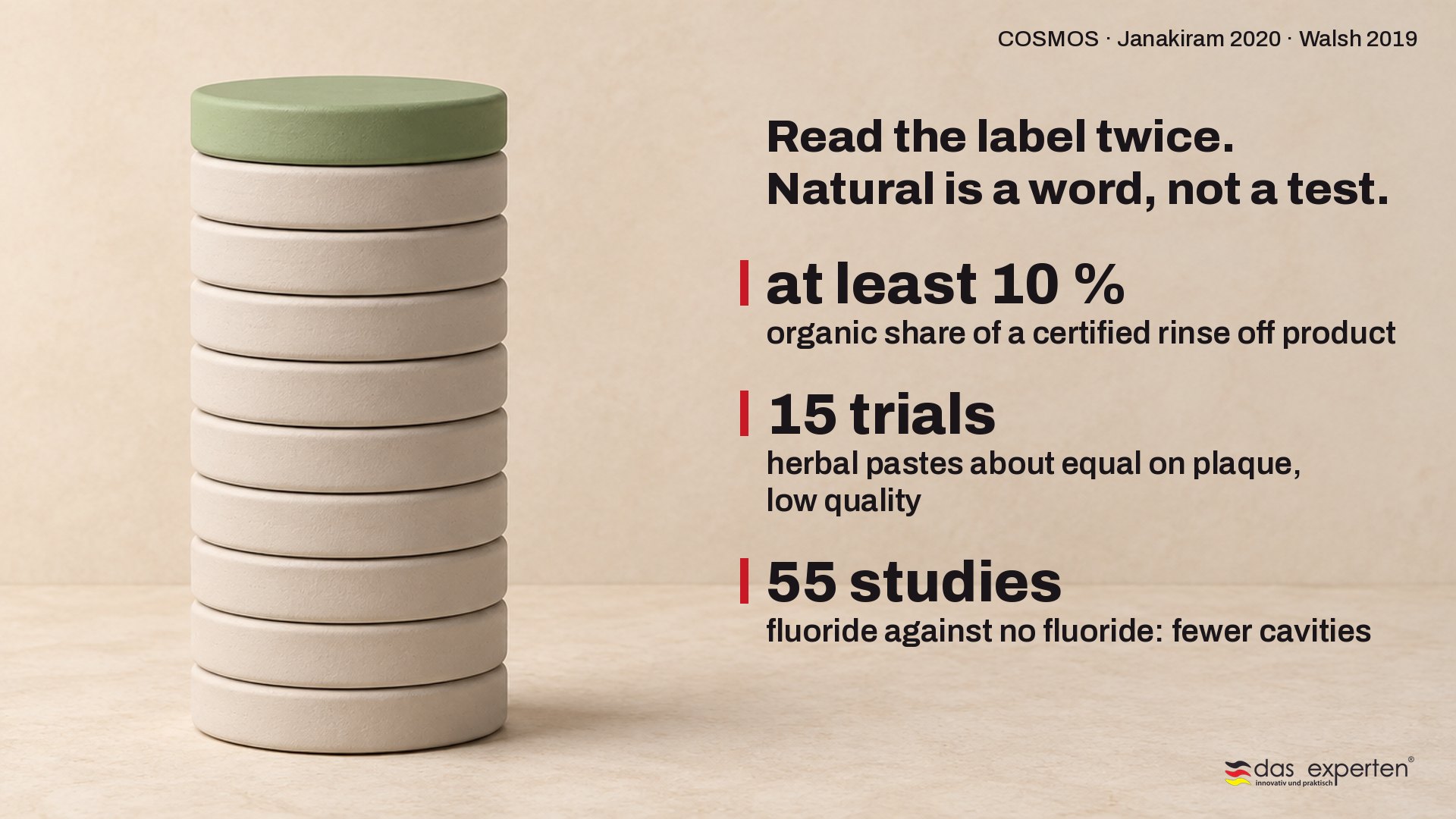
Organic is the one word on this list with real rules behind it, and they are worth reading. The FDA says the term is not defined in the laws it enforces for cosmetics; in the US the claim follows the National Organic Program of the Department of Agriculture, which certifies agricultural ingredients. In Europe many tubes carry a private seal such as COSMOS ORGANIC. Its technical guide asks that at least 95 % of the physically processed agricultural ingredients be organic, yet for a rinse off product, and a toothpaste is rinsed off, only at least 10 % of the total product has to be organic. Water and minerals are not farmed, so they cannot count. A certified organic paste can honestly be nine parts ordinary to one part organic. The seal tells you how the plants were grown, not what the paste does to plaque.
4. Chemical free and free from: read what is missing
Everything in a toothpaste is a chemical, the water and the mint oil included, so chemical free cannot be true of any tube. Its quieter cousin is the free from list. The EU technical document on cosmetic claims, applicable from 1 July 2019, sets the limits: a free from claim should not concern an ingredient the law already bans, should not boast about something that kind of product does not normally contain, and should not denigrate an ingredient that is permitted and safe. Its own example: free from parabens should not be accepted, because it denigrates the entire group. Free from is fair when it helps a particular person choose, such as free from alcohol in a mouthwash for the whole family. Ask whom the missing ingredient was missing for.
5. Herbal works as well: on plaque, roughly yes
Here the natural side has real evidence. A 2020 systematic review and meta analysis by Janakiram and colleagues, written at the US National Institutes of Health, pooled 24 randomised trials with 1 597 adults; 15 of them, with 899 people, compared herbal toothpaste with conventional paste. For short term plaque reduction herbal paste did about as well, and in a subgroup it was not superior to fluoride paste. The authors name the catch themselves: the evidence comes from low quality studies. Plant extracts can be good ingredients. They are not proof that a whole formula is better.
6. SLS free: a real benefit for one group
Sodium lauryl sulfate is the foaming detergent in most toothpastes (our guide to SLS explains what it does). A 2019 systematic review by Alli and colleagues found 4 double blind crossover trials with 124 participants who suffer recurrent mouth ulcers. With a paste free of SLS they had fewer ulcers, shorter ones, fewer episodes and less pain. More trials are needed, the authors say, but for people with recurring ulcers this is a label worth reading. For everyone else it is a preference, not a health upgrade. Our own DETOX paste foams with sodium lauroyl sarcosinate instead of SLS.
7. Fluoride free: a choice with a known cost
This is where natural most often costs you something. A 2019 Cochrane review of 96 studies found high and moderate certainty evidence, from 55 studies, that toothpaste with 1 000 to 1 250 ppm fluoride reduces decay in children and adolescents compared with paste without fluoride; in adults, 1 000 or 1 100 ppm also reduced it. Das Experten makes fluoride free pastes too, among them DETOX with cinnamon extract 0.8 % and clove extract 0.2 %. We offer them as a formulation preference and say it straight: a formula without fluoride is not an established substitute for fluoride toothpaste in preventing cavities. If decay is your risk, ask your dentist before you swap.
The ten second label check
Turn the box over. The front sells a feeling; the back lists what goes on your teeth. Look for the active ingredient and its amount, a seal you can trace to a published standard, and a free from claim that matches a need you really have. Natural can be a fine reason to like a paste. It is not, on its own, a reason to believe it works. If you want botanicals, our natural toothpaste guide sets out what each one is built on, and every tube, ours included, deserves the same seven questions.