


Foods That Cause Cavities: Hunters Without Sugar Had Decay in Half Their Teeth. Sugar Still Counts, but Sticky Starch Counts Too
Ask anyone which foods cause cavities and the answer arrives before you finish the question: sugar. Sweets, soda, the biscuit tin. It is a good answer, and it is incomplete in a way that is easiest to see from very far away, fifteen thousand years away, in a cave in the hills of north eastern Morocco, among people who had never tasted refined sugar in their lives.
Here is the result first. When researchers examined the jaws of 52 adults buried in that cave, 51.2% of their surviving teeth had decay. Only 3 of the 52 showed no cavities at all. No farms, no bakeries, no sweets, and a rate of decay comparable to modern industrial populations. Sugar was not in the room. Something else was.
Foods that cause cavities, 15,000 years before sugar
The cave is the Grotte des Pigeons near Taforalt, and its burials form the earliest known cemetery in North Africa. The people were hunter gatherers of the Iberomaurusian culture, and the layers that tell us what they ate date to between 15 000 and 13 700 years ago. A number like 51.2% means little on its own, so here is the scale. In archaeological skeletons, farming populations show decay in 2.2 to 48.1% of teeth. Hunter gatherers usually show 0 to 14.3%. Taforalt sits above the top of the farmers' range, several thousand years before anyone in the region planted a field.
The plant remains explain why. The most abundant edible plants in the deposits were acorns from the holm oak and pine nuts from the maritime pine, alongside wild pulses, wild oats and terebinth pistachio. These people had found a reliable harvest of starch, and they had the tools to make it easier to eat: grinding stones, and stones heated in the fire to boil the acorns. That is the turn in the story. Grinding and cooking make starch soft and sticky, and sticky food clears from the teeth slowly. The authors' conclusion is careful and clear: fermentable carbohydrates, made stickier by processing, pushed this population towards decay long before agriculture did.

Does bread cause cavities? What the modern evidence says about starch
So is starch the new sugar? Not quite, and the nuance matters for your plate tonight. In 2019, a systematic review written to inform World Health Organization guidance screened 6 080 papers and found 22 studies on total starch and dental caries. The evidence was of low quality, and it pointed in a precise direction: total starch intake was not linked to caries risk, while rapidly digestible starch, the refined, processed kind, may significantly increase it. Slow starch, as in whole grains, was not the problem.
An older review from Gothenburg drew the same line from the other side. Where people eat starch with little sugar and only two or three meals a day, starch does not seem particularly harmful to teeth. In modern diets, processed starch eaten alongside sugar and often acts as a partner in the damage, and the authors wrote that it was premature to call food starches safe for teeth. That is the Taforalt lesson in modern language: the problem is not one molecule, it is how long fermentable food stays on the tooth.
What foods cause cavities? The ones that stay
A small experiment in Amsterdam shows the mechanism almost too neatly. One volunteer grew plaque in tiny grooves cut into dentin samples worn in the mouth, seven days per condition. Dipping the plaque in a sugar solution eight times a day dropped its pH to 5.3 to 5.5 within minutes, yet left no measurable mineral loss. Biscuits seven times a day, and the volunteer's ordinary diet rich in starch and carbohydrates, produced distinct lesions. One person is a pilot, not a verdict. But the direction is the same as the cave: acid spikes are not the whole story; food that lodges and stays is.
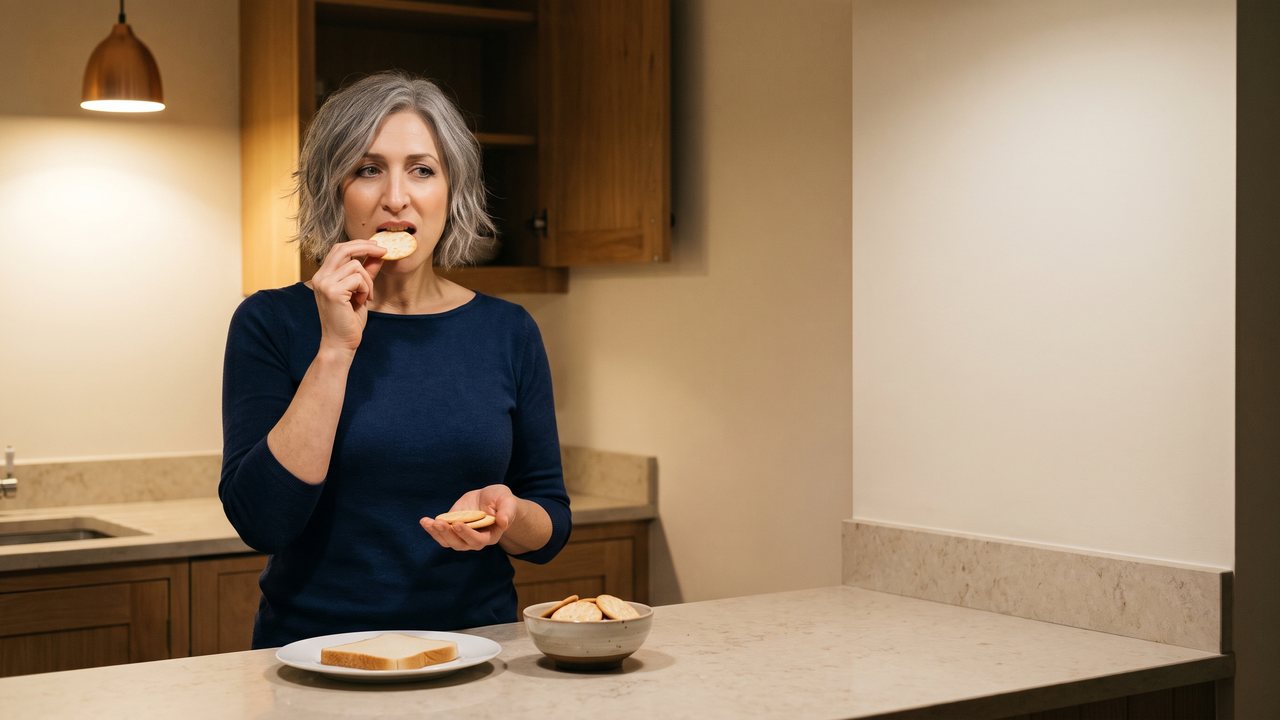
Think about your own afternoon. You probably skip the dessert and feel virtuous, then eat crackers at your desk, a handful of crisps on the way home and a slice of white toast late at night. None of it tastes sweet. All of it turns soft and sticky in the grooves of your molars and in the gaps between your teeth, exactly where a toothbrush reaches least. That is where the acorn paste of Taforalt sat, too.
So the practical list is short. Count how often you snack, not only what. Prefer slow, whole grain starch to refined, crunchy then gluey snacks. After sticky starch, clean the places it hides, the grooves and the spaces between teeth. Our SCHWARZ floss is a black expanding floss: whatever it lifts from between the teeth shows up white or yellow against the filament, so you see what the brush left behind.
Tonight, before the last cracker, ask yourself one question: will this leave the tooth in a minute, or stay there until morning?
Foods that cause cavities are not only the sweet ones. Fifteen thousand years ago, people without a grain of sugar lost half their teeth to food that stayed.