


Do Apples Clean Your Teeth? One Test Found More Plaque, Not Less
In February 1866 the London journal Notes and Queries printed a rhyme from Pembrokeshire, in the far west of Wales: “Eat an apple on going to bed, and you’ll keep the doctor from earning his bread.” By the end of the century it had shrunk to the version everyone knows, an apple a day keeps the doctor away. Somewhere along the way the doctor turned into a dentist, and the apple turned into a toothbrush.
You have probably heard it in one of its forms. An apple is nature’s toothbrush. A crisp apple after lunch scrubs your teeth. Cannot brush? Eat an apple. Health educators believed it too: a 1961 dental campaign in Dundee, Scotland, used apples, and in 1969 a London primary school ran an Apple Club.
So do apples clean your teeth? The short answer comes first. No. When researchers in Spain put one apple against one toothbrush, plaque went down after the brush and up after the apple.
One apple against one toothbrush
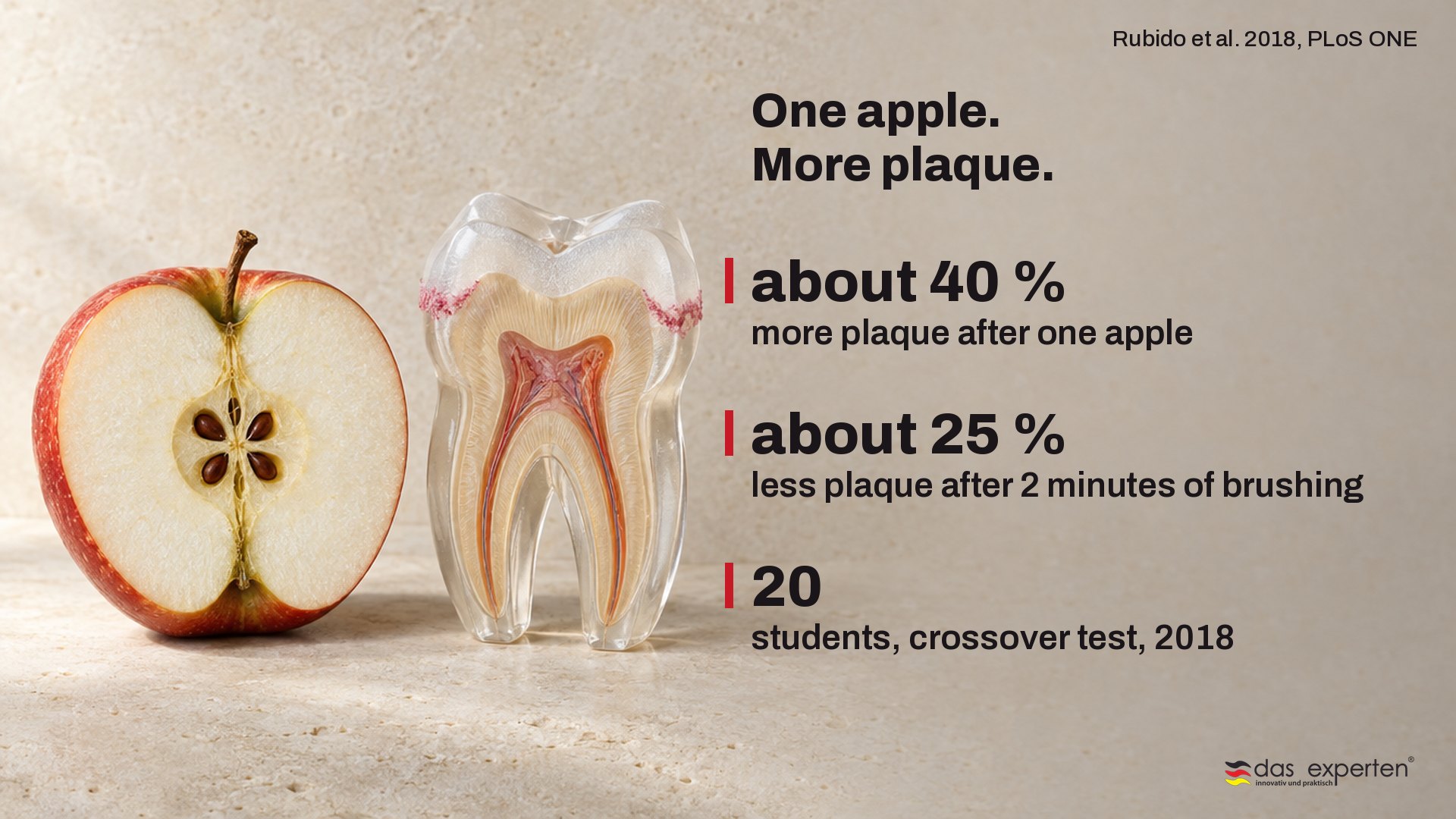
In 2018 a team at the University of Santiago de Compostela asked 20 dental students, aged 20 to 25, to clean their teeth two ways, two weeks apart. On one day they brushed for two minutes with a manual toothbrush and plain water. On the other they ate a Golden Delicious apple of about 160 grams, chewing on both sides. Before, straight after and 24 hours later, their plaque was stained red and scored tooth by tooth (Rubido et al. 2018).
After brushing, the average plaque score fell from 2.34 to 1.74, about a quarter less. After the apple it rose from 2.85 to 4.00, about 40 percent more. A day later plaque was still clearly higher after the apple than after the brush. The authors wrote their conclusion in one sentence: chewing an apple does not remove dental plaque, and it may favour plaque regrowth during the first 24 hours.
The study did not test why the score went up, and nobody should pretend it did. What it does show is simple. Plaque is a sticky film fixed to the tooth, and it comes off when bristles move across the surface. It gathers most along the gumline and between the teeth, the places a bite of apple never touches.
The part of the myth that is true
The apple did do something. Straight after eating it, the share of live bacteria in saliva fell from 82 to 61 percent, close to the fall after brushing, from 91 to 62 percent. Chewing makes saliva flow, and saliva washes bacteria away. The effect did not last: 24 hours later live bacteria stood at 87 percent after the apple and 80 percent after the brush.
Older studies point the same way. Tests published in 1971 and 1974 found that chewing apples did nothing to plaque (Wade 1971; Birkeland and Jorkjend 1974). In a school study in the British Dental Journal, ending the midday meal with an apple for ten weeks increased plaque (Longhurst and Berman 1973). One 1986 study did report less plaque with apples, at half the effect of supervised brushing. Even the best result for the apple puts it behind the brush.
What an apple is good for
Eat it because it is good food and you like it, not because it cleans. An apple carries natural sugars and fruit acid, so it belongs with a meal, not in place of brushing.
The cleaning still has to be done by something that reaches the surface: a toothbrush for two minutes, and between the teeth, where neither an apple nor a brush head gets in, floss or an interdental brush. Our INTERDENTAL S comes as four brushes in a pack and is listed for crowns, implants, braces and narrow gaps between teeth.
The rhyme from 1866 promised to keep the doctor away. It never said a word about plaque. That part we added ourselves.
An apple a day is good food. It is not a toothbrush, and in the one test that measured it, plaque went up.