


Chewing Cloves: A Han Emperor Gave an Old Official One Clove, and He Went Home to Say Goodbye
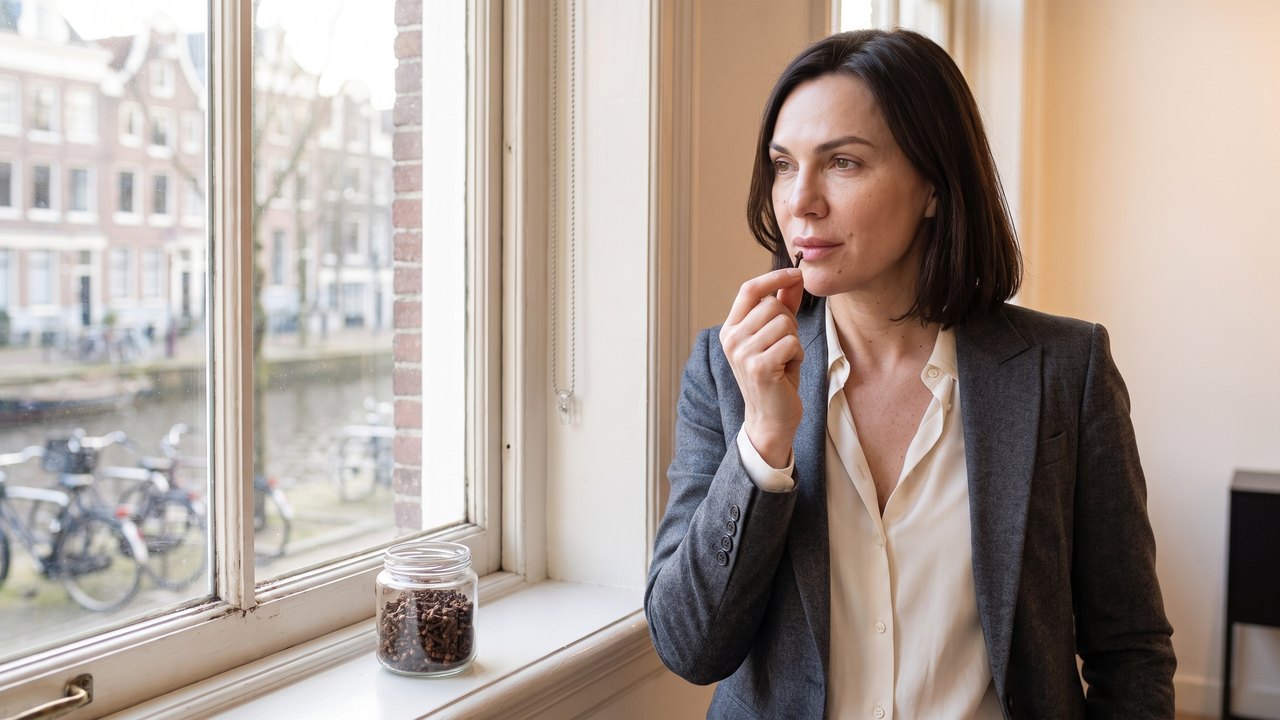
The gift was small enough to hide in a closed hand. In the palace at Luoyang, in the reign of Emperor Huan of Han (146 to 168), the emperor held something out to Diao Cun, an old palace attendant. It had the size and shape of a nail. Put it in your mouth, he was told, and keep it there. Diao Cun obeyed. The thing was hard and dry, and almost at once it began to bite: a hot sting that spread across the tongue and left the gums strangely numb. He did not dare chew it. He did not dare swallow it.
He went home certain he had been sentenced. An emperor who wants a servant gone does not always say so; sometimes he hands him something to put in his mouth. Diao Cun gathered his household to say goodbye, and his family wept without knowing why. Then colleagues who had heard of his disgrace came and asked to see the poison. He took it out of his mouth. They laughed. It was jishe xiang, “chicken tongue fragrance”: a clove. Diao Cun was old and his breath was bad, and the emperor had found the most polite way in the world to tell him. He swallowed the clove, and the matter was closed.
The story survives because Ying Shao, a scholar of the late second century, put it into his book on the customs of Han officialdom, the Han Guan Yi. The same book records a standing rule: officials of the imperial secretariat, kneeling below the red steps to deliver their reports, held chicken tongue fragrance in their mouths while they spoke.
Chewing cloves in Han China, crushed bone in Rome
Set that beside the other great empire of the same century. In Rome, people who cared for their teeth rubbed them with powders of crushed bone and oyster shell: grit to scour the surface, and very little else. A Roman senator could arrive before his emperor with polished teeth. A Han secretary arrived with a fresh mouth, by regulation, every working day.
Rome had the scrub. Luoyang had the chemistry, and did not know it.
What the clove was doing in the mouth
The Han court was not practising medicine. It was practising manners. Nobody in Luoyang counted bacteria; nobody could. But the manners rested on an observation anyone could repeat: hold a clove on the tongue for a while and the breath changes, the mouth goes quiet, a sore tooth stops shouting. Diao Cun’s fright records the mechanism almost clinically. The sting, the numbness, the instinct not to chew: that is what a strong dose of the clove’s main molecule feels like from the inside.
And here is the strange part. The officials who held cloves every day had no idea where cloves came from. Until the colonial era the tree grew only on a handful of small islands in the Moluccas, among them Ternate and Tidore, more than 5 000 kilometres from the Han capital. The buds reached China through long chains of middlemen. Even under the Song, a thousand years later, cloves were still bought from traders in Java and Srivijaya; only under the Yuan did Chinese ships sail to the Moluccas themselves. A Song era book of incense was still explaining to its readers that chicken tongue fragrance was simply the larger clove.
That is the silence at the centre of this story. The knowledge was never lost, because it was never attached to anything. It lived in a protocol, not in a theory. The court knew what to do with a clove and had no words for why it worked; the islanders who knew the tree knew nothing of the court. Between them stood a sea and a thousand years.
Eugenol: the molecule that stings
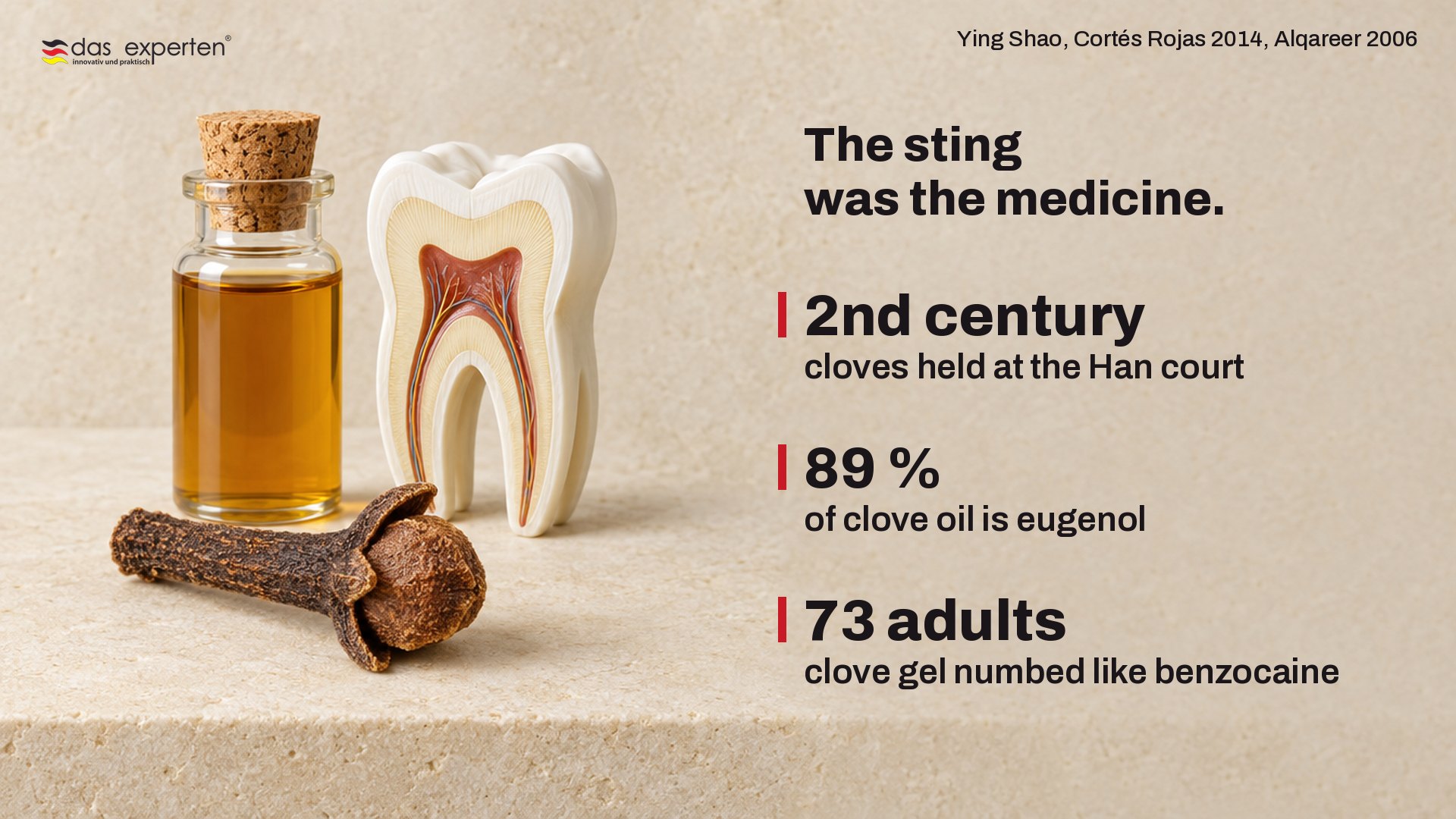
The word for why finally arrived from the laboratory, and it is eugenol. A clove bud carries up to 18 % essential oil by weight, and roughly 89 % of that oil is this one compound (Cortés Rojas et al. 2014). Eugenol is the bite Diao Cun mistook for a death sentence. It quiets nerve endings, which is why dentists still mix it into temporary fillings and dressings, and in the laboratory it damages the membrane of Porphyromonas gingivalis, one of the bacteria behind gum disease (Zhang et al. 2017).
The road back ran through Europe’s spice wars. In the seventeenth century the Dutch East India Company tried to hold cloves as a monopoly. In 1770 men working for Pierre Poivre carried seedlings off Ternate to Mauritius and the Seychelles, and the tree finally escaped its islands. By then the clove had become a kitchen spice and a toothache remedy in a hundred countries, and the courtly habit of carrying a fresh, quiet mouth into a meeting had been forgotten everywhere.
Is chewing cloves safe? The dose decides
Science has now measured both halves of Diao Cun’s afternoon: the relief and the fear. The relief first. In 2006 a randomised, subject blinded trial at Kuwait University applied a homemade clove gel, a 20 % benzocaine gel and two placebos to the gums of 73 adults, then gave each of them two needle pricks. Clove and benzocaine both hurt significantly less than placebo, and no difference was found between the two (Alqareer et al. 2006).
Then the fear, which was not entirely foolish. The molecule that soothes in a bud becomes dangerous in a bottle. Clove oil is concentrated eugenol, and in children under two years old, swallowing 5 to 10 ml of it has caused coma, seizures, failure of blood clotting and acute liver damage; a London case report in 1993 described exactly that course in a small child (Hartnoll et al. 1993). The joint food additives committee of the WHO and FAO set an acceptable daily intake for eugenol of up to 2.5 mg per kilogram of body weight. A whole clove held in the mouth, the way the Han secretaries did it, is a small dose. A spoonful of oil is not a bigger clove. It is a different thing.
Now the part that is about you. Tomorrow morning you will reach for something to make your mouth feel clean. It will be either scrub and nothing else, the Roman way, or grit plus a molecule that works on the bacteria themselves, the way the Han court did without knowing it. This is not a question of trend. It is a question of which century is standing on your sink.
Our own DETOX toothpaste takes the clove as an extract, not as an oil: 0.2 % clove extract beside 0.8 % Ceylon cinnamon bark extract, with sodium lauroyl sarcosinate in place of SLS. Nobody has tested it against a Han court clove, and the eugenol studies above were done on gels, oils and bacteria in dishes, not on our tube. What it keeps is the molecule and the measure. This week, hold one whole clove on your tongue after lunch and notice the sting Diao Cun took for his last hour.
A Han official thought the clove would kill him. It was the most useful thing anyone ever put in his mouth, and the dose was the only difference.