





What Causes Bad Breath? Bukhara Found the Source Before 983 — and It Is Mostly Your Mouth

Bukhara, a morning in the tenth century. Before she says a word to anyone, a woman unwraps a small cloth and places a dark tablet on her tongue. The taste comes in layers: the heat of clove, the bitterness of dried bergamot peel, the earth of valerian, the resin of agarwood, a thin edge of vinegar, and over everything the sweetness of musk. The recipe is exact — one deramsang, about 4.6 grams, of each, and half that of musk. Her physician wrote that the tablet goes into the mouth every morning.
But the tablet was not his real answer. Before prescribing it, he asked the question most of us still skip when a friend steps back half a pace: where is the smell coming from? He named three places. The stomach, when a high fever comes with it. The lungs. And the teeth — and for a tooth that was the source, his instruction was not perfume. It was that the tooth should be extracted.
What causes bad breath: a physician in Bukhara named three sources
He was Abubakr Rabiʿ ibn Ahmad al-Akhawayni al-Bukhari, who died around 983, and his book, the Hidayat al-Mutaʿallimin fi al-Tibb — the Learner’s Guide to Medicine — runs to 185 chapters. Two of them are about the mouth. They contain nerves, gums, gargles of vinegar, a lancet worked around the tooth to separate the nerve, a fume of burned henbane seed to numb it, and extraction only as the last resort. He sorted a painful mouth into kinds — with redness, with pale patches, and a corrosive ulcer of the cheek — and he is one of the few writers of any era to describe cutting the dental nerve to stop the pain.
What they do not contain is a worm. At the same time, and for centuries after, the belief that a worm inside the tooth caused decay and pain — an idea already written on a Babylonian clay tablet — held its ground, and in Europe it survived into the eighteenth century, until Pierre Fauchard rejected it in Le Chirurgien Dentiste in 1728. One side of the map had a monster in the mouth. The other had an address.
How Bukhara knew without a microscope
No microscope, no word for bacteria. What he had was the empiricist’s oldest tool: try it, watch it, write down only what held. “I have treated many of these patients,” he wrote, “and what I have mentioned here are methods that I have experienced myself.” For inflamed gums he prescribed rubbing them with rough linen and vinegar until they bled, then rinsing — crude, and not something anyone should copy, but aimed at the right tissue. Al-Razi, working a generation earlier in Rey, had recommended the same.
So why did a thousand years pass before this reached a European reader? Because he wrote in the wrong language. The giants of his world — al-Razi, al-Majusi, Ibn Sina — wrote in Arabic, and their books were translated into Latin. Akhawayni wrote in Persian, the language the Samanid court (875–999) was reviving. His book is the oldest medical treatise in Persian. Its oldest surviving copy, made in 1058, sits in the Bodleian Library in Oxford; a critical edition, prepared by Jalal Matini, appeared only in 1965, in Mashhad. The knowledge was not lost. It was simply never translated.
Stomach, lungs or mouth: what the numbers say
Breath became something one could measure only in the twentieth century, once the smell was traced to volatile sulphur compounds released by bacteria. In 2009, a multidisciplinary bad-breath clinic in Leuven, Belgium, published the records of 2 000 consecutive patients. Most had come without a referral, and on average they had lived with the complaint for seven years. For 76% the cause was in the mouth, and the largest single cause was the coating on the back of the tongue: 43%. Ear, nose, throat and other organs together accounted for 4%. And 16% had no bad breath the clinic could detect at all — they were sure they did, and that fear has a name of its own in the paper: halitophobia.
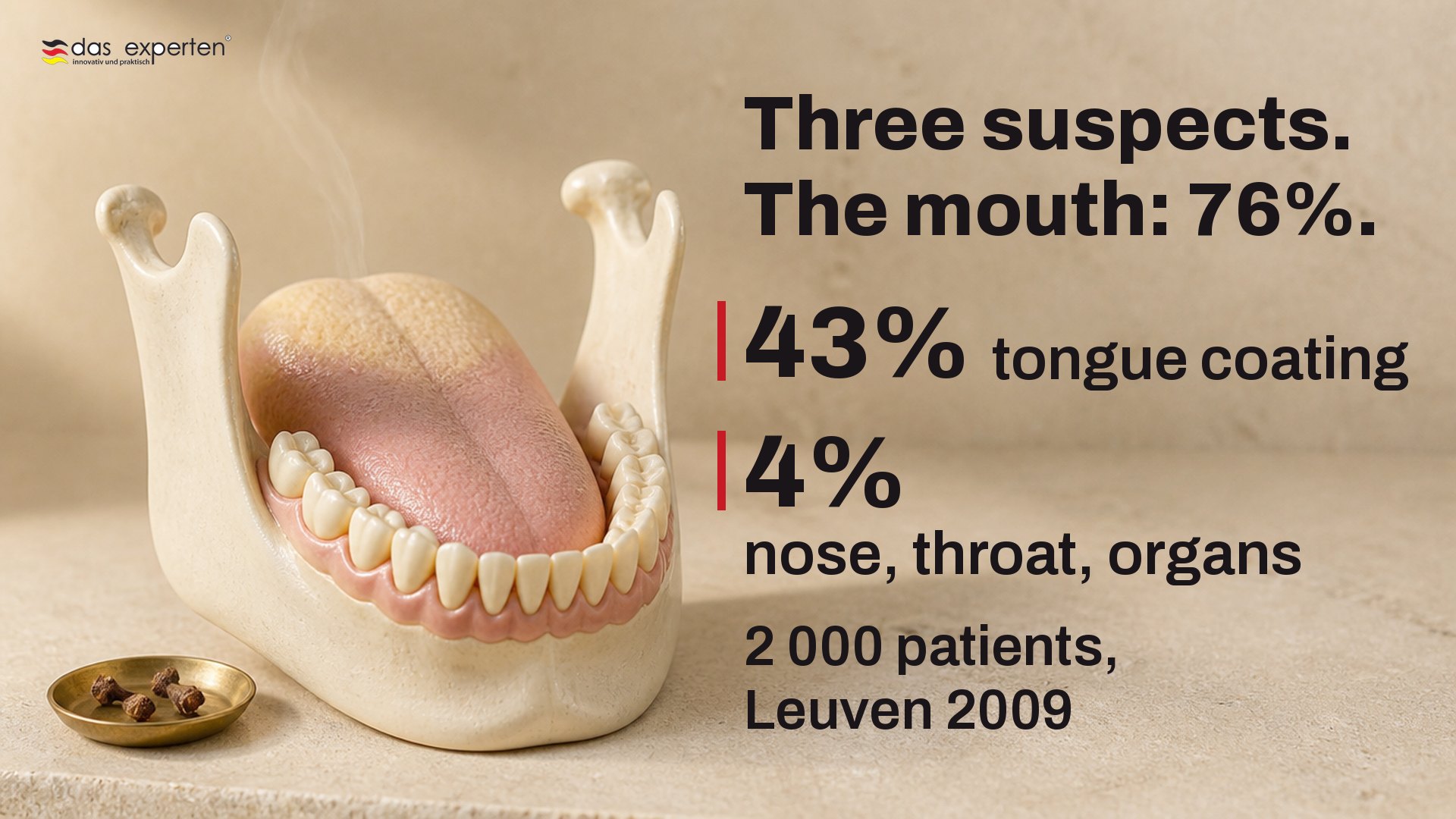
A 2012 review gives a similar split: about 85% from the mouth, about 10% from ear, nose and throat, and about 5% from the stomach and hormones. So the stomach, the suspect people search for most, is real — and rare. Akhawayni put it first on his list. The numbers put the teeth, the gums and the tongue first. His diagnosis was one third right, and that third turned out to be three quarters of the problem.
The bridge: clove, eugenol and the limit of a tablet
The molecule that crosses the thousand years is eugenol, the main aromatic compound of clove. In a 2017 laboratory study, eugenol from clove oil stopped Porphyromonas gingivalis, a bacterium of gum disease, at 31.25 µM by breaking open its membrane — in a dish, not in a mouth. Honesty demands the other half: in a 2019 test of eight mouthrinses on 90 people, a zinc chloride rinse cut breath odour fastest, and the rinses built on alcohols, menthol, thymol and eugenol did less. Clove is not a deodorant. Its measured action is on bacteria, and bad breath is fixed at the source, not over it.
And now the part about you. Tomorrow morning, when you worry about your breath, your hand will reach for something. It will be either a mint — the tablet of musk in modern wrapping — or the source. This is not a question of freshness. It is a question of which century your bathroom lives in.
The source, for most of us, is in reach of a mirror. Clean the back of the tongue, where 43% of the Leuven patients carried the cause — here is how to use a tongue scraper. Brush the gum line, where the bacteria of gum disease live. For that brushing, DETOX carries clove extract, 0.2%, the same source of eugenol that went into the Bukhara tablet, with Ceylon cinnamon bark extract, 0.8%, sodium pyrophosphate as an anti-tartar ingredient, and no SLS or fluoride in its formula. If your breath stays bad after a week of that, go to a dentist first and a doctor second — in that order, as the numbers say.
This week, look at your tongue in daylight before you buy another mint.
Bad breath was never a smell to cover. It was an address — and Bukhara wrote it down a thousand years before we went looking.