





Tongue scraper: how to use one and whether you need it

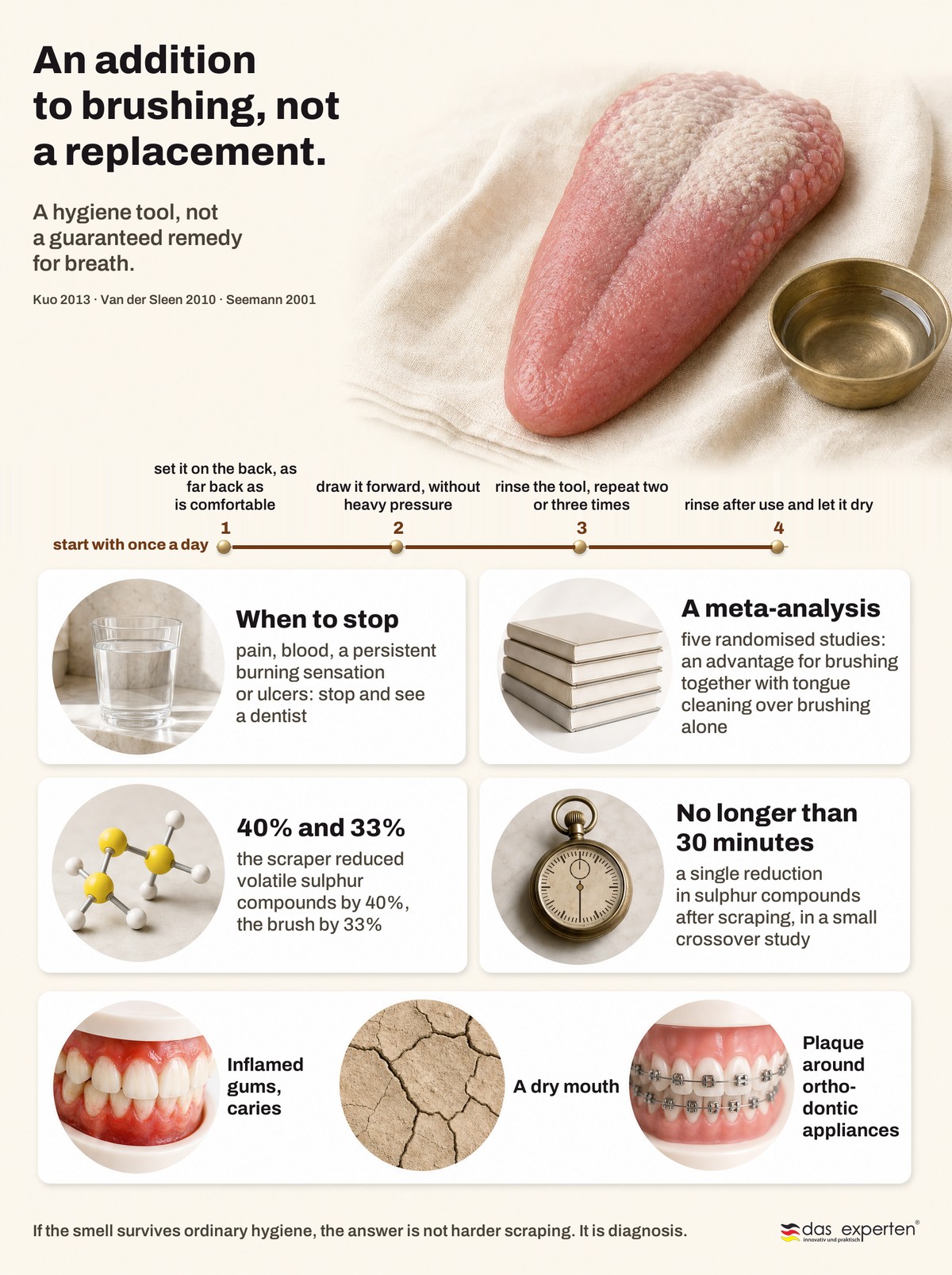
A tongue scraper mechanically lifts the soft coating off the dorsum of the tongue. It is an addition to brushing, not a replacement for the brush, for floss, or for treating the cause of persistent bad breath.
What you are actually removing
The coating is a soft film of shed epithelial cells, food residue, bacteria and the by-products of their metabolism. It sits thickest in the crypts between the papillae on the back of the tongue, and that is also where the anaerobes associated with odour are most at home. This is why the back of the tongue matters far more than the tip, and why a quick pass over the front of the tongue tends to change very little.
The gag reflex is the practical limit
Most people cannot reach the very back on the first attempts, and forcing it gains nothing. Start further forward than you think you should and move back over a few days as the reflex settles. Scraping before eating rather than after helps, as does breathing through the nose and pressing less. If you are fighting the tool, you are pressing too hard rather than reaching too far.
How to use a tongue scraper properly
- Put your tongue out and set the scraper on the back of it, as far back as is comfortable.
- Without heavy pressure, draw the scraper forward, towards the tip.
- Rinse the tool and repeat two or three times. You are not trying to get a squeaky-clean feeling.
- Rinse the scraper after use and let it dry.
Start with once a day. There is not yet enough reliable data to set an ideal frequency or duration for tongue cleaning. Pain, blood, a persistent burning sensation or ulcers are a reason to stop and see a dentist.
Does a scraper help with bad breath
A short-term effect is plausible: mechanical cleaning reduces the coating on the tongue and the volatile sulphur compounds associated with odour. A meta-analysis of five randomised studies found an advantage for brushing together with tongue cleaning over brushing alone. The authors state plainly that there is not enough evidence to determine the best frequency, duration or method.
Another systematic review reached a more cautious conclusion: a scraper potentially reduces odour and coating, but the evidence is insufficient for treating chronic halitosis. In a small crossover study, a single reduction in sulphur compounds after scraping lasted no longer than 30 minutes. So a scraper is better described as a hygiene tool than as a guaranteed remedy for breath.
Scraper or toothbrush
An ordinary brush can clean the tongue too, but a dedicated scraper lifts the coating with a flat edge and often needs fewer strokes. In one study the scraper reduced volatile sulphur compounds by 40% and the brush by 33%; the clinical duration of the effect remained limited in both cases. Choose the tool you can use gently and regularly without injuring your tongue.
When a scraper will not solve the problem
Persistent odour can come from more than the tongue: inflamed gums, caries, a dry mouth, plaque around orthodontic appliances, or causes outside the mouth entirely. If the smell survives ordinary hygiene, the answer is not to mask it with harder scraping. It is diagnosis.
How to choose a scraper
- A smooth working edge, with no burrs or sharp sections.
- A comfortable width: the tool should pass along the tongue without extra pressure.
- A washable material: the surface should rinse and dry easily.
- Control over pressure. The shape matters less than a gentle technique.
Das Experten makes a tongue scraper, ZUNGER (DE114). Availability differs by market, so check the Das Experten catalogue for your region rather than taking a stock claim from an article.
Sources
- Kuo et al., 2013 — systematic review and meta-analysis
- Van der Sleen et al., 2010 — systematic review
- Seemann et al., 2001 — cleaner, scraper and brush compared
Used gently and daily, a scraper is a reasonable part of a routine. Used as a substitute for finding out why a mouth smells, it is a way of not answering the question.