


Titanium Dioxide in Toothpaste: Out of European Food Since 2022, Still on Your Brush
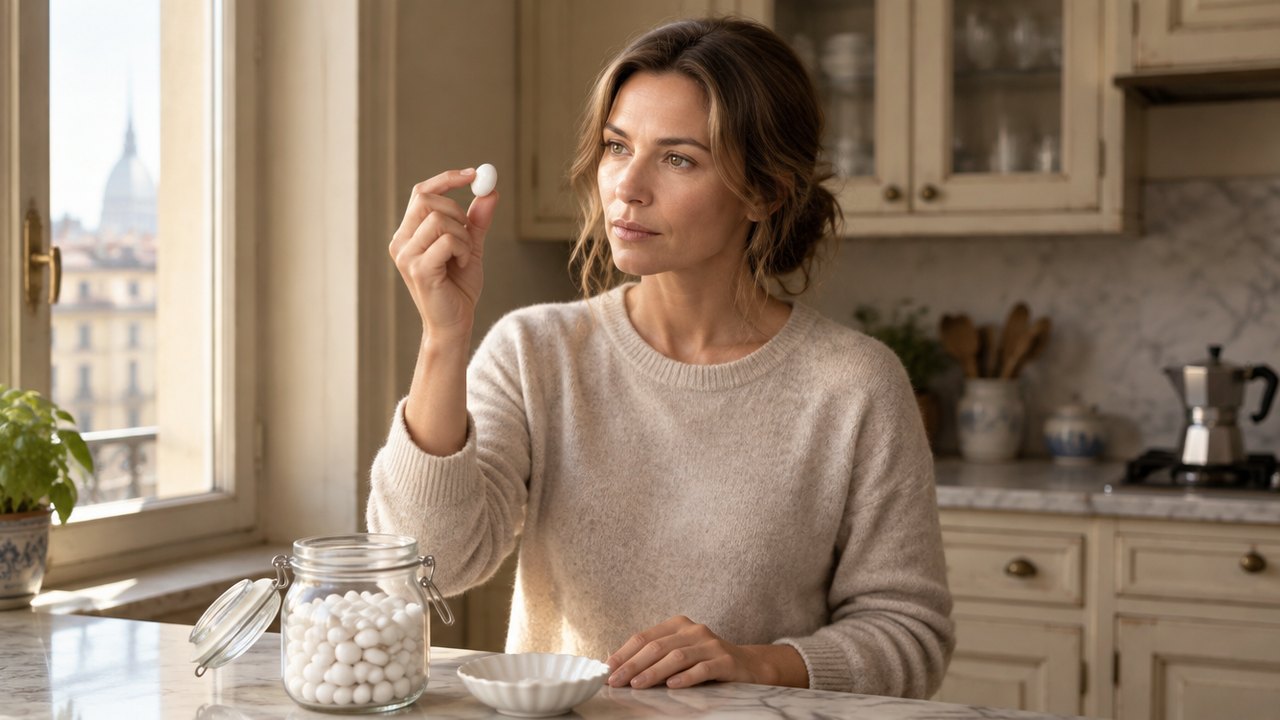
Look at the paste on your brush tomorrow morning. That bright, solid white is not a sign of cleaning power. It is paint. In most white toothpastes the colour comes from one mineral pigment, titanium dioxide, written in the ingredient list as Titanium Dioxide or CI 77891. It does not polish, it does not fight decay, it does not freshen breath. Its whole job is to make the paste look clean.
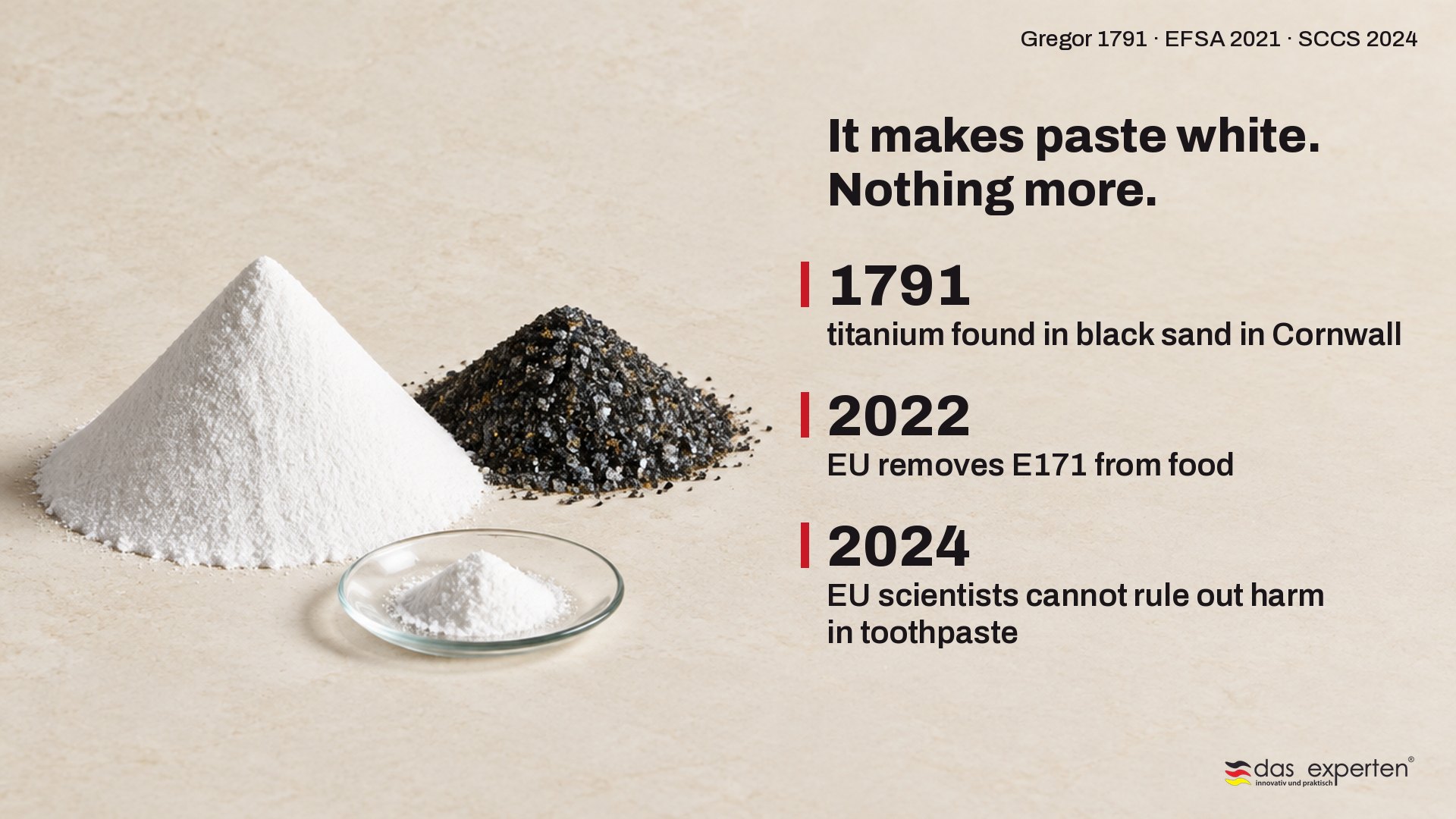
The story of that white begins with black sand. In 1791 William Gregor, a vicar and amateur mineralogist in the Cornish parish of Manaccan, picked up a black magnetic sand from a stream valley and pulled out of it the oxide of a metal nobody knew. Four years later the Berlin chemist Martin Heinrich Klaproth found the same element in a red mineral, rutile, and named it titanium, after the Titans of Greek myth. Neither man ever saw the pure metal. What they held was the oxide: the white powder this article is about.
From paint to sugared almonds to toothpaste
For a century the oxide stayed a curiosity. Then in 1916 a company in Norway and another in New York began to make titanium white commercially, and within decades it pushed lead white out of paint: just as brilliant, without the poison. Its secret is optics. Titanium dioxide bends light more strongly than almost any other white substance, so a thin layer scatters everything that falls on it and nothing shows through. That made it the white of paper, plastics, sunscreen, tablets, chewing gum, Italian sugared almonds and toothpaste.
Food makers wrote it as E171. Cosmetic makers wrote it as CI 77891. One powder, two rulebooks, and that split is the whole story of the last ten years.
The verdict on food
In 2017 a team at the food toxicology centre of INRA in Toulouse, led by Sarah Bettini and Eric Houdeau, fed rats E171 at levels they described as relevant to human intake. After 100 days the animals showed microinflammation in the colon and early preneoplastic lesions, small changes that can come before tumours (Scientific Reports, 2017). One rat study proves nothing about people, and the authors did not claim it did. But part of food grade titanium dioxide comes as nanoparticles, small enough to be taken up by cells, and regulators began to look again.
France moved first. From 1 January 2020 it suspended the sale of food containing E171 and has renewed that suspension every year since; cosmetics and toothpaste were left out. In May 2021 the European Food Safety Authority concluded that E171 can no longer be considered safe as a food additive. EFSA did not find that it damages DNA. It found that a concern for genotoxicity, harm to genetic material, could not be ruled out, and without ruling it out it could set no safe daily intake. The European Union withdrew the additive from food on 7 February 2022, and the last old stock was sold off by August.
Why toothpaste was left out
Toothpaste is not food. In Europe it is a cosmetic, ruled by a different law and judged by a different panel, the Scientific Committee on Consumer Safety. The argument for keeping the pigment is simple: you spit toothpaste out. The argument against is just as simple: not everyone does. In 2016 the Dutch national health institute RIVM estimated where people in the Netherlands get their titanium dioxide. For children aged two to six, toothpaste was among the main sources, next to sweets, because small children swallow much of what goes on the brush.
So the European Commission asked its cosmetics scientists whether titanium dioxide is safe in products used in the mouth. In May 2024 the committee answered that the evidence was not sufficient to exclude a genotoxic potential for almost all of the grades used in oral products. It examined 44 pigment grades and 40 nano grades. Two nano grades showed no such concern in the data supplied, and even for those it asked for more information on uptake through the lining of the mouth, because a toothpaste is used every day, often twice. Industry sent new data in 2025, the committee accepted a fresh mandate in September 2025, and its opinion is expected around the end of 2026. Until then titanium dioxide remains a permitted cosmetic colorant in Europe.
One more ruling adds to the confusion. In 2019 the EU classified certain titanium dioxide powders as a suspected carcinogen when breathed in as dust, a workplace question, not a toothpaste one. The EU courts annulled that classification in 2022, and the Court of Justice confirmed the annulment on 1 August 2025. In the United States the FDA still allows titanium dioxide as a food colour up to 1 % of the weight of the food; petitions filed in 2023 asking it to withdraw that permission are still open.
What this means at your sink
Here is the honest state of knowledge. Nobody has shown that titanium dioxide in toothpaste harms people. Nobody has yet shown, to the standard European regulators require, that it is safe for daily use in the mouth either. That is an unfinished question, not a scandal, and it is reasonable to make your own choice while it stays open.
Three practical points follow. First, the pigment does nothing for your teeth, so a paste without it costs you nothing in cleaning or protection. Second, the people who swallow the most toothpaste are small children; whatever paste you choose, give them the small amount that suits their age, as we explain in how much toothpaste to use. Third, read the label: look for Titanium Dioxide or CI 77891 in the ingredient list.
The same goes for us. In our own range, titanium dioxide stands in the composition of four of our nine toothpastes, SCHWARZ, GINGER FORCE, SYMBIOS and EVOLUTION KIDS, where it is there for colour and opacity. The other five do not list it: DETOX, COCOCANNABIS, BUDDY MICROBIES, TERMO 39° and INNOWEISS. We tell you this so you can choose with the same facts we have.
A white powder from Cornish black sand left European food in 2022; whether it stays in toothpaste is the question European scientists are answering now.