


Silver Fillings Are 1 367 Years Old: Tang China Put Silver in Teeth in 659

Chang'an, the year 659. The capital of the Tang dynasty is the largest city on earth, and in a government office near the palace about twenty officials and physicians are finishing a book the emperor ordered two years earlier. Emperor Gaozong wants one official list of every medicine in the empire. Su Jing, the editor in chief, delivers some 850 of them in more than fifty scrolls: the Xinxiu bencao, the Newly Revised Materia Medica, the first pharmacopoeia in history issued by a state.
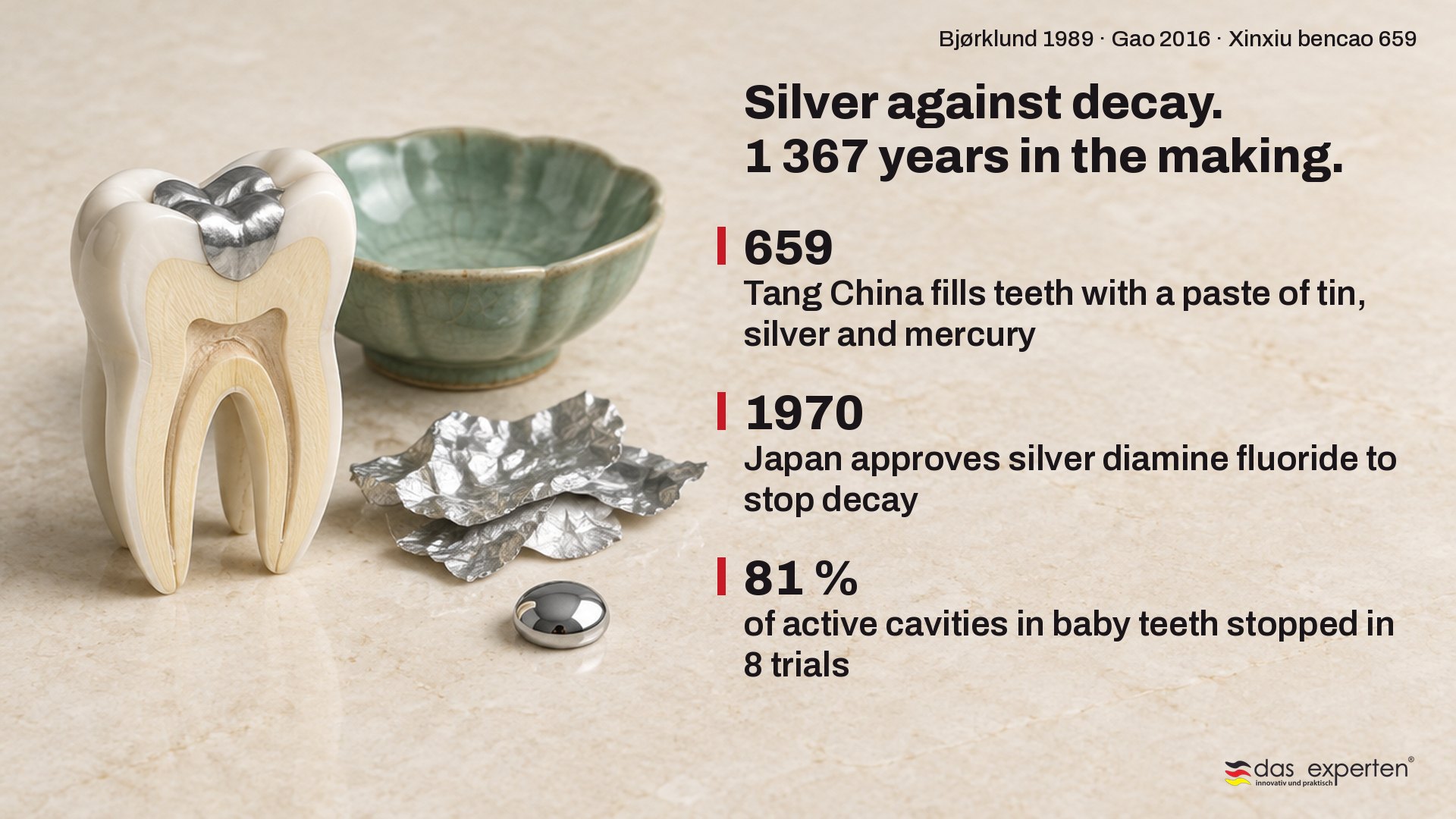
Among the minerals sits a recipe that later Chinese writers quote with pride. Take white tin. Take leaves of silver foil, thin enough to tremble when you breathe. Work them together with quicksilver, the liquid metal that runs across a dish like a living drop. The result is a soft grey paste, a yin gao, a silver paste, that is pressed into a hole in a tooth and then hardens there.
The stakes in that room were not small. In the same court, mercury was also being swallowed: several Tang emperors are believed to have died of alchemical elixirs taken in search of immortality. The physicians found the one place where quicksilver did good instead of harm, locked inside metal, inside a tooth.
Meanwhile, in the West
Europe in the seventh century had no filling at all. A rotten tooth was explained by a worm, and the cure was pliers. The first European trace of an amalgam filling, according to the historian of dentistry Geir Bjørklund, appears in Germany around 1528, almost nine centuries after Chang'an. Silver paste reached the United States only in 1833, when two dentists named Crawcour arrived from Europe with a mix of mercury and silver coin filings they sold as Royal Mineral Succedaneum.
American dentistry answered with a war. In the middle of the 1840s the American Society of Dental Surgeons asked its members to sign a pledge never to use amalgam, under threat of expulsion. Members resigned, the pledge was quietly withdrawn by 1850, and in 1856 the society itself dissolved. The filling won. The society did not.
How did Tang physicians get there first?
Not through theory. They had the oldest kind of evidence: things that last. Silver does not rot, a paste that hardens keeps food out of a hole, and a tooth that is sealed hurts less and stays longer. Chinese medicine had collected recipes like this for centuries, tested on bodies rather than in laboratories, and the state simply wrote the working ones down.
The book itself then travelled east. A copy of the Xinxiu bencao reached Japan in 721, and it is Japan that kept it: by the Song dynasty the text was lost in China, and what survives today comes from the Japanese copy and from fragments found in the caves of Dunhuang. That is why the recipe reaches us through later quotations, not through an original page. Hold on to Japan. It comes back.
And here is the paradox of silence. The Tang physicians described what silver did and never why. They had no microscope and no word for a bacterium. They saw a sealed tooth stop aching, and they could not see the living film inside the cavity that the seal was starving. For more than a thousand years silver in teeth was understood as a plug, a better kind of stone. Nobody asked whether the metal itself was fighting anything.
The long road back
The question came from Japan. In the late 1960s Japanese researchers combined silver with fluoride and ammonia into a clear liquid, silver diamine fluoride, and in 1970 Japan's health ministry approved it as a medicine to stop tooth decay from progressing. No drill, no paste, no filling: a drop painted onto the decayed spot with a tiny brush. For decades it stayed a quiet habit of Japanese and Hong Kong clinics. The United States cleared it only in 2014, and then only as a treatment for sensitive teeth.
The single atom that makes the bridge from Chang'an to that drop is the silver ion, Ag⁺. A silver ion is a silver atom that has lost one electron, and in that state it binds to the sulphur in bacterial proteins and enzymes, jams the machinery of the cell and damages its DNA. The fluoride in the same drop hardens what is left of the tooth. Silver is not a stone in the hole. It is a poison for what lives in the hole.
What the science says now
In 2016 a team at the University of Hong Kong collected the clinical trials of silver diamine fluoride in children, from Chinese, Japanese, English, Portuguese and Spanish databases. In the eight trials that used the 38 % solution on baby teeth, 81 % of active cavities stopped progressing. The price is visible: the arrested spot turns black. The Cochrane review of 2024, which pooled 29 randomised trials with 13 036 participants, is more cautious. It finds a likely benefit for stopping decay in baby teeth, but rates much of the evidence as low certainty. Silver works; how well, and for whom, is still being measured.
This is the moment that concerns you personally. Tomorrow morning you will hold a toothbrush. It will be either a tuft of plastic that lives wet in a cup between brushings, or something made with a little more thought about what grows on it. The Tang physicians would have understood the choice at once.
One of ours carries the old metal in a modern form. The bristles of the Das Experten NANO MASSAGE brush are soft silicone with silver bound inside them, and the silver is there to help keep the brush head itself fresher between brushings. It does not fill a cavity and it does not replace silver diamine fluoride, which only a dentist applies. It is the same metal, doing a smaller and honest job. Look at your brush cup this week.
China put silver in teeth in 659; the West fought it for a century, and Japan had to explain why it worked.