


Is Chewing Gum Good for Your Teeth? Singapore Sells It in Pharmacies, and the Trials Explain Why It Still Cannot Replace Brushing
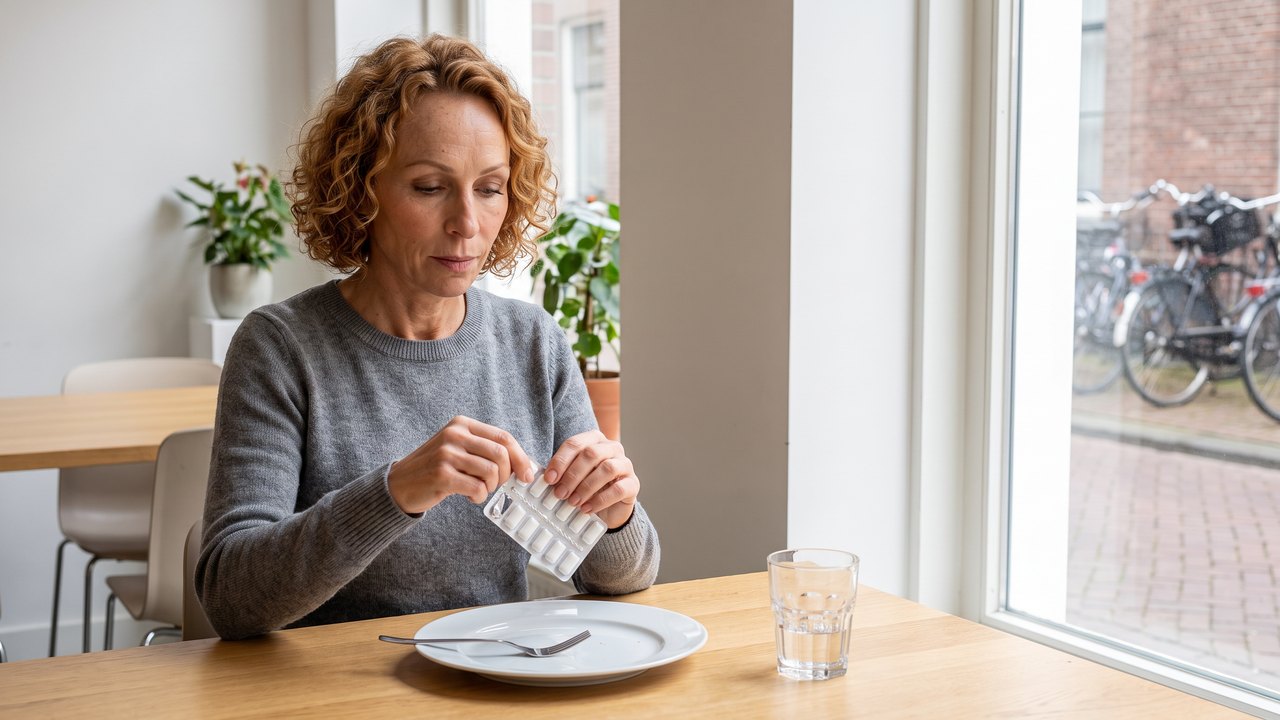
In Singapore you cannot buy a pack of chewing gum at the supermarket checkout. Selling it has been illegal since 1992. Yet you can walk into a pharmacy and leave with a pack of sugar free dental gum, as long as the pharmacist writes down your name. Since 2004 the law has carved out an exception for therapeutic, dental and nicotine gum, a concession that arrived together with the free trade agreement between the United States and Singapore. One small country decided that a piece of gum is either litter or medicine, depending on what it does for your body.
Most of the world made the opposite decision quietly. Gum sits next to the till, and it comes with a promise many people take literally: chew a piece after lunch and your teeth are as good as brushed. It is a convenient belief. So is chewing gum good for your teeth? Yes, in one specific way. Can it replace brushing? No, and the way the myth fails is more interesting than a simple no.
Why does chewing gum feel like brushing?
Because chewing does something real. In 1992 Colin Dawes and Lee Macpherson at the University of Manitoba asked 24 young adults to chew different gums for 20 minutes while they collected saliva minute by minute. In the first minute, flavoured gum pushed the flow of saliva to about 10 to 12 times the resting rate of 0.47 ml per minute. After 20 minutes it was still about 2.7 times higher. With a sugar sweetened gum and a sugar free one alike, the acidity of saliva fell as soon as chewing began: its pH rose and stayed above the resting level.
Saliva is the repair crew the mouth carries with it. It washes food away, buffers the acid that bacteria make from sugar and brings calcium and phosphate back to enamel that acid has softened. So the clean feeling after a piece of gum is not imagined. The question is what that feeling actually measures.
Gum also catches bacteria. In Groningen, in the Netherlands, a team of biomedical engineers asked 5 volunteers to chew gum for up to 10 minutes and then counted what was stuck inside it: around 100 million bacteria per piece, most of them trapped in the first minutes. Two of the authors worked for the gum maker Wrigley, which is worth knowing; the measurement itself is one any laboratory can repeat.
What the trials on gum and teeth actually show
When researchers at King’s College London pooled 12 trials on sugar free gum and tooth decay, the chewers developed fewer new cavities than people who did not chew: a preventive fraction of 28 %, with a wide band of uncertainty from 7 to 48 %. In the 8 trials that used xylitol gum the figure was 33 %. The authors themselves called it tentative evidence, because the trials were of moderate quality and differed a great deal. Notice what was compared: gum against no gum. Not gum against a toothbrush.
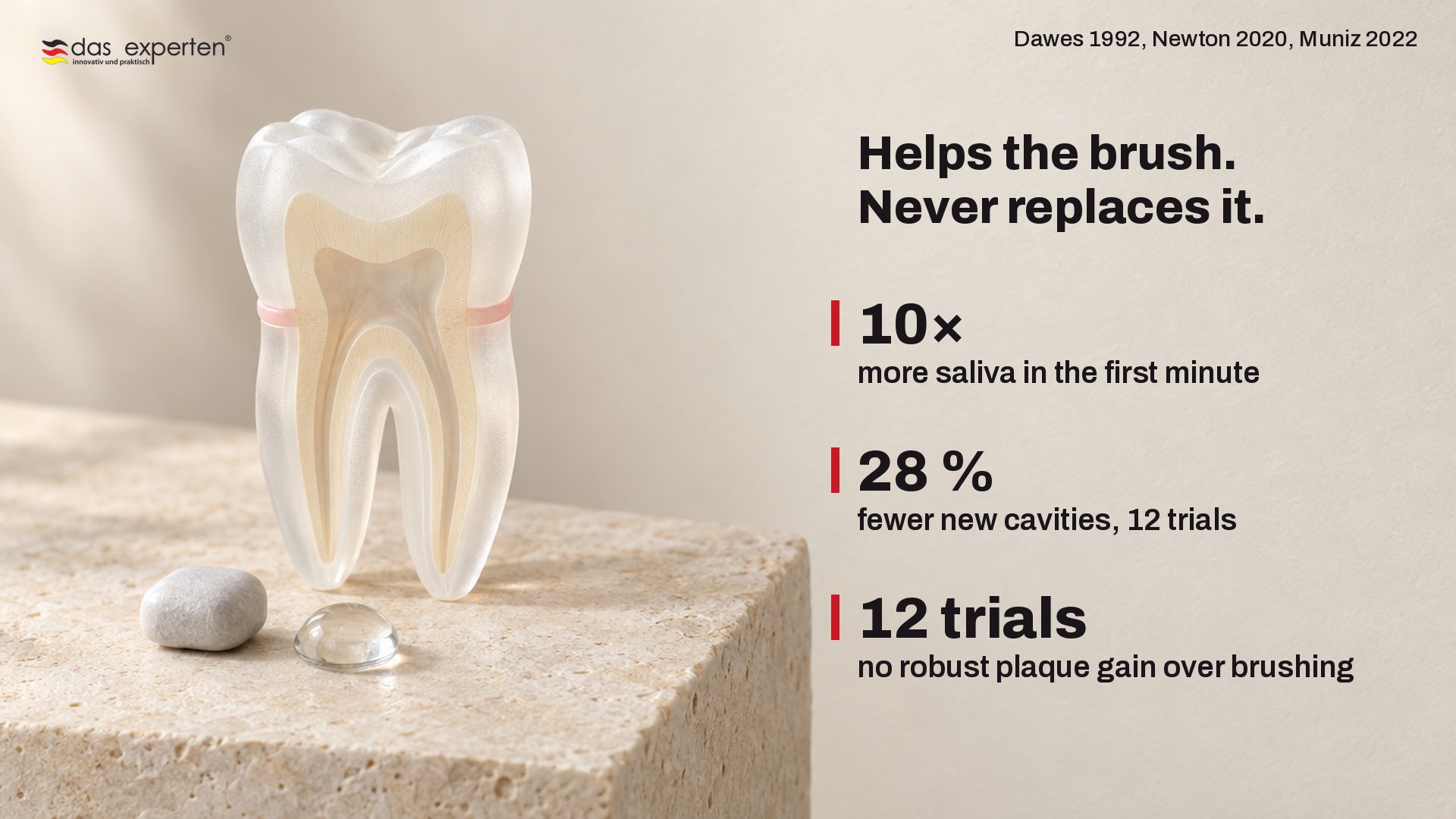
On plaque the story is thinner. The same London group found that sugar free gum reduced the amount of plaque across 8 studies, again with large differences between them. A Brazilian network meta analysis then asked the question that matters for anyone who already brushes: does gum add anything on top? Across 12 randomised trials, with 850 people measured for plaque and 1 459 for gum inflammation, its authors concluded that there is no robust evidence for sugar free gum as an addition to toothbrushing, either for controlling plaque or for treating gingivitis.
Can chewing gum replace brushing your teeth?
No, and the reason is geometry. The plaque behind gum disease lives where the gum meets the tooth and in the narrow gaps between teeth. A soft pellet rolling over the chewing surfaces does not reach those places; bristles and floss do. Saliva can neutralise acid after a meal, but it cannot lift a mature film of bacteria off the gumline. This is a mechanical argument rather than a trial result, and it is exactly why no trial ever needed to test gum instead of a brush. Gum works on the chemistry of your mouth. Brushing works on its mechanics. Both jobs need doing, and chewing can do only one of them.
This is where the line Singapore drew becomes useful. Its law does not treat gum as a toothbrush. It treats it as a therapeutic product, something taken in addition to care, from a pharmacist who knows your name. That is close to what the evidence says.
How to use gum without fooling yourself
Brush twice a day and clean between your teeth; that is the work. After a meal, when a brush is out of reach, a piece of sugar free gum is a reasonable bridge: in the Manitoba measurements, saliva flowed fastest in the first minutes and was still well above rest after 20. Make it sugar free, because gum sweetened with sugar feeds the very bacteria you are trying to wash away. Then brush when you get home.
Xylitol, the sweetener in 8 of those 12 decay trials, also stands in the formulas of two Das Experten toothpastes, SYMBIOS and BUDDY MICROBIES. That is a fact about what is in the tube. It is not a claim that the paste prevents cavities, and nothing in this article suggests that a toothpaste makes gum unnecessary or brushing optional.
Gum is a rinse you can carry in your pocket. It is not a brush, and no country, not even the one that sells it in pharmacies, has ever said it was.