


How Many Bacteria Are in Your Mouth? 557 Kinds, and 80 Million Change Hands in One Kiss
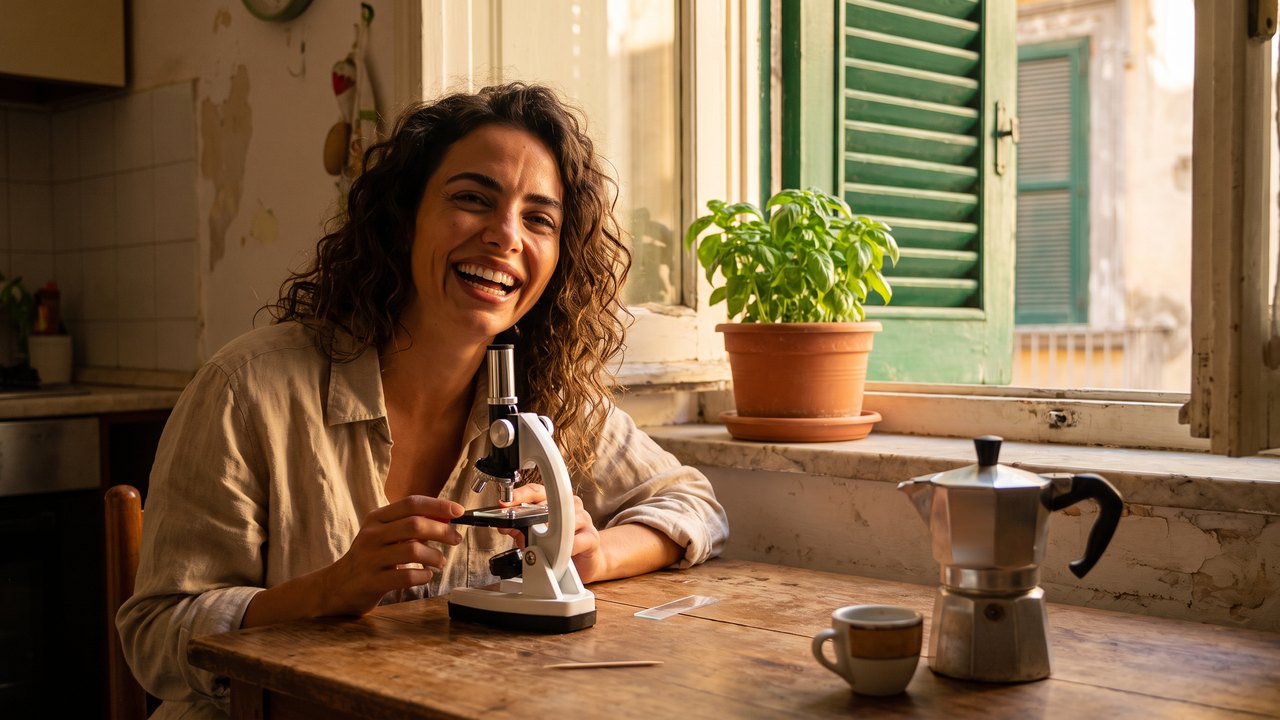
On 17 September 1683 a draper from Delft named Antonie van Leeuwenhoek scraped a little of the white matter from between his own teeth, mixed it with clean water and put it under a lens he had ground himself. He saw tiny creatures that shot through the water and spun like tops, and he wrote to the Royal Society in London to say so. It is one of the first descriptions of living bacteria ever recorded, and it came from a human mouth.
Three centuries later the crowd he saw can be counted. Here are the numbers, where they come from, and what they mean for the mouth you are using to read this.
How many kinds of bacteria live in your mouth?
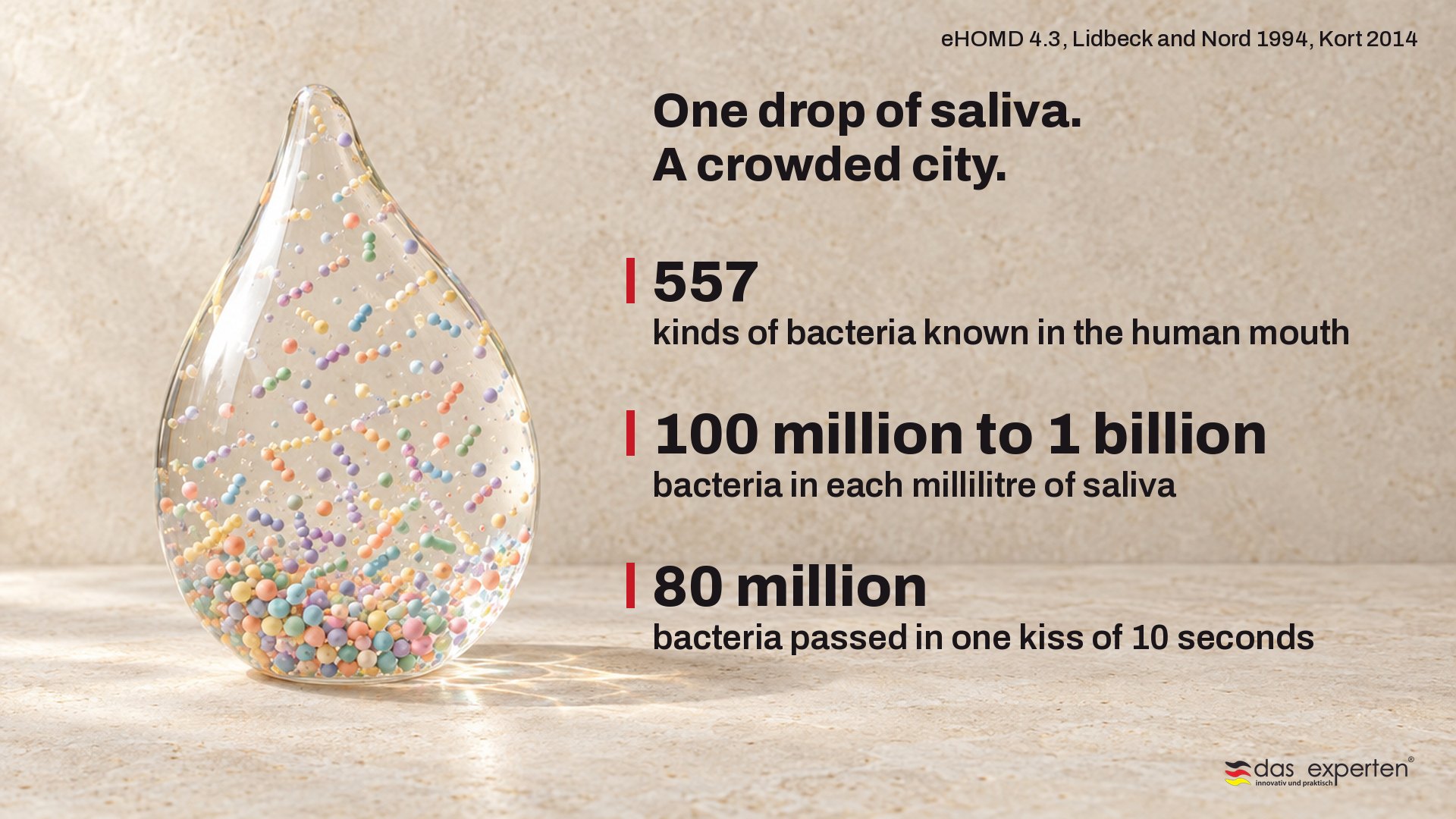
The Human Oral Microbiome Database, the reference catalogue researchers use, currently lists 557 kinds of bacteria that live in the human mouth, 547 of them mainly there and nowhere else in the body. Only 64.6 % have a proper name. 12.8 % have been grown in a laboratory but never named, and 22.6 % are known only from their genetic signature: nobody has ever grown them at all. Put together, more than a third of the bacteria in your mouth are strangers to science.
No one carries all 557. In a 2014 Dutch study, samples from the tongue and saliva of 42 people held about 3 000 distinct bacterial types between them, but each sample averaged 96, and only 25 types turned up in more than half of the samples. Your mouth is a city with its own mix of residents, not a copy of everyone else's.
How many bacteria are in saliva?
A standard microbiology reference puts the count at 100 million to 1 billion bacteria in every millilitre of saliva. Most of them are not born there: saliva is a river that keeps washing cells off the tongue, the cheeks and the teeth. At rest the mouth holds only about 0.74 ml of saliva, roughly 15 drops, and simple arithmetic puts 74 million to 740 million bacteria in it at any quiet moment.
The river never stops. A healthy adult makes 1 to 1.5 litres of saliva a day, at about 0.3 ml a minute when resting and far faster when eating, which supplies 80 to 90 % of the daily total. Multiply the two published ranges and you swallow somewhere between 100 billion and 1.5 trillion oral bacteria a day. That is arithmetic, not a measurement, but it shows the scale.
Where they really live: plaque
Saliva is the traffic. The residents live in plaque, the soft film that builds up on teeth when they are not cleaned, the same film Leeuwenhoek scraped off. Reference figures collected in Harvard's BioNumbers database put dental plaque at around 100 billion bacteria per gram, which is about 100 million in a single milligram, a speck you would barely see on a toothpick.
80 million in one kiss
On 26 July 2012, at the Artis zoo in Amsterdam, researchers asked 21 couples aged 17 to 45 to kiss intimately for 10 seconds. Before a second kiss, one partner drank 50 ml of a probiotic yoghurt drink, whose bacteria are easy to tell apart from the mouth's own. Afterwards those marker bacteria showed up in most of the receivers, and the team calculated an average transfer of 80 million bacteria per kiss.
One kiss changed little. Habit did. Couples who reported kissing at least 9 times a day had noticeably more similar saliva, and the effect faded about 1 hour 45 minutes after the last kiss. The tongue told a different story: partners shared more tongue bacteria than strangers whatever their kissing frequency, which points to a shared home, table and toothbrush habits. One more number from the questionnaires: men reported an average of 10 kisses a day, women 5, and 74 % of men claimed more than their own partner. The authors put that down to over reporting.
What the numbers mean for you
A mouth is never sterile, and it is not meant to be. Most of those hundreds of kinds are ordinary residents that have lived with people for as long as there have been people. What changes the picture is time: plaque left on a tooth for hours becomes the densest crowd in the body, at 100 million per milligram. Brushing twice a day does not empty the city. It clears the oldest, thickest neighbourhoods before they settle in.
So the next time you look in the mirror, remember Leeuwenhoek and his lens. The life he saw in 1683 is still there, about 557 kinds of it, and the part you control is how long it gets to stay on your teeth.
You cannot count them, and you do not need to. You only need to keep the oldest layer from staying put: twice a day, every day.