





Does Sugar Cause Cavities? How Often Sets the Attacks — How Much Set the Cavities

Somewhere around your first filling, someone told you the rule. It is not how much sugar you eat that rots teeth, it is how often. A chocolate bar after lunch is fine; a bag of sweets grazed through the afternoon is not. It is one of the few pieces of dental advice almost everyone can repeat, and it sounds like physics. It came from an experiment that could never be run again — and when it was finally tested on ordinary adults over a decade, the half everybody remembers did not hold.
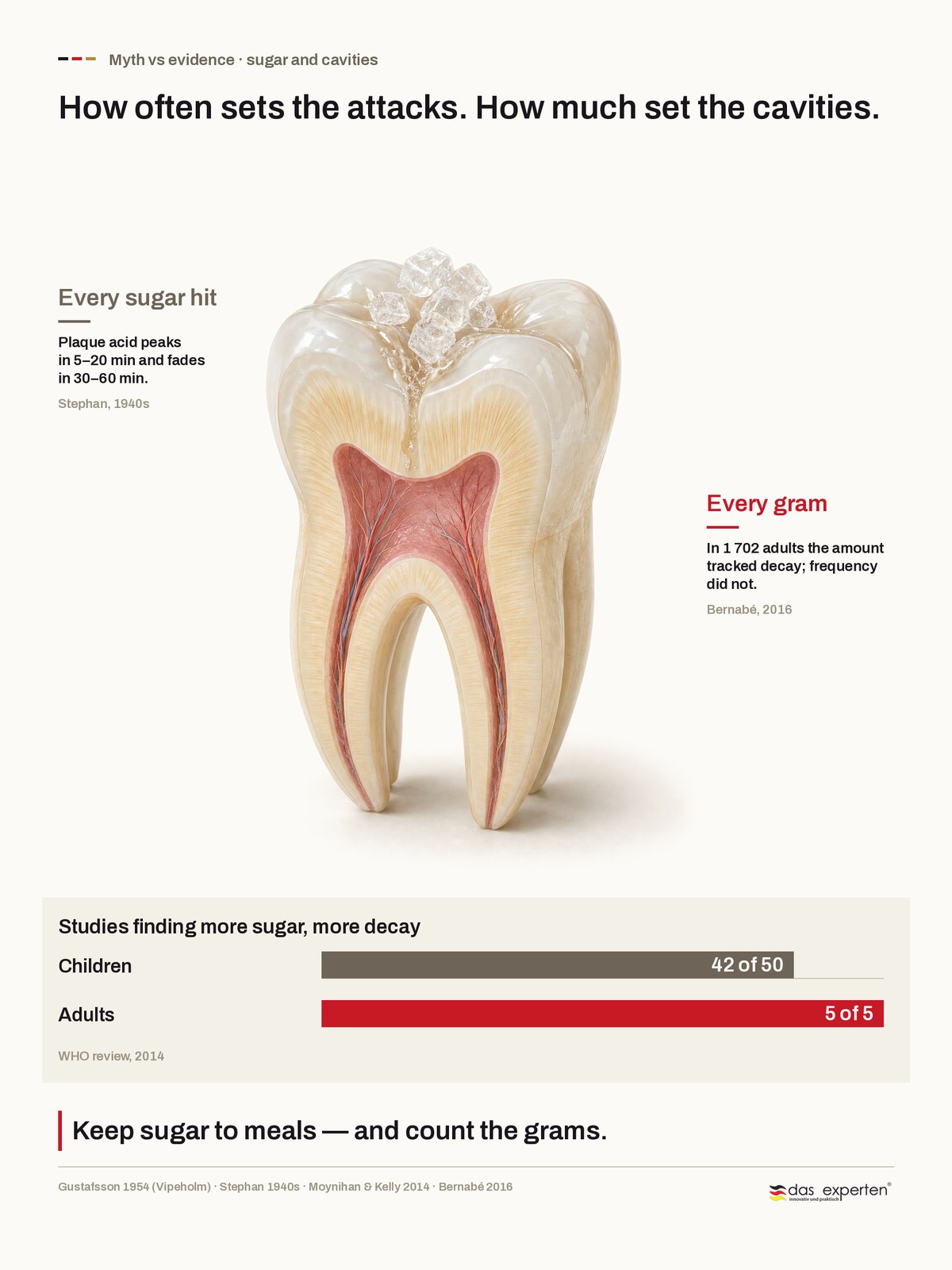
So does sugar cause cavities by the dose or by the clock? The short answer first. How often you eat sugar decides how many acid attacks your teeth sit through in a day. How much you eat decided, in the longest adult study we have, how many cavities people actually had: among 1 702 Finnish adults, the amount of sugar tracked decay and the frequency did not. Both clocks run. Only one of them is the one you were told you could ignore.
The experiment behind the rule could never be run today
Between 1945 and 1953, at the Vipeholm Hospital near Lund in Sweden, researchers followed 436 residents for five years and changed one thing: sugar. Some groups got extra sugar with meals, dissolved in drinks or baked into bread. Others got it between meals as toffee — eight or twenty-four pieces, made to cling to the teeth. The residents were people with intellectual disabilities, and nobody asked for their consent.
Decay rose most in the groups eating sticky sugar between meals, and the rise stopped when the diet went back to normal. Sugar taken with meals moved the numbers far less. The paper published in 1954 became the rule you know: sugar does the most harm between meals, in a form that clings. The chemistry agreed. In the 1940s Robert Stephan measured the acidity of dental plaque after a sugar rinse: it fell to its lowest point within about 5–20 minutes and took 30–60 minutes to climb back. Every snack buys a new dip.
What the rule quietly assumed
It assumed you can pull the two clocks apart. At Vipeholm you could: the kitchen set the grams, the ward set the timetable. In a real life you cannot. People who snack often usually eat more sugar in total, and people who eat more sugar usually snack more. Tell someone that only frequency matters and you have told them, by omission, that the total is free.
In 2014 a systematic review done for the World Health Organization went through 55 eligible studies of sugar amount and caries. 42 of 50 studies in children and 5 of 5 in adults found at least one positive link: more sugar, more decay. Evidence that decay is lower when free sugars stay under 10% of daily energy was rated moderate; a 5% cut-off showed a relationship, on very low-quality evidence.
Then came the test the rule had never faced. Researchers in London and Finland followed 1 702 adults through national surveys in 2000, 2004/05 and 2011, with sugar intake measured by a validated food-frequency questionnaire. When amount and frequency went into the same model, the amount was significantly linked to decayed, missing and filled teeth across the whole follow-up. The frequency was not. Forty-three curved models were tried; none fitted better than a straight line — no safe plateau, only a slope.
Both clocks are real, and they bill you differently
None of this makes Stephan wrong. Each sugar hit still costs your enamel one acid dip; that is chemistry. What the Finnish data says is that, across years, the total dose is what shows up in the mouth. Frequency sets the number of attacks in a day. Amount sets the bill for a decade. And Vipeholm itself showed how wide the spread between people is: some residents developed many new lesions on diets that barely touched others. Your mouth may be more or less forgiving than average, and no label will tell you which.
You may be the person who never snacks and still takes two sweetened coffees and a juice with lunch, sure you are on the safe side of the rule. On the clock, you are. On the scale, you are not.
What you control this afternoon
The useful rule has two lines, not one. Keep sugar to mealtimes, because each extra occasion is another half-hour of acid. And count the grams, because they add up whether you eat them in one sitting or in twelve. A tin of biscuits within reach of the keyboard makes you pay on both clocks at once.
The same honesty applies to the tube. Our SYMBIOS and EVOLUTION kids pastes list xylitol, a sweetener that S. mutans, the main caries bacterium, cannot ferment. Both are fluoride-free, so the Finnish finding that daily fluoride toothpaste weakened the sugar–decay link is not ours to borrow. And no paste, ours included, cancels the grams you ate.
The rule told you to watch the clock. The evidence says watch the clock and the scale — and the one you were told to ignore is the one your teeth have been counting.