





Recaldent (CPP-ACP) in Toothpaste: A Real Mineral Helper — and a Number That Shrinks on the Way to Your Child’s Mouth

You have done this. You stand in a pharmacy aisle with a child’s toothpaste in one hand, turn it over, and look for the one word that tells you it actually does something. On more and more tubes that word is Recaldent, or its chemical name, CPP-ACP — and next to it, sometimes, a percentage: how much of an early lesion it “repairs”. The percentage is real. Someone measured it. The question nobody on the shelf answers is where.
That is the whole of this article. Not whether the molecule works — it does, and a trial of 2 720 teenagers found 18% lower odds of decay getting worse — but where it was standing when it worked. Because the number changes every time the test moves one step closer to a real child’s mouth, and it only ever moves in one direction.
What is Recaldent (CPP-ACP)? A milk protein that holds calcium in place
CPP-ACP stands for casein phosphopeptide–amorphous calcium phosphate. Casein is the main protein of milk. Broken into fragments — phosphopeptides — it grips calcium and phosphate and keeps them dissolved in a form that would otherwise fall out of solution as useless chalk. Recaldent is the trade name of that complex, developed by a research group at the University of Melbourne led by the biochemist Eric Reynolds. The idea is elegant: park a reservoir of the two minerals enamel is built from right at the tooth surface, so that when acid pulls mineral out, there is something close by to put back.
Step one: the dish, where CPP-ACP looks almost like a cure
In 1997 Reynolds placed human wisdom-tooth enamel with early, subsurface lesions into CPP-stabilised calcium phosphate solutions for ten days. The 1.0% solution replaced 63.9% of the mineral the lesions had lost. In a dish, with nothing else going on, that is a spectacular number — and it is precisely the kind of number that ends up printed on a box.
Step two: chewing gum in 2 720 teenagers — real, and much smaller
Then the molecule went into mouths. In a trial published in 2008, 2 720 teenagers from 29 schools chewed sugar-free gum three times a day, ten minutes each time, for 24 months. Half the gum carried 54 mg of CPP-ACP; the other half was identical without it. On X-rays of the surfaces between the teeth, the odds of decay getting worse were 18% lower in the CPP-ACP group. That is a genuine effect, in a large trial, in real children. It is also a different kind of number from 63.9% — not mineral restored, but the odds of a lesion progressing — and it came from gum held against the teeth for half an hour a day, not from a paste. One more fact belongs in the same sentence: the inventor was one of its authors.
Step three: toothpaste in 103 toddlers — no difference
In Thailand, 103 children aged two and a half to three and a half, all at high risk of decay and all brushing with fluoride toothpaste, had a 10% CPP-ACP paste applied every school day after lunch — or a placebo — for a year. Lesions improved in both groups. Between the groups there was no difference: the odds of a lesion stopping or reversing came out at 1.03 to one, a coin toss. In 2018 an American Dental Association expert panel reviewed the trials and issued a conditional recommendation, on low-certainty evidence, against using 10% CPP-ACP to arrest early lesions where fluoride, sealants or resin infiltration are available — and added that it should not be used as a substitute for fluoride.
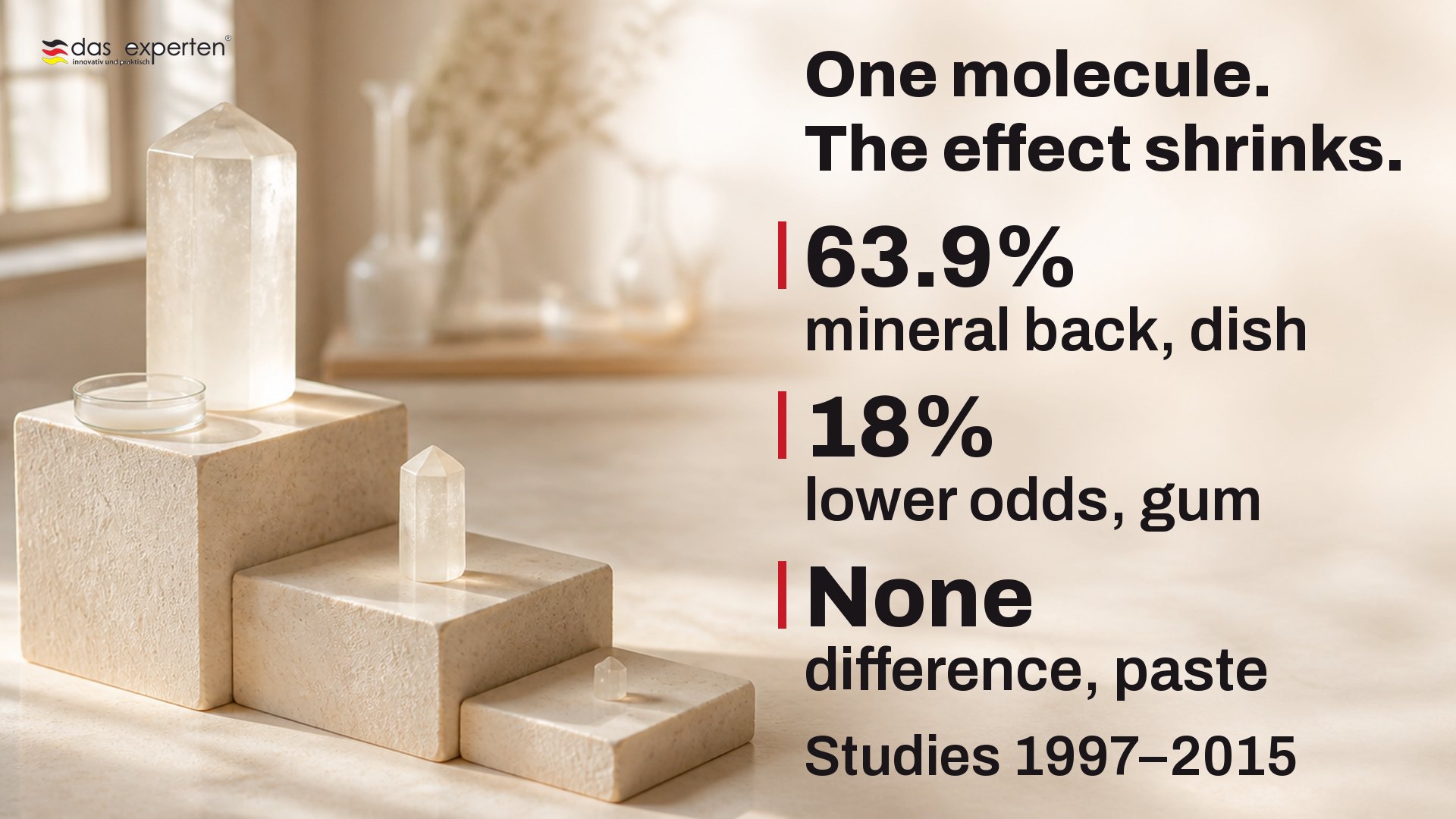
Notice the shape of it. The closer the test gets to how you and your child actually use a product — a paste, two minutes, spat out, on top of everything else you already do — the smaller the number becomes. A dish has no saliva, no spitting and no fluoride competing for the same job. Gum stays in the mouth for ten minutes. A paste leaves with the rinse. A 2014 review of the long-term trials said it plainly: CPP-ACP beats placebo, is not significantly different from fluoride, and whether it adds anything on top of fluoride is still unclear. The fragile part is not the molecule. It is the leap from the first step to the label.
CPP-ACP toothpaste for kids: three questions before you buy
Right now you are making a choice about your child’s teeth on the strength of one word on a box, whether or not you think of it that way. Three questions make it an informed one. Which step does the number come from — dish, gum or paste? Is CPP-ACP there instead of fluoride, or as well as it? The panels that weighed the evidence treat it as an addition, never a replacement, so if your child’s dentist prescribes fluoride, that decision stays with the dentist. And is anyone in the house allergic to milk protein? CPP-ACP is made from casein, so a milk-protein allergy rules it out entirely.
Our EVOLUTION kids toothpaste lists CPP-ACP (Recaldent) together with Bacillus coagulans and xylitol, is fluoride-free and SLS-free by its listed formula, and contains milk protein. You will not find a remineralisation percentage for it here. Every such figure in existence comes from the dish or from gum, not from this paste, and we will not borrow a number from a step it was never measured on.
Tonight, turn the tube over and ask the one question the label does not answer: where was this number measured?
CPP-ACP is neither a myth nor a miracle. It is a real molecule whose effect shrinks at every step from the lab to your child’s mouth — so judge it by the last step, not the first.