


Tooth Enamel in Numbers: Hard as a Knife, 2.5 mm Thick, and It Never Grows Back
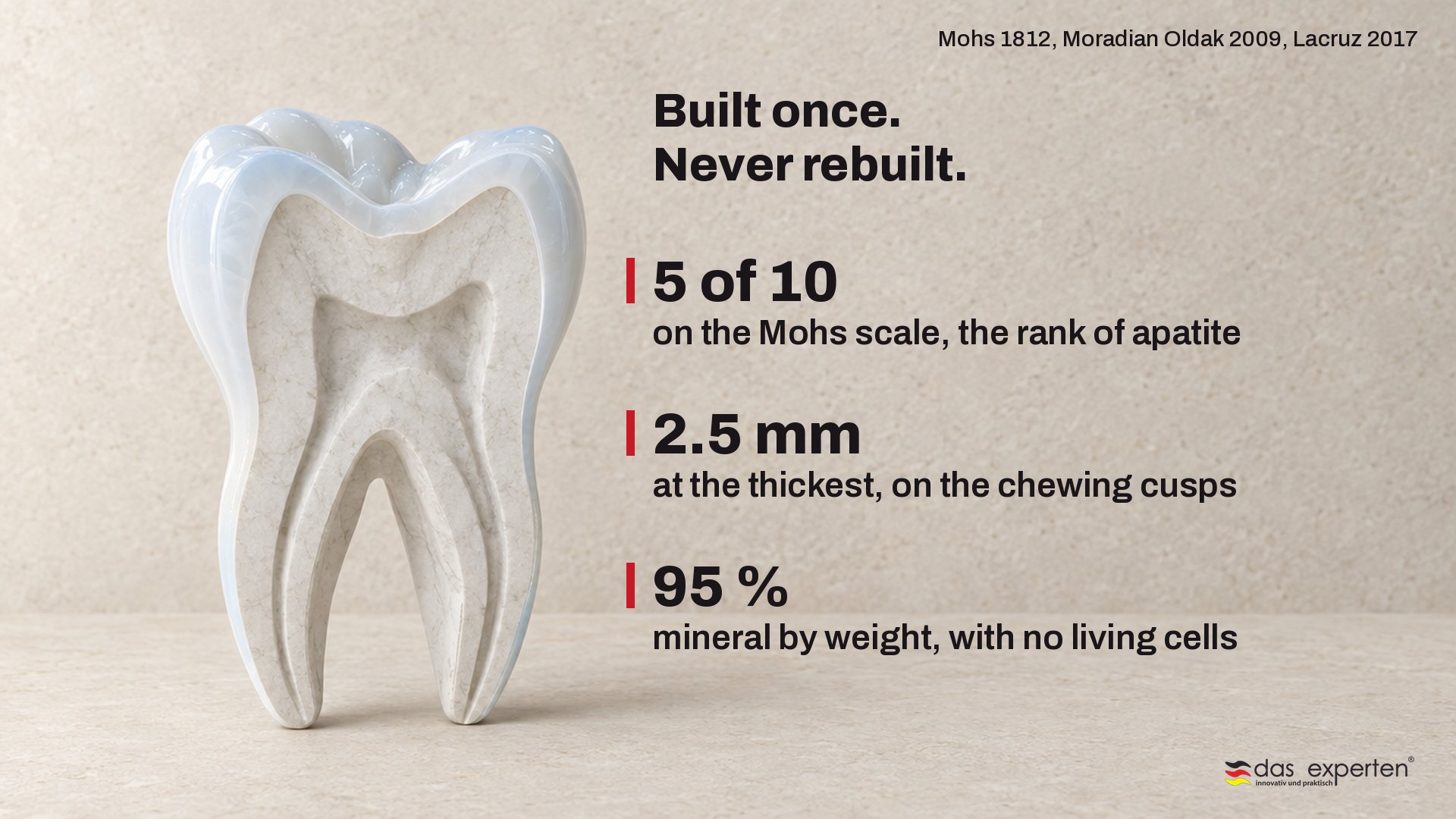
In 1812 a German mineralogist named Friedrich Mohs needed a simple way to tell one stone from another in the field. He picked ten minerals and ranked them by a single test: which one scratches which. Talc sits at 1, diamond at 10. At number 5 he put apatite, a mineral of calcium and phosphate. He was ranking rocks. Without knowing it, he had also given a rank to the hardest thing the human body makes. Tooth enamel is built from apatite crystals, and on his scale it sits at 5.
Here is the layer you smile with, in numbers: how hard it is, how thick, what it is made of, and the one number that matters most of all, which is zero.
How hard is tooth enamel?
On the Mohs scale enamel shares rank 5 with apatite, its own mineral. For comparison, the same geology reference puts a fingernail at 2 to 2.5 and a knife blade at 5 to 6.5. The surface of your teeth sits in the same band as kitchen steel. The layer underneath, dentin, is softer: of the three mineralised tissues in a tooth, enamel is the hardest.
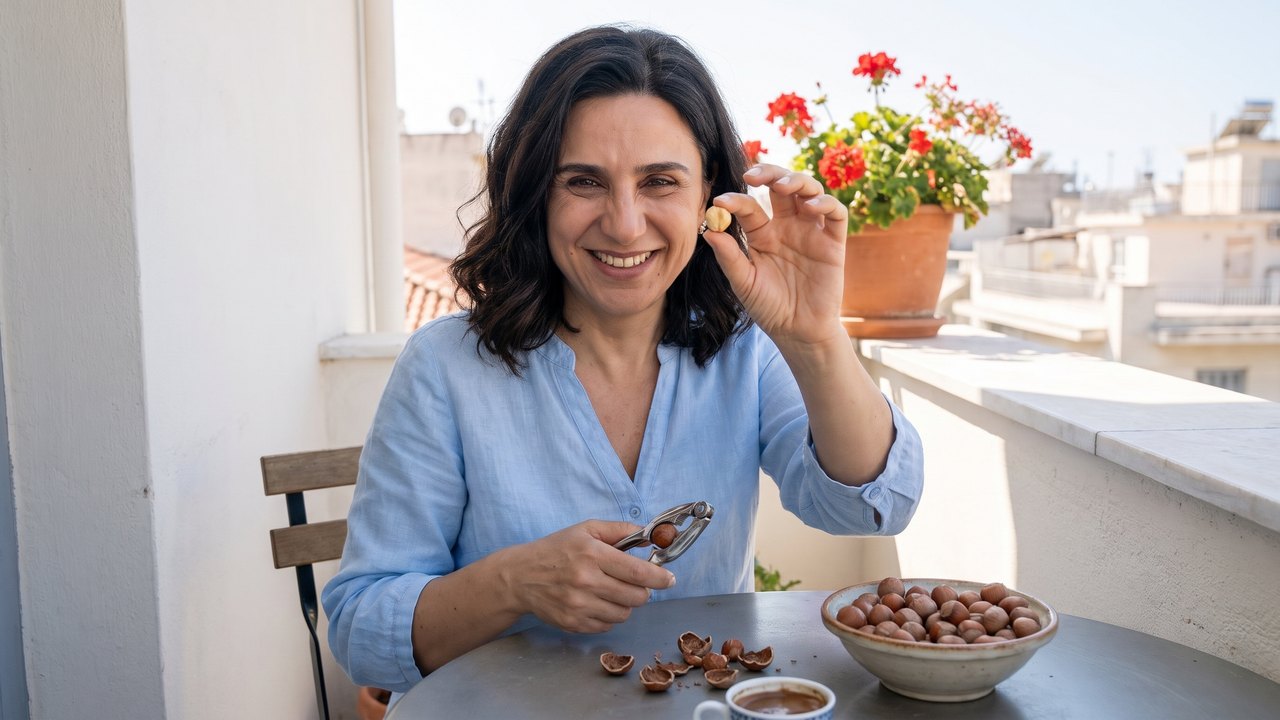
Hard is not the same as unbreakable. Mohs measured scratching, not blows, and a hard material can still chip under a sharp knock. A 2009 review on enamel regeneration calls enamel a natural bioceramic, hard yet resistant to fracture and wear, and credits that balance to the way it is built. Cracking nuts, bottle caps or ice with your teeth tests exactly the property the scale never measured.
How thick is tooth enamel?
At its thickest, on the chewing cusps of the back teeth, enamel is about 2.5 mm. Under a microscope it is woven from rods only 3 to 5 micrometres across, and each rod is most likely the work of a single cell, an ameloblast.
Those cells build slowly. Growth lines in enamel show that ameloblasts lay down nearly 4 micrometres a day, with a coarser line every 5 to 10 days. At that pace, 2.5 mm takes about 625 days of steady work. That is our own arithmetic, not a measurement, but it gives the scale: the thickest enamel on your molars took well over a year to lay down, and all of it was made before the tooth came through the gum.
What is tooth enamel made of?
By weight, mature enamel is about 95 % mineral, 1 to 2 % organic material and 2 to 4 % water, according to a 2017 review in Physiological Reviews. It does not start that way. While it forms, the matrix is about 70 % water and protein and only 30 % mineral; the cells then break down almost all of that protein and let crystals fill the space it leaves. Bone keeps living cells and collagen inside it. Enamel keeps neither.
Will tooth enamel grow back?
This is the number that matters: 0. When the enamel is finished, the cells that built it stop working and are lost. The 2017 review puts it plainly: enamel contains no collagen and, once formed, has no cells, so it cannot remodel. A broken bone knits. A chipped or worn enamel surface does not rebuild itself.
There is one nuance worth knowing. Saliva carries calcium and phosphate, and at a very early stage, when acid has only softened the surface into a chalky white spot, minerals can move back in. A 2003 paper in the Journal of the Canadian Dental Association explains why that early repair is possible while enamel already dissolved away by acid cannot be restored. It adds that there is no single fixed critical pH: the point at which enamel starts to dissolve depends on how much calcium and phosphate surround it.
The acid in your glass
Which brings the numbers to your fridge. In a study published in 2016, American researchers measured the pH of 379 drinks bought in ordinary shops. 93 % had a pH below 4.0, the zone the authors class as erosive, and 39 % were below 3.0, which they call extremely erosive. Only 7 % were minimally erosive.
What the numbers mean for you
The enamel you have now is all the enamel you will ever have. It was laid down once, a few micrometres a day, before your teeth appeared, and no cell is left to add to it. So the sensible habits are the quiet ones: keep acidic drinks to mealtimes instead of sipping them all afternoon, give shells to a nutcracker rather than your molars, and keep the surface clean twice a day, so that small softened spots get the chance to harden again.
Mohs ranked it 5 out of 10. Nature gave it one chance. Treat it like the only one you have.