


Is Fluoride Bad for Your Brain? Three New Studies on Fluoride in Water
You fill a glass at the kitchen tap without thinking about it. In many countries that water carries a little fluoride, added on purpose to protect teeth, and in the last two years the question of whether it is bad for you has moved from dentists' journals to dinner tables. In August 2024 the US National Toxicology Program concluded, with moderate confidence, that fluoride exposure above 1.5 milligrams per litre is associated with lower IQ in children. That is more than twice the 0.7 milligrams per litre used in US tap water, but the word IQ stuck. Then, between 28 October and 4 November 2026, three new studies landed. Here is what each one found, and what none of them can tell you.
Study 1: 2 495 Irish adults and a lifetime of tap water
Ireland has fluoridated public water under a law passed in 1960, which makes it a natural experiment: some people drank it all their lives, others grew up on private wells. On 4 November the Journal of Dental Research published work by Sharma, O'Connell, Zgaga, Winning and colleagues from Trinity College Dublin and University College Cork. They used the Irish Longitudinal Study on Ageing (TILDA) and matched each person's address history to national water monitoring records, back to the first five years of life.
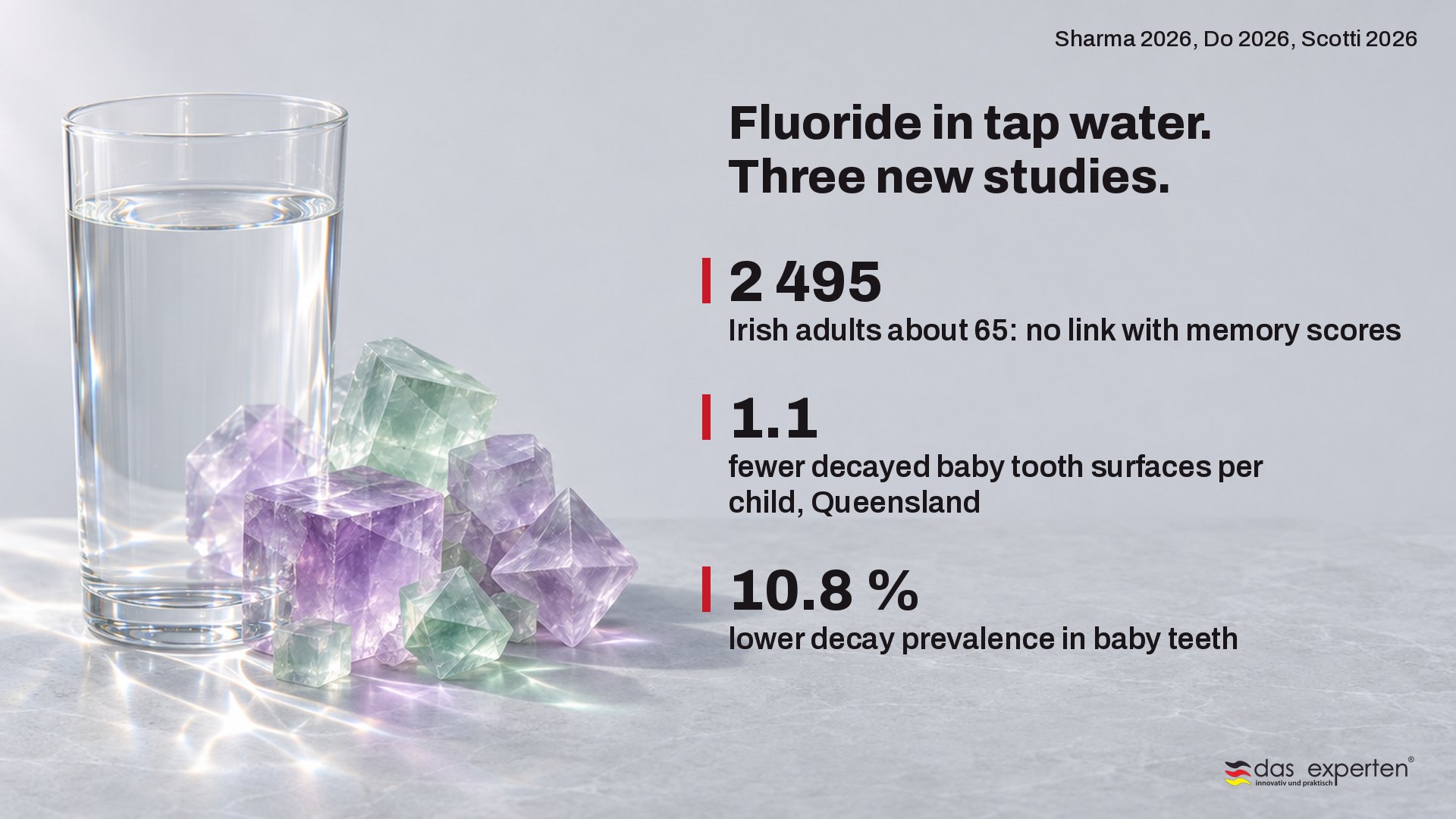
For 2 495 adults with a mean age of 65, they compared lifetime exposure with two standard memory and thinking tests, the MMSE and the MoCA. The result was flat. Each extra year of fluoridated water changed the error rate by a factor of 1.00, with a confidence interval of 0.99 to 1.01. In the raw numbers, people who had spent more than 75 % of their lives on fluoridated water actually made fewer errors, but that advantage disappeared once age, education, income, health and loneliness were taken into account. Exposure in early childhood did not change the picture either.
The honest limit: this is an observational snapshot of older adults, not a study of children's developing brains, which is where the IQ worry lives. It shows no harm at Irish tap water levels in this group. It cannot prove the absence of every possible effect.
Study 2: Queensland, where the taps changed after 2008
On 28 October the same journal published a study from the University of Queensland led by Loc Do, with colleagues in Adelaide, Otago and Cork. Queensland started fluoridating many water supplies after a 2008 policy change, so some towns switched on while others never did. The team examined randomly selected children aged 5 to 14 twice: 5 407 children in 2010 to 2012 and 7 718 in 2022 to 2024, using a difference in differences design built to separate the effect of the water from everything else that changed over twelve years.
In baby teeth, children in newly fluoridated areas ended up with 1.1 fewer decayed, missing or filled tooth surfaces and a decay prevalence 10.8 % lower than children in areas that never fluoridated. In permanent teeth the gains were smaller and the statistics could not rule out zero. The authors' own conclusion is careful: fluoridation still works in children, even where decay is already low and other prevention exists.
Study 3: the lab result that will travel fastest
On 31 October the journal Chemosphere published a laboratory study from Brazil (Scotti, Picada and colleagues, Lutheran University of Brazil). They tested fluorosilicic acid, the compound many utilities use to add fluoride to water, on V79 cells (hamster lung cells grown in a dish) and on tiny nematode worms. The cells did not die quickly, but they divided less and showed chromosome damage. The acid did not cause gene mutations in the standard bacterial Ames test. The worms survived less at the highest concentrations and developed more slowly.
Read that carefully before it reaches your feed. A hamster cell in a dish and a worm one millimetre long are not a person drinking a glass of water, and the authors themselves call for further studies to judge whether this matters for real fluoridation.
What the three studies say together
Put side by side, the picture is lopsided in a useful way. The two studies in people, one about memory in older adults and one about children's teeth, point the same direction: no sign of harm to thinking at normal tap water levels, and a measurable benefit for baby teeth. The study that raises a flag is the one furthest from a human body. That does not make it worthless. It makes it the first step of a question, not the answer. The real open question remains high exposure in pregnancy and early childhood, which is exactly where the 2024 review drew its line at 1.5 milligrams per litre.
What to do with this today
If your tap water is fluoridated at the usual level, these studies give you no new reason to avoid it. If you use a well, check its fluoride level once: natural groundwater in some regions far exceeds safe limits. For small children, use a rice grain smear of toothpaste under three and a pea sized amount after that, and teach them to spit, not swallow. Whether you choose a toothpaste with fluoride or without it, the bigger levers are the same: brush twice a day, cut down how often you snack on sugar, and see a dentist.
The scariest fluoride headline this month was written about worms. The two studies in people are the ones that should decide what you pour into your glass.