


Aspirin for Toothache: A Tablet on the Tooth Burns the Gum and Leaves the Pain

It is two in the morning and a back tooth is throbbing. You find an aspirin, and an old piece of advice comes back: put it right on the tooth, so the medicine goes straight to the pain. It sounds logical. It is wrong in a way your gum will remember. A tablet resting on a tooth does almost nothing for the ache, and it can leave a white, raw patch of burned tissue that hurts for days after the tooth is fixed. The Academy of General Dentistry lists this exact habit as a myth, and dentists have been writing up the burns it causes for half a century.
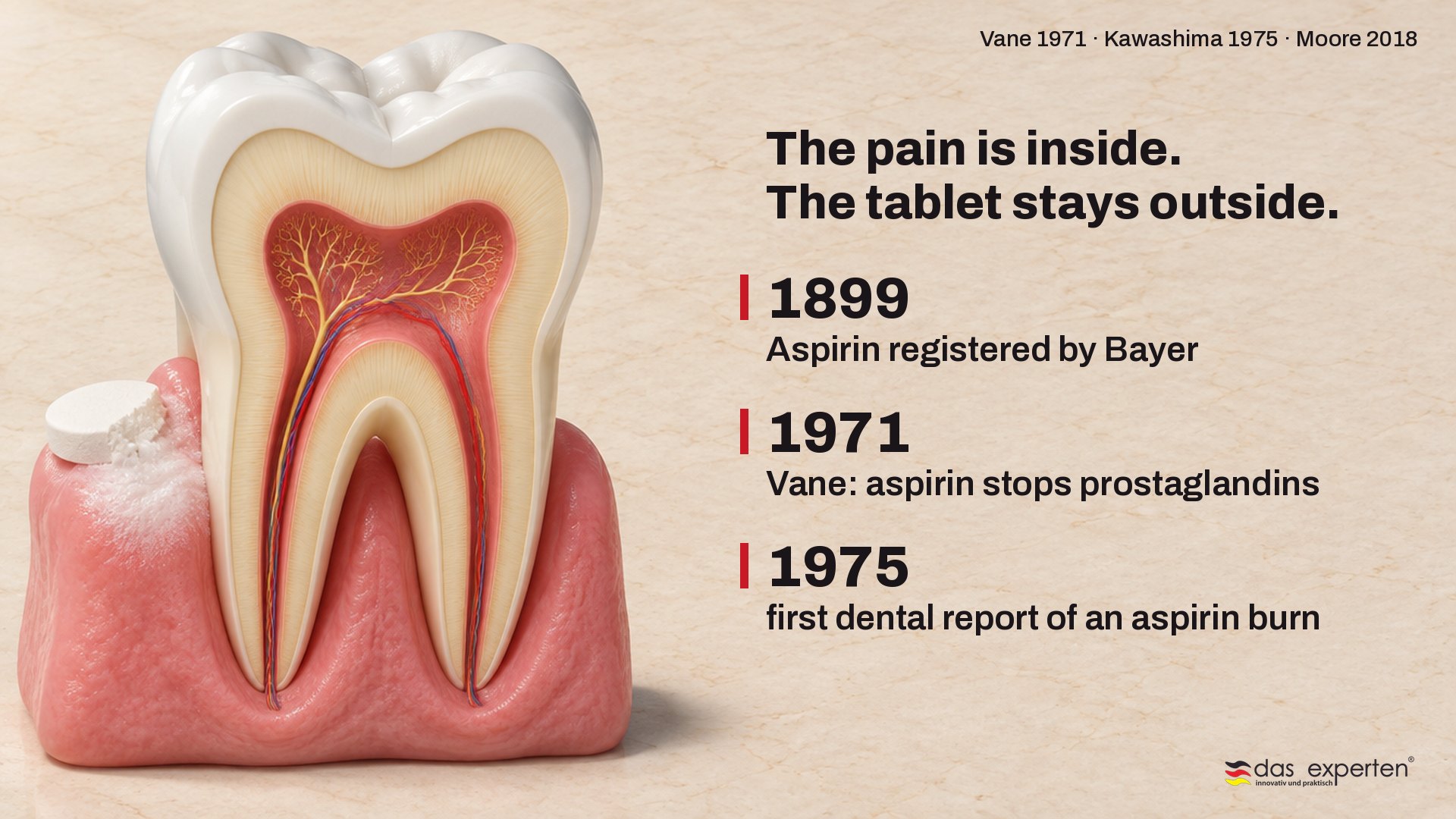
To see why, follow the tablet. Aspirin is acetylsalicylic acid, made in the laboratories of Bayer in 1897 and registered as a trademark on 6 March 1899. For more than seventy years people took it without knowing how it worked. Then in 1971 the British pharmacologist John Vane showed that aspirin stops the body from making prostaglandins, the messengers that switch on pain and swelling where tissue is inflamed. That discovery won a Nobel Prize in 1982, and it holds the whole answer to the myth.
Where a toothache actually lives
A toothache is not on the surface of the tooth. It comes from the pulp, the soft core of nerves and blood vessels sealed inside the tooth under enamel and dentine, or from the tissue around the root deep in the jaw. That is where the prostaglandins are being made. Enamel is the hardest substance in your body, and it is built to keep things out. A tablet sitting on the outside cannot soak through it to reach the nerve.
Aspirin reaches the pulp the same way it reaches a headache: you swallow it, it is absorbed in the stomach and gut, and the blood carries it into every tissue, including the small artery that enters each tooth through the tip of its root. The Academy of General Dentistry put it plainly in 2015: aspirin blocks pain after it is ingested. Pressed against the gum, only a small amount of the drug enters the blood, too little to calm the nerve.
What the tablet does to your gum
What the tablet does do is sit on wet tissue as an acid. As it dissolves against the gum or the inside of the cheek, it damages the thin lining of the mouth, and the surface turns white and wrinkled, then peels to leave a raw sore. Dentists call it an aspirin burn. In 1975 the Journal of the American Dental Association published a case of an aspirin lesion of the mouth that cleared once the patient stopped using the drug. In 1989 the same journal described a girl of 4 who fell asleep with five chewable aspirin tablets still in her cheek and woke with a mucosal burn. Similar cases followed in 1998 and 2023; in the last one an older woman who habitually chewed a painkiller containing aspirin saw the lining of her mouth begin to shed.
So the trade is lopsided. On one side, almost no extra relief for the tooth. On the other, a second wound in the mouth, right next to the first problem, which makes eating and brushing harder while you wait for the dentist.
What actually helps
Pain relief for a tooth works from the inside, so it has to be swallowed. In 2018 an overview of systematic reviews in the Journal of the American Dental Association compared painkillers for acute dental pain. The best balance of benefit and harm came from painkillers that calm inflammation, such as ibuprofen, alone or together with paracetamol (acetaminophen). Take any of them by mouth, with water, at the dose on the label, and check with a pharmacist if you take other medicines. In the United Kingdom aspirin is not given to children under 16 unless a doctor prescribes it, because of the risk of Reye syndrome, so it is not the answer for a child with a toothache.
Then treat the painkiller as a bridge, not a cure. It turns down the signal, but the cause, a cavity reaching the nerve, a crack or an infection at the root, keeps going. Book a dentist. Go urgently if your face or jaw swells, if you have a fever, or if the pain keeps you awake despite tablets.
If you already tried the tablet trick, stop it, rinse with plain water and leave the white patch alone; the burns described in the journals cleared once the contact stopped. Until it heals, brush around it gently. A very soft brush helps here: our SENSITIV has ultra soft DuPont Tynex bristles. For more on bristles, read soft or medium toothbrush.
Aspirin fights tooth pain only from the inside: swallow it, never park it on the gum, and let the dentist find what is hurting.