





Soft or Medium Toothbrush: The Word on the Packet Is Not a Measurement
The question arrives in our review queue more often than any other, and it always arrives in the same shape. Someone has bought a brush, used it for a week, and writes to ask whether it is the right one. Too soft, they suspect. Or too hard. They would like to be told which word to buy next time.
It is a fair question and it has an unfair premise. The word on the packet is not a measurement of the thing you are worried about. It is a statement about one property of one object on one day — the day it left the factory. Three other things decide how your gums look in ten years, and none of them is printed anywhere on the box.
The trade is real, and somebody did measure it
Start with the part that is honest. In 2010 a randomised trial at Heinrich Heine University put 120 adults into three groups of forty and gave them manual brushes identical in every respect but stiffness — hard, medium, soft — for eight weeks of ordinary twice-daily brushing. The hard brushes won on plaque. Both plaque indices came back lower at eight weeks, one at p < 0,05 and the other at p < 0,001. The same hard brushes also produced more gingival lesions at p < 0,01 and higher bleeding scores at four weeks and again at eight, both at p < 0,001.
So the folklore is not wrong. Harder does clean better. It simply also does the other thing, and the study measured both in the same mouths at the same time. A systematic review in 2018 went back through 1 945 papers, kept 13, and reached the same conclusion from the other direction: hard bristles produced more gingival lesions than medium or soft, and soft and extra-soft tend to be the safer choice. Read the small print of that review and you find something more interesting than its conclusion — only 4 of the 13 studies had the damage as the thing they set out to measure. In the rest it was noticed in passing.
That is the first asymmetry, and it is not about teeth. Cleaning is what gets funded, counted and published. Harm is what gets recorded in a side column. You are reading a literature that was built to answer the other question.
Three variables the packet never mentions
The first is your own hand. A Zurich group brushed 80 stained dentine samples with custom soft and medium brushes at 1, 2, 3 and 4 newtons of force. At twenty-five minutes of accumulated brushing the harder push cleaned more. At 2 minutes — the length of time a real person actually brushes — pressing harder bought nothing at all, and soft and medium came out comparable whatever the force. The conclusion is worth reading twice: over a real brushing session, the stiffness you chose and the force you applied both stopped mattering long before the enamel did.
The same group ran the wear side on 160 samples. At 1, 2 and 3 N there was no significant difference in abrasive dentine wear between soft and medium at all. The difference appeared only at 4 N, where the medium brush took away significantly more. Stiffness, in other words, is not a property of the brush. It is a property of the brush multiplied by you, and it only becomes visible when you push hard.
The second variable is geometry, and here the packet is not merely silent — it is misleading. In 2022 twelve groups of dentine samples were brushed across three abrasivity levels with brushes that differed in how their tufts were arranged: crossed, or parallel. Parallel tufts caused significantly more wear than crossed tufts at every abrasivity and every stiffness. And inside the crossed-tuft brushes the soft one caused significantly more wear than the medium. The word you were choosing between turned out to be the weaker lever, and the one that mattered has no name on any packet in any shop.
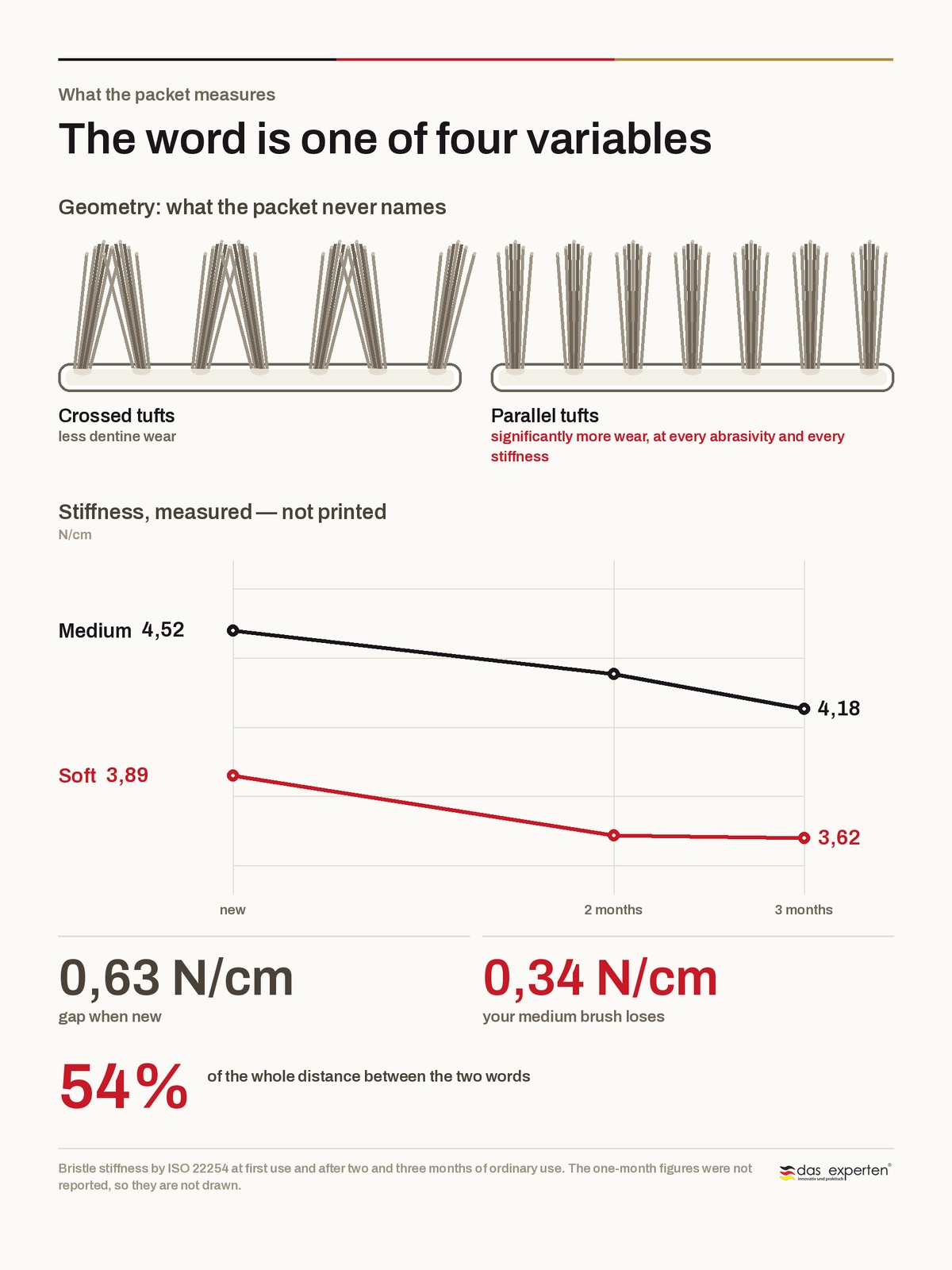
The third variable is time, and it is the one that quietly makes the label obsolete. A randomised trial at Hiroshima University handed soft and medium brushes to 80 students and measured the bristle stiffness by the international method, ISO 22254, at first use and after one, two and three months. New, the soft brushes measured 3,89 N/cm and the medium 4,52. By two months both had fallen significantly. By three the soft sat at 3,62 and the medium at 4,18.
Do the arithmetic yourself, because it is the whole point. On the day you bought them, medium stood 0,63 N/cm away from soft. Three months later your medium brush had lost 0,34 N/cm of its own stiffness — 54% of the entire distance between the two words. It is still labelled medium. It has spent most of the journey to soft, and nothing on the handle changed. A follow-up trial on 34 people found the softening is not even uniform: the top row of tufts loses its bending stiffness measurably after one month, the bottom row only after three.
You have already made this decision, and you probably made it in four seconds, standing in a shop, choosing between two words on two pieces of card. Nobody told you that one of the words expires.
Why the cost is not symmetrical with the benefit
Plaque you missed this morning is still removable tonight. Gum that has receded does not come back, and neither does dentine that has been abraded off the neck of a tooth. A study of 182 adults found that people with a history of hard-brush use had a mean 9,4% of tooth surfaces showing recession against 4,7% for those who had never used one — and among the hard-brush users, recession climbed sharply with how often they brushed, an effect that simply did not exist in the other group. Brushing more was only damaging if you were holding the wrong instrument.
A cross-sectional study of 404 patients and 3 859 teeth found sensitivity in 20,6% of them, and found recession and cervical wear significantly associated with two habits: brushing horizontally, and using a medium-stiffness brush. Not hard. Medium — the grade most adults consider the sensible middle.
This is the shape of the bet. On one side, a small advantage in plaque that a second minute of brushing or one pass between the teeth recovers anyway. On the other, a slow subtraction from a structure that does not regrow, compounding across decades, invisible until the day it is visible. When the downside is permanent and the upside is recoverable, you do not optimise the upside.
What to actually do with this
Buy soft, and treat the word as a starting condition rather than a guarantee. Watch the force instead of the label, because force is the variable you control and the one the trials kept catching. Replace the brush on a schedule rather than when it looks tired — the stiffness measurements had already moved significantly at two months, long before the bristles splayed enough to notice. And if your gums are already receded, or the enamel is thin, or a whitening treatment has just been done, that is where a genuine ultra-soft belongs: our SENSITIV and AKTIV brushes are built on DuPont Tynex® filaments rated 48% softer than standard nylon, with AKTIV's conical filaments tapering to a 0,01 mm tip. INTENSIV answers the same need by density instead of force — 7× the filament count of a standard soft brush, so one stroke covers more.
We sell a hard brush too, and its own specification says who should not buy it: not for recession, not for exposed roots, not for enamel erosion, not for sensitivity. A range that refuses to recommend one of its own products to four kinds of customer is telling you something the packet cannot.
You were never choosing between soft and medium. You were choosing how hard to press, how the tufts are set, and how long you keep it — and the only one of those three the shop lets you see is the one that changes while you own it.