


Baby Teeth: When Do They Fall Out? A Survey of 37,973 Children Puts the Start at Six; and Shows Why a Two Year Spread Is Normal
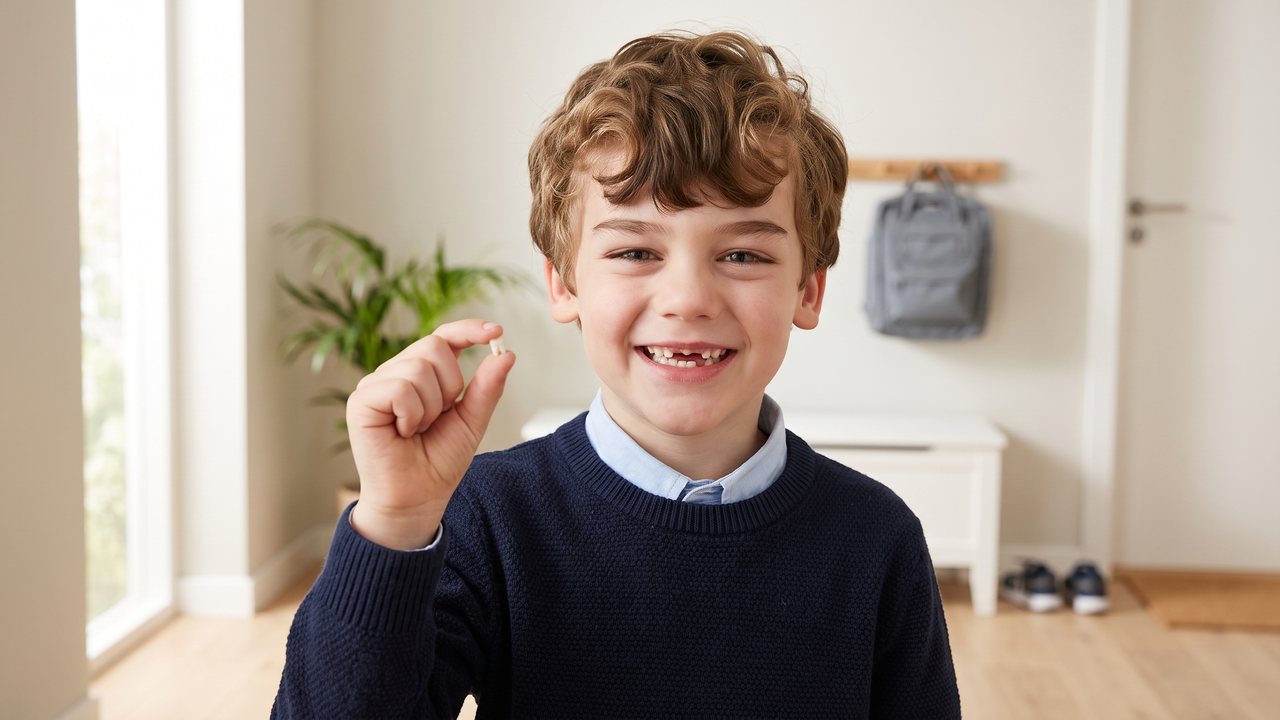
It usually starts at the school gate. Another child grins, and there it is, a gap, front and centre, worn like a medal. That evening you look into your own child’s mouth. Twenty small white teeth, all present, none of them loose. And the question arrives on its own: is mine late?
It is the wrong question, and the numbers show why. Baby teeth do not fall out on a birthday. They fall out across a window, and the window is wider than almost anyone at that school gate would guess. Six is a midpoint, not a deadline.
When do baby teeth fall out? The answer from 37,973 children
In 2015 a team from the Capital Institute of Pediatrics in Beijing examined 37,973 children aged four to seven in nine cities, from Harbin in the cold north to Guangzhou and Kunming in the south. For each child they recorded one thing: had the change from baby teeth to permanent teeth begun, a baby tooth gone, or a permanent one through?
At four to four and a half, almost nobody had started: 0.6 %. Between five and a half and six, 30.3 %. Between six and seven, 74.5 %. The midpoint, the age by which half the children had begun, came out at 6.00 years. That is the honest answer to the question in the title: the tooth change starts, on average, at six.
But look at the edges. The researchers also reported the range that holds 94 of every 100 children, from the 3rd to the 97th percentile: 4.88 to 7.11 years. More than two years separate the early starters from the late ones, and both ends are normal. Girls began slightly earlier than boys, 5.94 against 6.06. City children began earlier than children from the suburbs, 5.94 against 6.05. Children who had started were, on average, a little taller and heavier for their age. And compared with the same survey in 1995, the midpoint had moved earlier by 0.24 years, about three months in twenty years.

Baby teeth falling out: what happens underneath
A child has 20 baby teeth, and the first of them arrive at about six months, according to the American Dental Association. The permanent teeth are already forming in the jaw below them. As each one rises, the root of the baby tooth above it dissolves. That is why a baby tooth that falls out looks so strange, a crown with almost nothing underneath. The root did not break off. It was taken apart from below to make room.
Count it out and the numbers close neatly. Twenty baby teeth go; by about 21, the ADA notes, all 32 permanent teeth have usually arrived. Twenty of them step into places that baby teeth kept warm. The other twelve, the molars at the back, wisdom teeth included, come up in new ground behind the baby teeth, where nothing was ever lost.
The order has a pattern. The lower front teeth usually go first; across studies, the lower teeth change before the upper ones, and girls run slightly ahead of boys. There is also a quiet newcomer. The first permanent molars come through behind the last baby teeth and replace nothing at all. A six year old can begin the tooth change without losing a single tooth, which is exactly why the Beijing team counted the start of the change, not the first lost tooth.
Then the change takes years. In a study of 1,211 children in Syria, those aged five to six had 2.41 permanent teeth on average; those aged twelve to thirteen had 24.48. The second molars came last, at about 11 to 11.7 years. In Finland, children born in 1999 to 2002 started the change earlier than children born in 1976 to 1985 but finished it later, so the mixed stage, half baby teeth, half permanent, lasted longer.
Is my child late? A point against a curve
Here is the trap at the school gate. The child with the gap is one point. Your child is another. Two points tell you almost nothing about a curve that is two years wide. In Kampala, girls’ permanent teeth came through on average 0.8 years before boys’. Nigerian children were earlier than children in the United States and Australia. Sex, place, growth and the decade you were born in all move the clock, none of them makes a child wrong.
What does deserve a dentist’s look is not timing alone but a mismatch: a baby tooth that falls out on its own long before its neighbours, a gap that stays empty for many months, or a permanent tooth coming through while the baby tooth in front of it will not budge. And a baby tooth lost early to decay is a different story from one pushed out on schedule. The second is a handover. The first is a hole in the place the permanent tooth was counting on.
So tonight, when you count the teeth again, count differently. Not “is it six yet?” but “is it inside the window?” Then brush the new tooth that comes through. It is the only one that will grow there.
The average child starts the tooth change at six. Almost no child is the average, and that is exactly what normal looks like.