


Papain in Toothpaste: The Papaya Enzyme That Tenderised Meat in 1750 Now Works on Your Stains
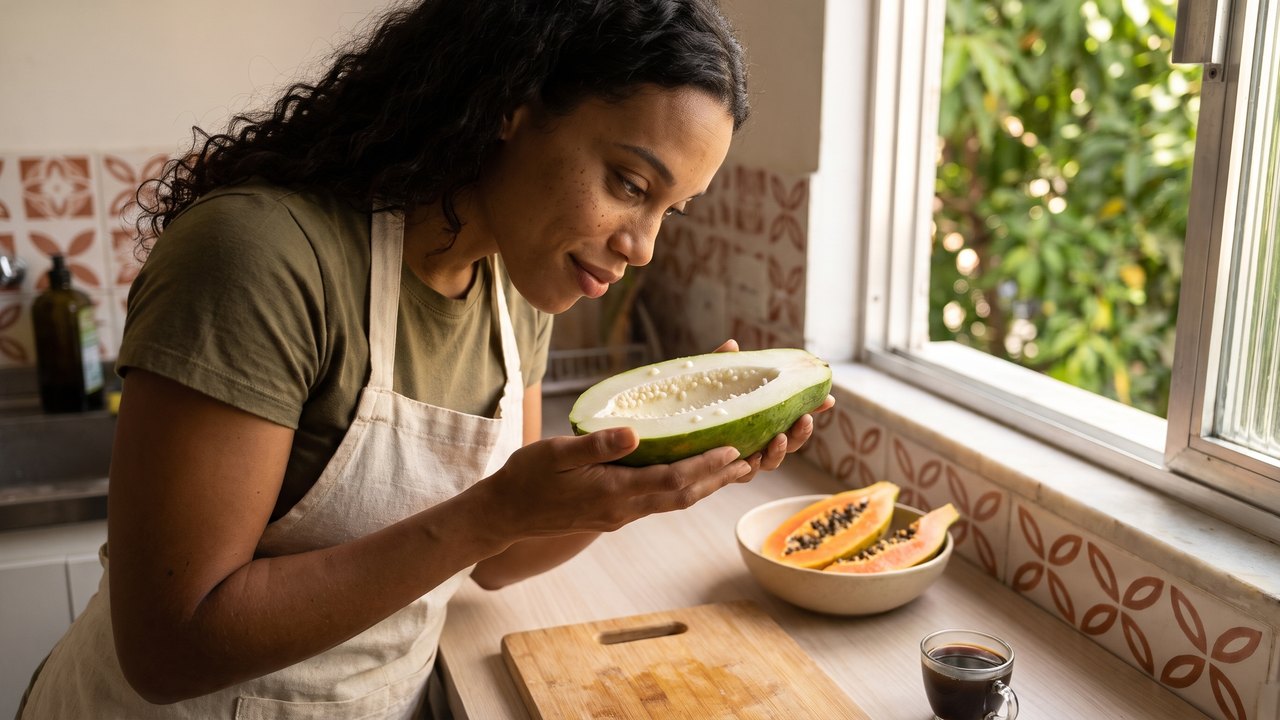
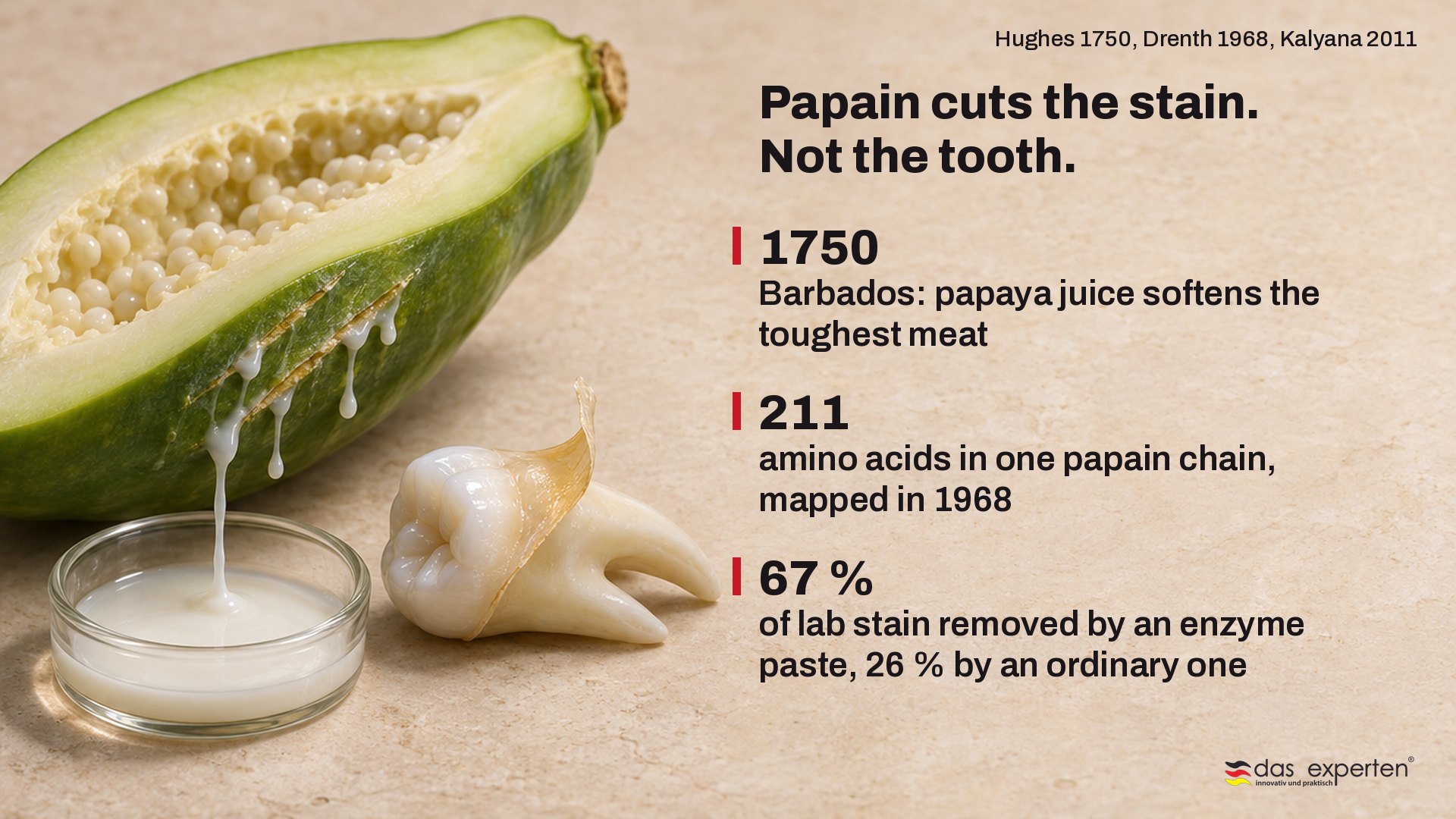
Barbados, 1750. The Reverend Griffith Hughes, rector of the parish of St Lucy, is finishing a book about everything that grows on his island, and he stops at the papaya tree. Cut an unripe fruit and it bleeds a thick white milk. Hughes calls that juice corrosive and writes down a kitchen trick of the island: boil the green fruit, skin and all, with the toughest old meat, and the meat soon turns soft and tender. He did not know why. He only knew that something in a fruit could undo a piece of meat.
That something is now printed on the back of some toothpaste tubes. Its name is papain, and the question this article answers is simple: what is a meat tenderiser doing next to your teeth, and does it actually do anything there?
A pair of scissors made of protein
In 1879 two Paris scientists, the chemist Charles Adolphe Wurtz and the physician Eugène Bouchut, purified the active part of the papaya milk and gave it the name it still carries. Papain is an enzyme: a protein whose whole job is to cut other proteins. It holds a chain of protein still and snips the bonds between its links, one after another, which is exactly what tough meat needs.
In 1968 a team led by Jan Drenth in Groningen saw how it does this. Their X ray study, published in Nature, showed one chain of 211 amino acids folded into two halves with a cleft between them, like a mouth. In that cleft sit the cutting tools: a cysteine at position 25 and a histidine at position 159. A protein slides into the cleft and comes out in pieces. Papain was one of the early enzymes whose shape was seen atom by atom, and chemists still call a whole family of cutting enzymes papain like.
Why a protein cutter belongs on a tooth
Here is the part most people never hear about. Your teeth are never really bare. Within minutes of brushing, proteins from saliva settle on the enamel and form a thin film called the pellicle. It protects the tooth, and it is also where trouble sticks. The coloured molecules in tea, coffee and red wine bind to the proteins of that film, and the film slowly turns from clear to yellow and brown. A stain on a tooth is often not in the enamel at all. It is in the protein coat on top of it.
A normal toothpaste attacks that coat by scrubbing: fine abrasive particles polish it away, and with it a little of whatever is underneath. Papain takes the other road. It cuts the protein that holds the stain, and it leaves the mineral of the enamel alone, because enamel is not protein. Hughes's meat and your morning coffee stain have one thing in common: both are held together by protein bonds, and papain cuts them.
What the studies found
Dentists trusted the idea first in a harder place than stains. In 2003 a research group in Brazil turned papain into a gel called Papacarie, painted on decayed dentin so that the softened tissue could be scooped out by hand instead of drilled. In a trial with 25 children, the gel took slightly longer than the drill, but the children felt less pain and less fear.
For stains, the evidence is real but modest, and it is worth reading carefully. In a laboratory test at Manipal in India, a paste with papain and bromelain, the pineapple enzyme, removed 67 % of the stain from enamel samples, against 26 % for an ordinary paste. In a randomised trial with 90 adults, the stain score with an enzyme paste fell from 37.24 to 30.77 in one month, against a fall from 35.08 to 32.89 with an abrasive whitening paste. In Pelotas, Brazil, experimental papain pastes did not roughen enamel after thousands of brushing cycles, while most commercial whitening pastes did.
And now the limits, because they matter just as much. In that same Pelotas study, none of the pastes made stained enamel whiter than it had been at the start. In a 2024 laboratory comparison, a paste with hydrogen peroxide whitened more than a papain and bromelain paste. Papain is not bleach. It can lift the coloured film from the surface; it does not change the colour of the tooth itself. And papain is a protein, so it can sensitise: in a German study of 33 factory workers who breathed papain dust every day, 17 developed asthma like symptoms. A paste on a brush is not dust in a factory, but if papaya makes you react, read the ingredient list.
What this means for your tube
Tomorrow morning, turn your toothpaste over and look for the word papain. If it is there, you are brushing with a descendant of Hughes's kitchen trick: a protein cutter working on the protein film where coffee and tea leave their colour, without leaning on hard abrasion to do it.
We put it in two of our pastes. TERMO 39° pairs papain with lysozyme and dextranase, with low abrasivity, RDA <50, and no fluoride or SLS. INNOWEISS carries five enzymes, papain and bromelain among them, with an abrasivity of RDA <30. On both, papain does the job the science gives it: it helps clean protein bound stain on the tooth surface while you brush. It will not bleach your teeth, and nothing honest would promise that.
A fruit that softened the toughest meat in Barbados in 1750 now cuts the protein film that holds your coffee stain, gently, and without pretending to be bleach.