





How to Reduce Gum Inflammation: Melaka's Answer Became a Vice
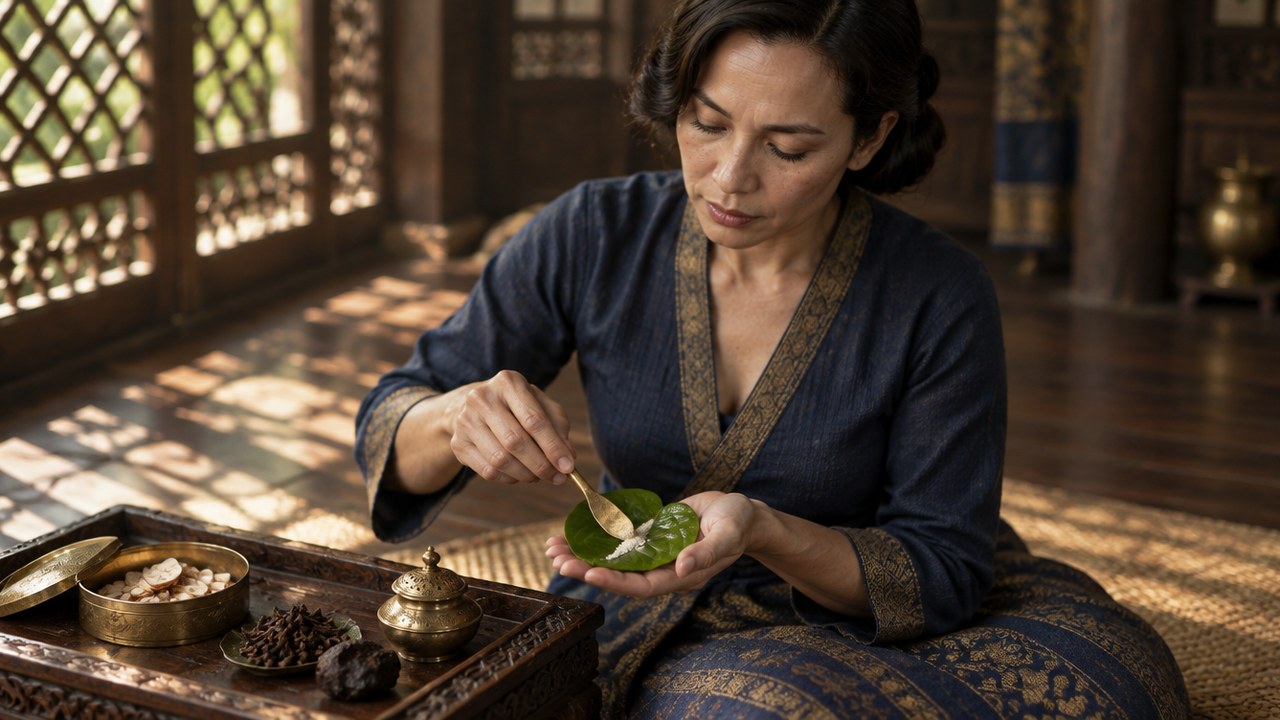
A woman kneels on a mat in Melaka. It is a morning somewhere in the 1440s, and the harbour below the court is already loud — Gujarati, Tamil, Javanese, Hokkien, four monsoons of shipping tied up in one port. She is not listening to any of it. She is holding a leaf.
It is heart-shaped, waxy, dark green, and it smells faintly of pepper, because it is a pepper: Piper betle, a vine trained up a post in the yard. She lays it flat across her palm and drags a thin stroke of slaked lime along it with a brass spatula. Then the additions — a pale sliver of areca, a dark crumb of gambier, and two dried clove buds, carried in from the Moluccas by the ships that made this town rich. She folds the leaf into a tight parcel and puts it in her mouth.
Her gums will sting for a moment. The lime is alkaline, the leaf is sharp. She will keep the parcel in her cheek for the better part of an hour, as she did yesterday and will tomorrow, as everyone in this court does, several times a day, for their whole lives. Nobody has told her she is treating her mouth. She thinks she is being polite.
What the civilised world was doing that morning
Six thousand miles west, at the same hour, a man with an aching jaw is being told he has a worm.
Not as a metaphor. The tooth worm was the working theory of dental disease in Europe, and it stayed the working theory for another three centuries — until Pierre Fauchard went looking for the worms under a lens in the 1720s and reported, to some annoyance, that there were none. In the meantime the treatment for a bad tooth was a barber with pliers, and the treatment for bad gums was, broadly, nothing. Europe had a theory of the mouth and no chemistry. Melaka had no theory at all and a daily dose of phenol.
Nobody in Melaka discovered anything
That is the part worth sitting with. There was no insight, no experiment, no moment. There was protocol. The tepak sirih — the betel set — was the instrument of Malay hospitality and Malay diplomacy, and the court of Melaka codified its use along with the rest of its ceremony under Sultan Muhammad Shah, who reigned from 1424 to 1444. You offered the leaf to a guest before you offered anything else. Refusing it was not a dietary choice; it was an insult with consequences. So everybody chewed, constantly, for reasons that had nothing whatsoever to do with health.
This is why nothing was written down. Knowledge that arrives as etiquette never gets recorded as knowledge, because nobody experiences it as knowledge. A thing you do a thousand times because not doing it is rude does not need a justification, and so it never acquires one. No one in Melaka wrote the leaf reduces gum inflammation, for the same reason no one in London wrote down why washing your hands before dinner was worth the trouble.
The Malay medical manuscripts that did record the leaf recorded it for something else. Manuscript MSS 2219 in the National Library of Malaysia, the Kitab Tib tradition, the royal-physician manuscript of the Pontianak sultanate — sirih appears in all of them, chewed with other ingredients, for sakit gigi: toothache. They wrote down the pain it stopped. They did not write down the inflammation it had been quietly holding down the whole time, because nobody can see that happening.
The long way back
On 24 August 1511, after forty days of fighting, Afonso de Albuquerque took Melaka for Portugal.
The Portuguese wrote the leaf down. So did the Dutch after them, and the British after them, for four hundred years — and what they wrote down, almost without exception, was the red mouth. Betel was a habit. A stain. A vice of the tropics. The chemistry was never the subject, because the chemistry was not visible and the stain was.
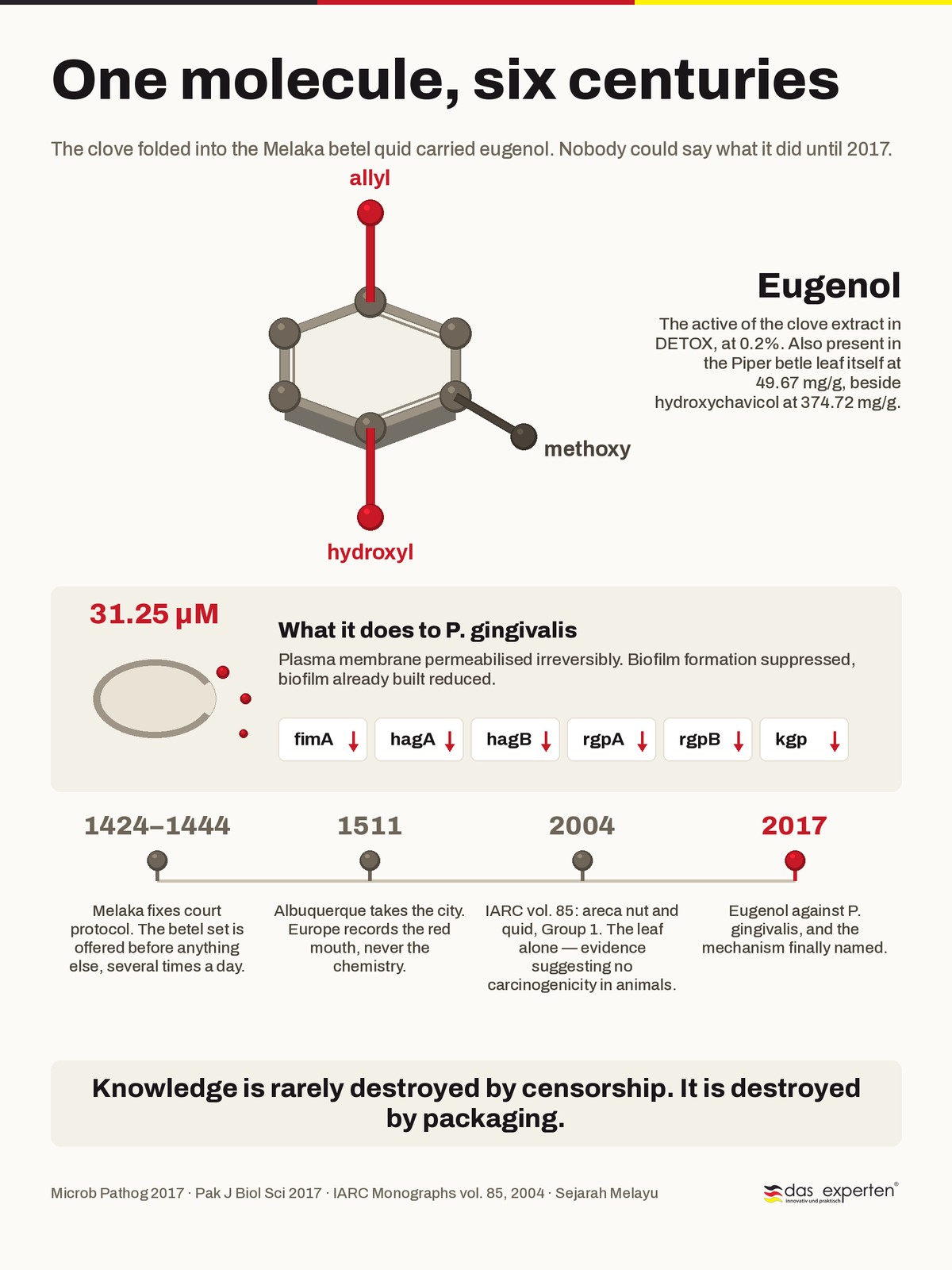
Then the twentieth century made the case worse, and made it correctly. Oral cancer among chewers was real and the epidemiology closed in hard. In 2004 the International Agency for Research on Cancer published Monograph Volume 85 and classified areca nut as carcinogenic to humans, Group 1, and betel quid without tobacco as carcinogenic to humans, Group 1. That verdict was right and it has saved lives, and nothing here argues with it. But read what it names. It names the nut, and it names the bundle. On the leaf by itself the same monograph records something different: evidence suggesting a lack of carcinogenicity in experimental animals. The nut was the problem. The leaf was simply in the room.
What was actually in the leaf
Because the leaf had spent six centuries as the wrapper for something dangerous, it went into the bin with it. That is the whole mechanism of this kind of loss, and it is worth naming plainly: knowledge is rarely destroyed by censorship. It is destroyed by packaging. Then, late and quietly, somebody unwrapped it. A methanolic extract of Piper betle leaf measures out at 374.72 mg/g hydroxychavicol and 49.67 mg/g eugenol — two allylbenzene phenols, the first dominant and the second the one that matters here. (That particular assay was run against fish pathogens, not oral ones; it establishes what is in the leaf, not what it does to a gum.) Separately, hydroxychavicol has been shown to inhibit the biofilms of Streptococcus mutans and Actinomyces viscosus and to block the formation of water-insoluble glucan — the scaffold plaque is built on.
Eugenol is the one that closes the circuit, and it closes it because of those two clove buds. In 2017, work published in Microbial Pathogenesis took eugenol from clove leaf oil and put it against Porphyromonas gingivalis, the organism at the centre of adult gum inflammation. It was active at 31.25 μM. Electron microscopy showed the cells shrinking and lysing; the mechanism was permeabilisation of the plasma membrane, irreversibly. It also suppressed biofilm formation and stripped back biofilm already built, and it did so by down-regulating the virulence genes the organism needs to build one at all — fimA, hagA, hagB, rgpA, rgpB, kgp. The court at Melaka was dosing that organism twice a day, for reasons of manners.
And now the part that is about you. Tomorrow morning you will pick something up and put it in your mouth, and it will be one of two things. It will be a habit you inherited without ever asking what is in it — or it will be a formula where somebody was obliged to name every ingredient and say what each one is for. That is not a question of tradition against science. It is a question of which century is standing on your shelf.
This is the logic behind building a paste on named botanical phenolics instead of on abrasion. The DETOX paste from Das Experten carries Cinnamomum zeylanicum bark extract at 0.8% and Syzygium aromaticum — clove — at 0.2%, which is the eugenol. On its own clinical record the clove fraction suppresses P. gingivalis by 71–74%; the cinnamaldehyde fraction cuts the cytokine markers of gum inflammation, IL-1β, TNF-α and PGE-2, by 87–98%; salivary pH moves from 6.2 to 7.4. It is fluoride-free and SLS-free, and it polishes at RDA below 49. None of which is a folk remedy, and none of which is new.
Melaka never lacked the science. Europe lacked the leaf — and when it finally got one, it kept the stain and threw away the molecule.