





Benefits of Flossing: Never Disproved, Only Never Measured

In August 2016 a reporter did the one thing almost nobody bothers to do. He asked for the evidence. The Associated Press had noticed something odd: the United States government, revising its dietary guidelines, had quietly dropped the line telling Americans to floss. Not softened it. Removed it. So the reporter filed freedom-of-information requests, pulled the trials, and found that the most universally prescribed habit in dentistry rested on studies that the reviewers themselves had described as weak and very unreliable.
The headlines wrote themselves inside a day. Flossing is useless. Your dentist has been lying to you. And a great many people put the little plastic box in the back of a drawer and felt, for the first time in their adult lives, absolved.
Here is what nobody put in a headline. The reviewers had not found that flossing fails. They had found that almost nobody had properly looked. Those are not the same finding. They are not even adjacent, and the distance between them is the distance between knowing a thing is false and knowing nothing at all.
Weak evidence and no effect are different animals
The document underneath the whole affair is a Cochrane review published in 2011 by Dario Sambunjak and colleagues. Twelve trials, 582 people brushing and flossing against 501 brushing alone. On gum inflammation it found a statistically significant benefit at every interval it measured: a standardised mean difference of -0.36 at one month, -0.41 at three months, -0.72 at six. That is not a null result. That is the same direction three times running, and widening as the months pass.
On plaque the same review called its evidence weak and very unreliable, and that is the phrase the wires quoted. On tooth decay it said something stranger and far more important: none of the included trials reported it. Not one had measured whether flossing prevents a cavity. The absence that the newspapers read as a verdict was an empty column in a table.
Eight years later the column is still empty
Cochrane returned to the question in 2019 — Helen Worthington and colleagues, 35 randomised trials, 3 929 adults, every interdental device anyone sells. Flossing again reduced gum inflammation at one month, a standardised mean difference of -0.58 across eight trials and 585 people, graded low-certainty. And again, in the authors' own words: no trials assessed interproximal caries. Thirty-five trials, and not one of them measured the thing the entire habit exists to prevent.
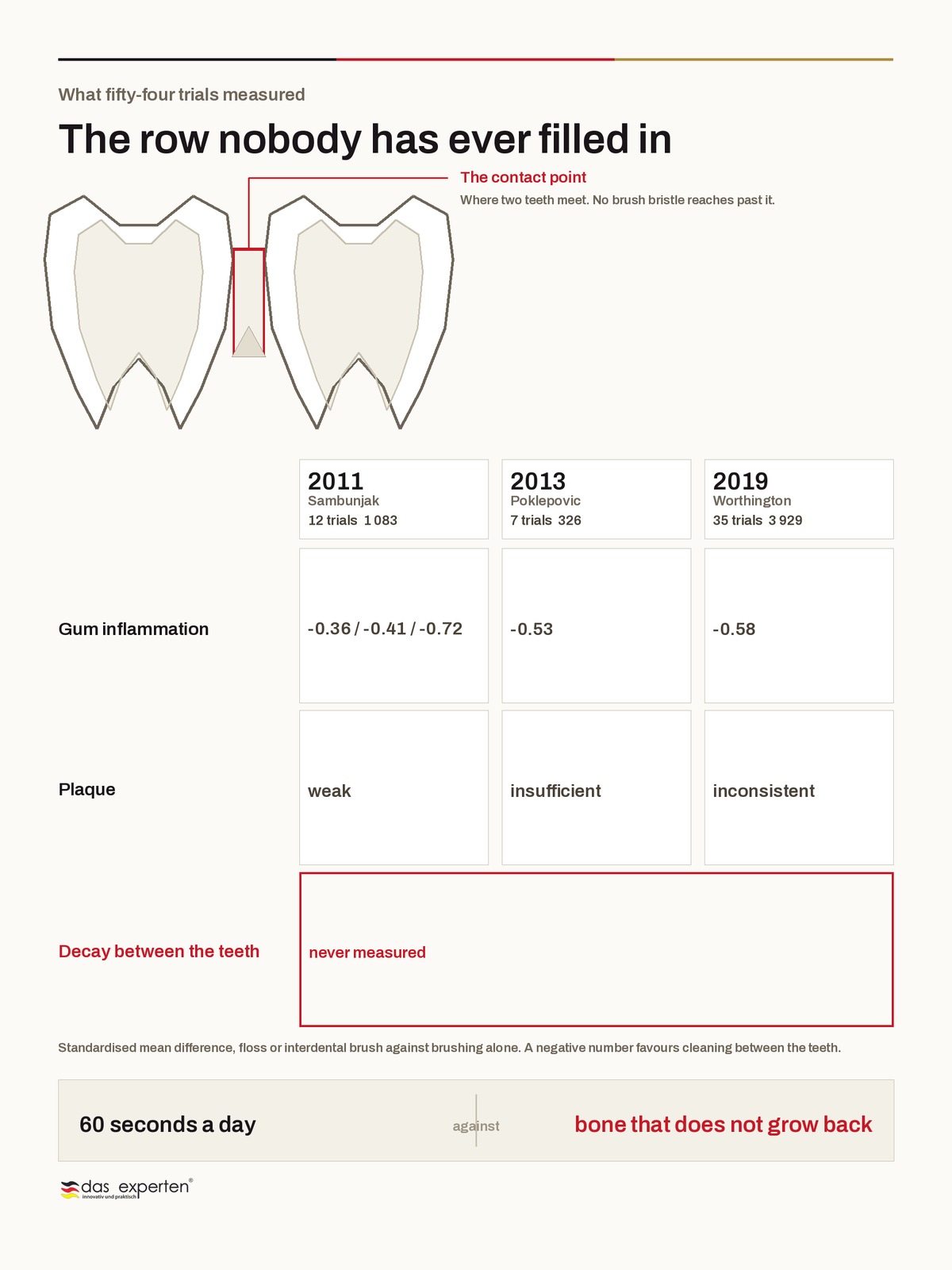
Once you ask why the evidence is weak, the weakness stops looking like a verdict and starts looking like a design problem. The trials run four weeks to six months; periodontitis and decay between the teeth take years, sometimes decades. You cannot blind a person to whether they are flossing, so every trial carries performance bias by construction — only 2 of the 35 were otherwise at low risk of bias. And most of them recruited people whose gums were already close to healthy. Try to demonstrate improvement in a nearly healthy mouth across four weeks and you will measure mostly noise.
You have probably already made a decision about this without noticing that you made one. Perhaps you read the headline in 2016, or absorbed it second-hand from somebody who had, and the habit quietly lapsed. Nobody followed up with you. Nobody ran the trial either. You are nine years into an experiment with one participant and no control group, and the result will arrive at a dental appointment you have not booked yet.
The asymmetry is the whole argument
Strip the science out and look at the shape of the bet. On one side, sixty seconds a day and a few cents of thread. On the other, a disease that stays silent until it is structural — bone that does not grow back, teeth that do not come back. The trials can only speak about small effects, over short windows, in healthy mouths. They cannot speak about your next forty years, and they were never built to. When the cost of acting is trivial and the cost of being wrong is not, you do not need strong evidence in favour. You need the absence of strong evidence against.
This is the error the 2016 coverage made, and it is not a small one. It treated missing evidence as though it were evidence of absence. In a domain where the harm compounds quietly across decades while the trials are measured in weeks, missing evidence is precisely what you should expect to find whether the habit works or not. A study that could not have detected the benefit is not a study that refutes it.
The finding that nobody reported
Buried in the same reviews sits a result far more useful than the one that made the news. When floss was compared not against nothing but against a small brush that goes between the teeth, the brush won. Tina Poklepovic and colleagues, reviewing seven studies and 326 people in 2013, found interdental brushing reduced gum inflammation more than flossing at one month — a standardised mean difference of -0.53. Worthington's 2019 review reached the same conclusion: interdental brushes may be more effective than floss. The 2016 story ran for a week. This has never had a headline at all.
The same review is just as blunt in the other direction. Oral irrigators — the water jets sold as the modern replacement for all of it — showed no reduction in bleeding sites or plaque against brushing alone, at one month or at three. The device with the best marketing carries the thinnest evidence of the three. That ordering should tell you something about the relationship between evidence and advertising.
Which leaves a better question than the one the headline asked
Not whether to clean between your teeth, but with what. Where teeth sit tight against each other, thread is the only thing that will pass: our WAXED MINT floss is peppermint-waxed polyester, built for tight contacts, implants and retainers. Where the gaps are irregular — restorations, orthodontic work, wider embrasures — EXPANDING floss is a hydrophilic multifilament that blooms to two or three times its dry width the moment it meets saliva, filling a space that thread of a fixed diameter cannot. And where a gap is wide enough to admit a brush at all, a brush is what the evidence prefers: INTERDENTALS S and M, a stainless core carrying polymer filaments, for crowns, implants, braces and open embrasures. Das Experten makes all three, because your mouth is not one gap repeated thirty-two times.
Nine years on, the study that would have settled this has still not been run, and it probably never will be. It would need thousands of people, a decade of follow-up, and a funder with nothing to sell. So the question was never going to be answered on your behalf, and treating a gap in the literature as permission was always a choice rather than a conclusion.
You were never waiting for evidence. You were waiting for an excuse — and in 2016 a wire story handed you one that the science underneath it never supported.