





Xylitol for Teeth: Birch Was in Human Mouths 9 700 Years Ago
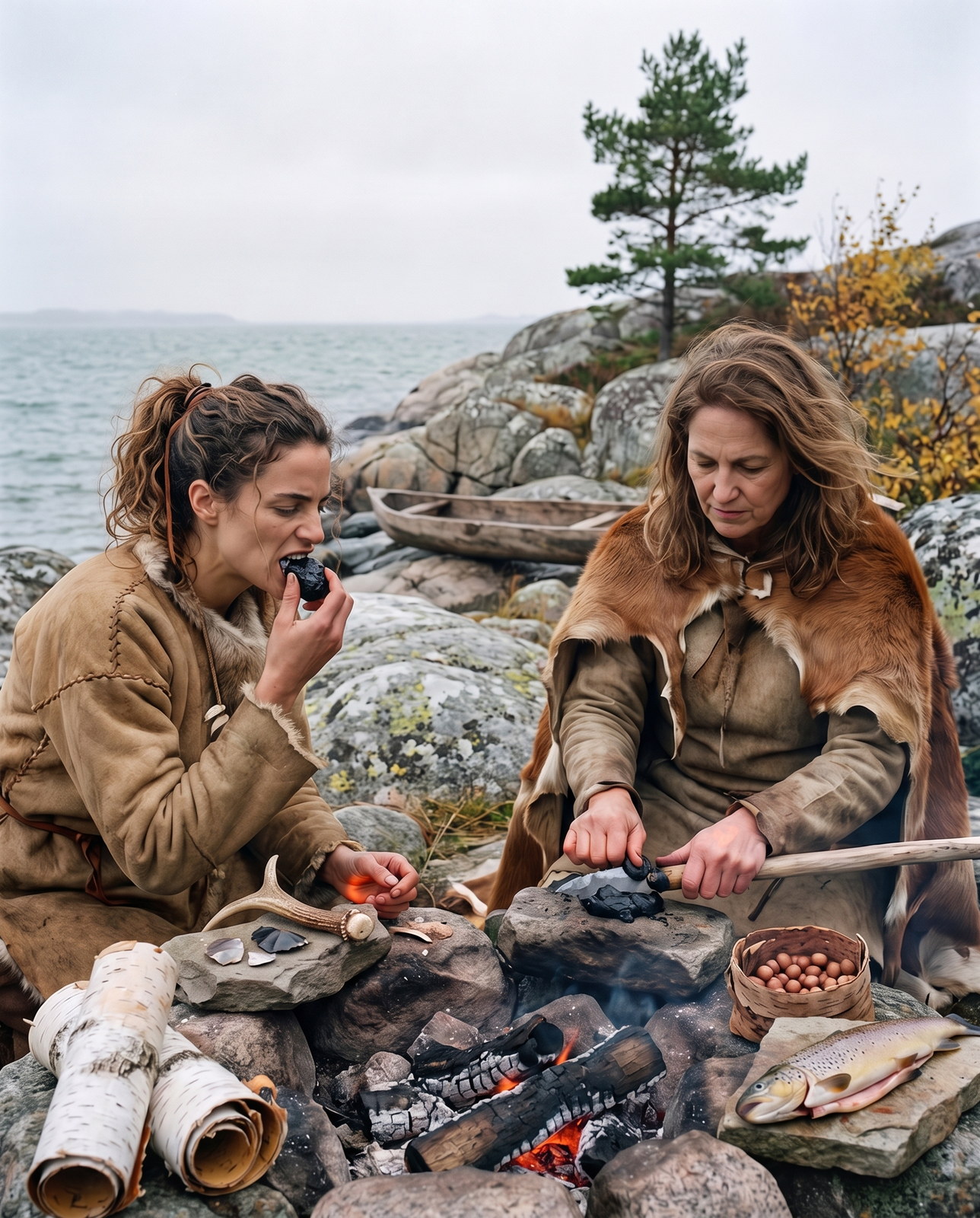
On the west coast of what is now Sweden, about nine thousand seven hundred years ago, a teenager put a lump of black tar into her mouth and began to chew.
The tar came off a birch tree. Somebody had stripped the bark, heated it under the ground until the wood gave up a thick dark resin, and let it cool into something with the consistency of a pebble. Cold, it is useless. Warmed by a mouth it turns pliable within a minute or two, and it tastes the way it smells, smoke, bitterness, something faintly medicinal that settles at the back of the tongue and stays there.
She was not chewing for pleasure. The pitch was glue. Warmed and worked, it was the adhesive that fixed a flint blade into a wooden haft, and a hunting camp went through a great deal of it. Chewing was a manufacturing step, and it fell to whoever had the time.
Her gums, at that moment, were badly infected. We know this. We know it in the specific, clinical way one knows the contents of a laboratory report, because she spat the lump onto the ground, the ground closed over it, and it is still here.
The ten thousand years that followed were not an improvement
Put the rest of the story beside that morning and it does not flatter us.
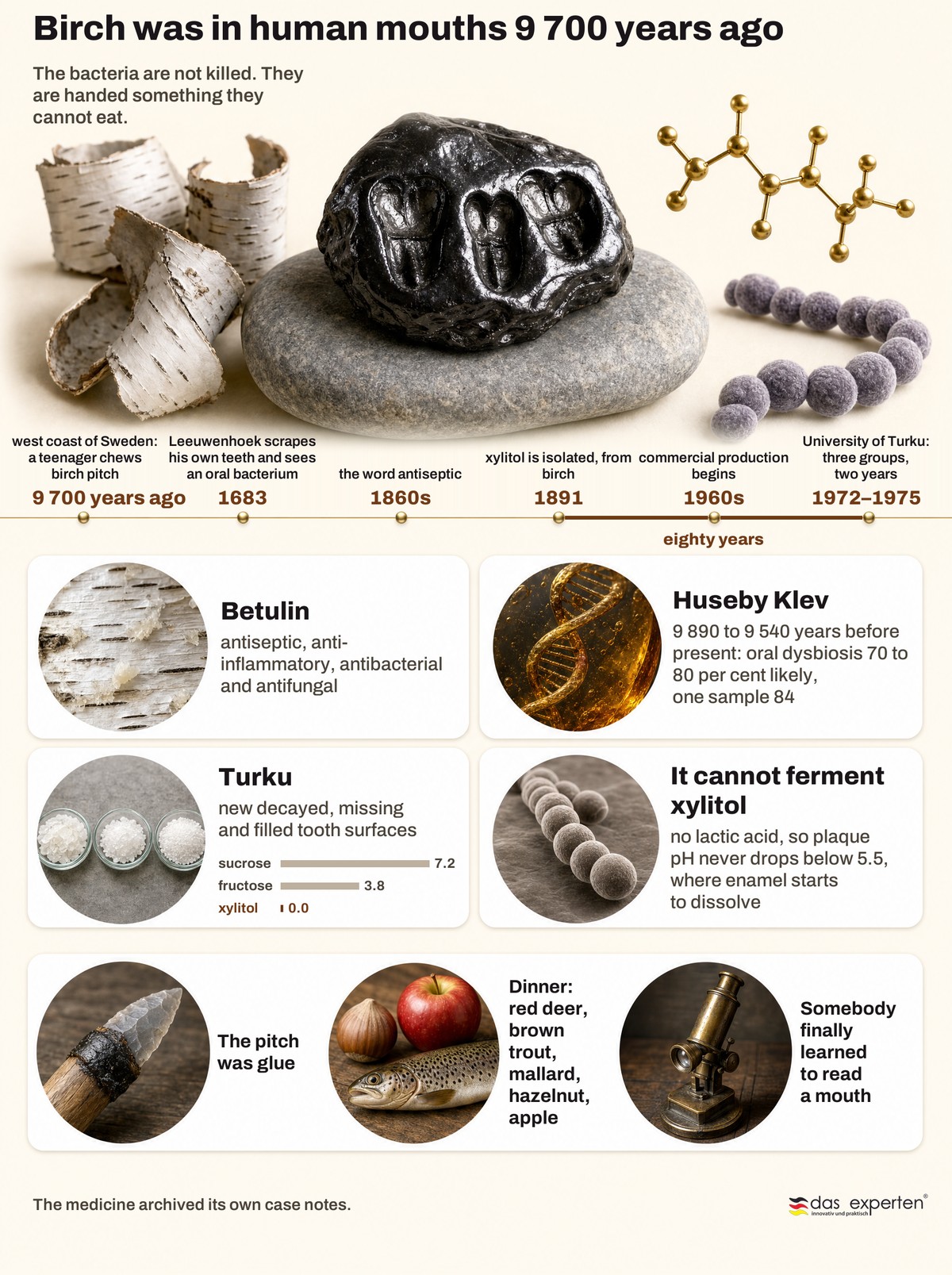
For most of the interval between her camp and your bathroom, the best available treatment for an infected mouth anywhere on earth was to pull the tooth out. Egypt, Rome, Baghdad, Paris: the instrument changed, the principle did not. Nobody had seen an oral bacterium until Antonie van Leeuwenhoek scraped his own teeth in 1683, and nobody connected the sighting to disease for two centuries after that. The word antiseptic dates from the 1860s.
She had no theory whatsoever. She simply had, in her mouth, a substance that happened to be one.
They were not guessing about the tar
Chewed lumps of birch pitch turn up across Mesolithic Europe in large numbers, and a great many of them carry tooth impressions. Archaeologists read them first as a manufacturing residue, which they are. The reading has never stopped there, because birch pitch is not a neutral thing to hold in a mouth. Its chemistry is dominated by triterpenes, betulin above all, and betulin is antiseptic, anti inflammatory, antibacterial and antifungal. The ethnographic record is explicit: birch pitch was used as a natural antiseptic for preventing and treating dental ailments.
So the honest description is not that anyone stumbled onto something. It is that people in pain reached repeatedly for the one thing at hand that made the pain retreat, kept reaching for it across thousands of years, and were right.
And then nothing. Nobody wrote it down, and the reason is not carelessness. Writing did not exist. It would not exist anywhere on earth for another four and a half thousand years, and in northern Europe for very much longer than that. There was no possible way to record the finding except by handing a warm black lump to the next person and watching them do it. The knowledge lived entirely inside a gesture, and a gesture has no shelf life.
The record survived because the medicine preserved it
There is a joke buried in this one.
DNA does not last. In ordinary conditions the bacterial DNA in a mouth is gone within decades of leaving it, digested by other bacteria. The only reason a Stone Age Scandinavian mouth can be read at all is that birch pitch is aseptic and hydrophobic, and inhibits microbial and chemical decay. The property that made the tar useful against a gum infection is the property that froze the evidence of that gum infection in place. The medicine archived its own case notes.
The archive is remarkably good. Three chewed pieces from Huseby Klev, dated 9 890 to 9 540 years before present, gave up a full metagenomic profile: Treponema denticola, Actinomyces johnsonii, Actinomyces timonensis, Streptococcus anginosus, an unmistakable periodontal signature, with trained models putting the probability of oral dysbiosis at 70 to 80 per cent, and one sample at 84. They also gave up dinner: red deer, brown trout, mallard, hazelnut, apple. A further piece from Syltholm in Denmark, radiocarbon dated to 5 858 to 5 661 years before present, carried an entire human genome, a woman with dark skin, dark brown hair and blue eyes, together with Epstein Barr virus and the full red complex of periodontal pathogens.
Then the birch went quiet for a very long time. Metal replaced pitch as an adhesive, the chewing stopped, and the tree became firewood and furniture.
In 1891 the tree gave up a second molecule, and nobody noticed for eighty years
Xylitol was isolated in 1891, from birch. Its name is the Greek word for wood with a chemist's ending attached. For decades afterwards it was a laboratory curiosity with no purpose. Finland took an interest during the war years, when sugar was short, and commercial production began only in the 1960s.
Then Turku. Between 1972 and 1975 the University of Turku ran the trial that settled the question: three groups, two years, sucrose against fructose against xylitol. New decayed, missing and filled tooth surfaces came in at 7.2 in the sucrose group, 3.8 in the fructose group, and 0.0 in the xylitol group.
Zero. Across two years.
The mechanism is almost rude in its simplicity. Streptococcus mutans, the organism that makes the acid that dissolves enamel, cannot ferment xylitol. It takes the molecule in, gets nothing out of it, and produces no lactic acid, so plaque pH never drops into the range below 5.5 where enamel starts to dissolve. The bacteria are not killed. They are handed something they cannot eat.
And now the part that is about you
Tomorrow morning you will put something into your mouth and hold it there for two minutes. It either contains a molecule that starves the organism or it does not, and almost nothing on the outside of the tube will tell you which. You have been making that choice every morning for years without being asked.
Which is the argument for putting the birch molecule back where it belongs, at a dose that does something, next to the other half of the problem. In SYMBIOS, the fluoride free probiotic paste from Das Experten, xylitol sits at a therapeutic dose alongside live Bacillus coagulans JYBC 016 at 4×10¹⁰ CFU per dose, one component starving S. mutans of anything to ferment, the other competing with it for the same surface. The cariostatic effect of xylitol rests on more than twenty validated clinical trials. The paste carries no broad spectrum antiseptic, and that is deliberate: the aim is not a sterile mouth but a mouth in which the wrong organisms lose.
She had the right tree and the wrong part of it, and no way on earth to say so.
Ten thousand years later the tree is still right, and the only thing that has changed is that somebody finally learned to read a mouth.