


Gold Teeth Are 2 600 Years Old: Etruscan Women Wore Gold Bridges in 630 BC

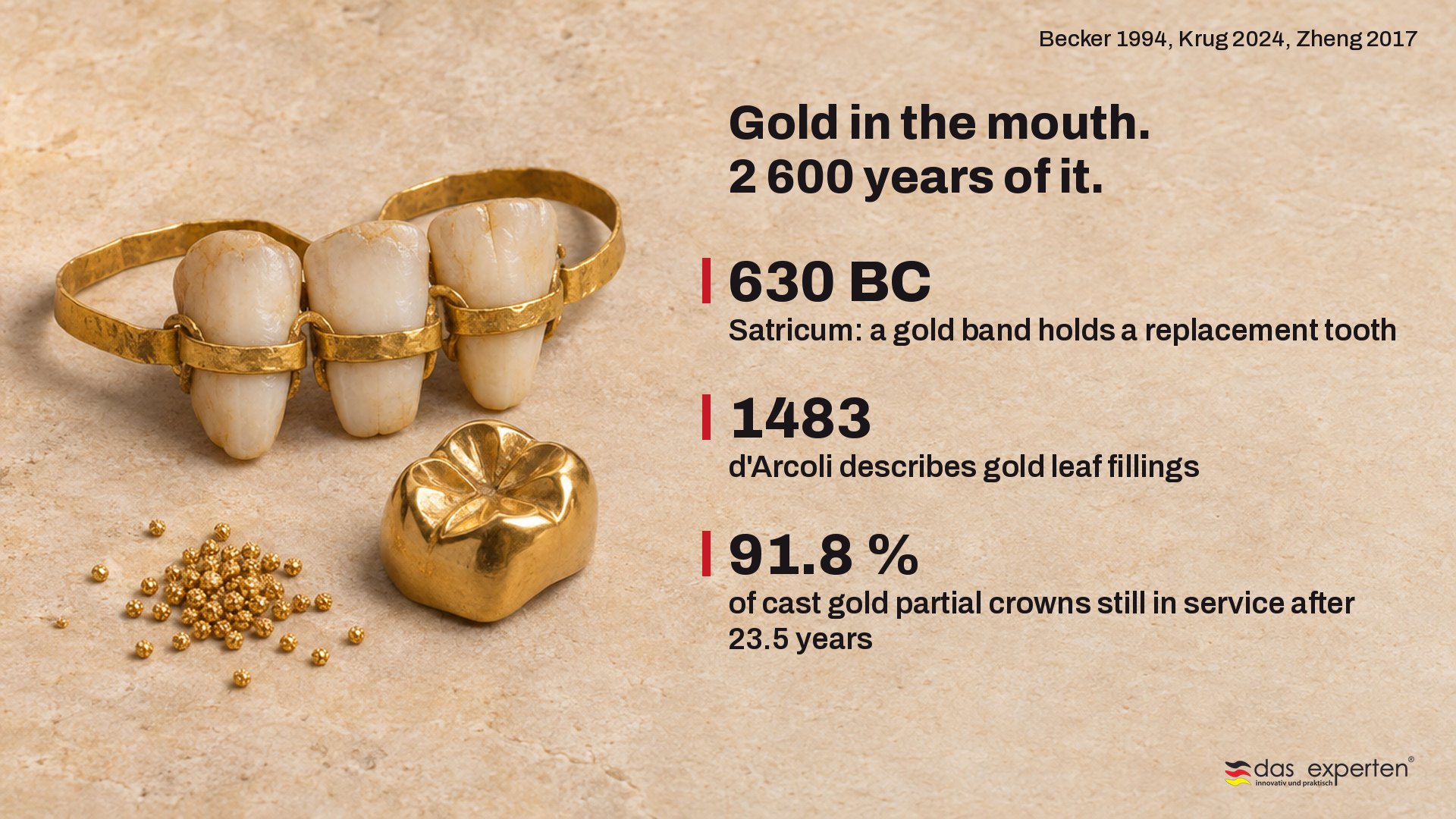
Satricum, about 630 BC. On a low hill in the plain south of the place that will become Rome, in a town that then belongs to the Etruscan world, a woman is laid in her tomb. We do not know her name. We know her teeth. Around her front teeth runs a band of pure gold, hammered so thin it bends under a fingernail, folded into loops that grip the healthy teeth on either side and hold a missing one in its place. The replacement tooth is gold as well. She goes into the earth with it.
Gold is soft, heavy and warm. In the mouth it takes the temperature of the body within minutes and never tarnishes, so a smile with a band of gold in it stays bright for the rest of a life. The anthropologist Marshall Becker, who spent decades on these appliances, dated the Satricum band to about 630 BC. With the historian Jean MacIntosh Turfa he later noticed something stranger: as far as the skeletons can tell, the known Etruscan gold dental bands were worn by women. They were too soft for hard chewing. Their work was the smile.
The stakes did not stay small. About two centuries later, around 450 BC, Rome set down its first written law code, the Twelve Tables, and the tenth table governed death. Gold must not be buried or burned with a body, it said, with one exception: if the dead person's teeth were bound with gold, that gold could go into the grave or onto the pyre without penalty. Cicero quoted the clause four centuries later in his book On the Laws. In a law written to keep luxury out of funerals, the city that would rule the Mediterranean made room for exactly one: the gold in a mouth.
Meanwhile, north of the Alps
Across most of Europe in those centuries a bad tooth meant pain and then pliers. Even after Rome fell, the continent forgot what the Etruscan goldsmith knew. The first known written instruction to fill a decayed tooth with gold leaf came from the Italian physician Giovanni d'Arcoli, Arculanus in Latin, and it was printed in 1483: more than two thousand years after Satricum. Europe did not invent gold teeth. It found them again.
How did the Etruscans get there first?
Not through medicine. Through the workshop. Etruscan goldsmiths of the seventh century BC were among the finest metalworkers of the ancient world, masters of granulation: they fused gold grains finer than sand onto jewellery so cleanly that jewellers of the nineteenth century spent years trying to copy the technique. People who could fix a bead of gold the size of a poppy seed could certainly fold a strip of it around a tooth. The dental band was jewellery that learned to work.
And here is the paradox of silence. The Etruscans wrote. They had sacred books on lightning, on reading the entrails of animals, on the founding of cities, and almost none of them survive. Their language can be read aloud today and only partly understood. The Roman emperor Claudius wrote a history of the Etruscans in twenty books; it is lost. What the goldsmiths knew lived in their hands, not on a page, and when their cities became Roman, the hands fell still. The gold stayed in the graves, and the explanation went into the ground with it.
The long road back
The road back to gold in the mouth took two and a half thousand years and ran through the dentist's chair. After d'Arcoli, gold leaf fillings spread slowly; by the nineteenth century American dentists packed layer after layer of gold foil into cavities. In 1907 the American dentist William Taggart introduced cast gold inlays made by the lost wax method: a wax model of the missing part of the tooth becomes a mould, and the mould is filled with molten gold. Etruscan workshops cast their bronzes on the same principle. Gold inlays and crowns became a standard of dentistry for a century.
Then came the numbers. In 2004 a team at Ludwig Maximilian University in Munich reviewed decades of clinical studies of fillings in back teeth. Cast gold inlays and onlays failed at a mean rate of 1.4 % a year, against 3.0 % for amalgam and 2.2 % for direct composite. In 2024 the University Hospital of Würzburg reported on partial gold crowns placed by supervised students: after 23.5 years, 91.8 % were still in service. Gold lasts because, as metals go, it does almost nothing. It does not rust, it does not dissolve, it does not react.
What the science says now
The single atom that bridges Satricum and the modern laboratory is gold, Au. In a crown or a band, gold is prized for being inert. In 2017 chemists at the National University of Singapore showed that this changes with size. Reduced to clusters smaller than 2 nanometres, a few dozen atoms each, gold began to kill bacteria, both Gram positive and Gram negative, which larger gold particles did not. The clusters enter the bacterial cell, upset its metabolism and flood it with reactive oxygen species, the cell's own exhaust. This is laboratory work, not a clinical trial, and it does not mean a gold tooth fights decay. It means the quiet metal of the Etruscan smile becomes active when it is small enough.
And now the part that concerns you personally. Tomorrow morning you will pick up a toothbrush. It will be either a tuft of plastic that waits wet in a cup between brushings, or a tool made with some thought about what lives on its bristles. The Etruscan goldsmith would have understood the choice at once: the thing that touches your teeth twice a day deserves the best metal you can give it.
One of ours carries the old metal in a new form. The Das Experten GROSSE brush has a wide, dense head whose filaments are treated with gold ions, Au⁺, to help keep the brush head fresher between uses, beside charcoal bristles that add fine texture for lifting plaque and stains. The gold works on the bristle, not on your enamel, and it does not replace a dentist's crown. It is the same metal with a smaller, honest job. Look at the brush in your cup this week.
Etruscan women wore gold in their smiles 2 600 years ago; Rome wrote it into the law of the dead, and Europe needed two thousand years to remember it.