





Clove Oil for Teeth: Japan's First Toothpaste Was Named After It
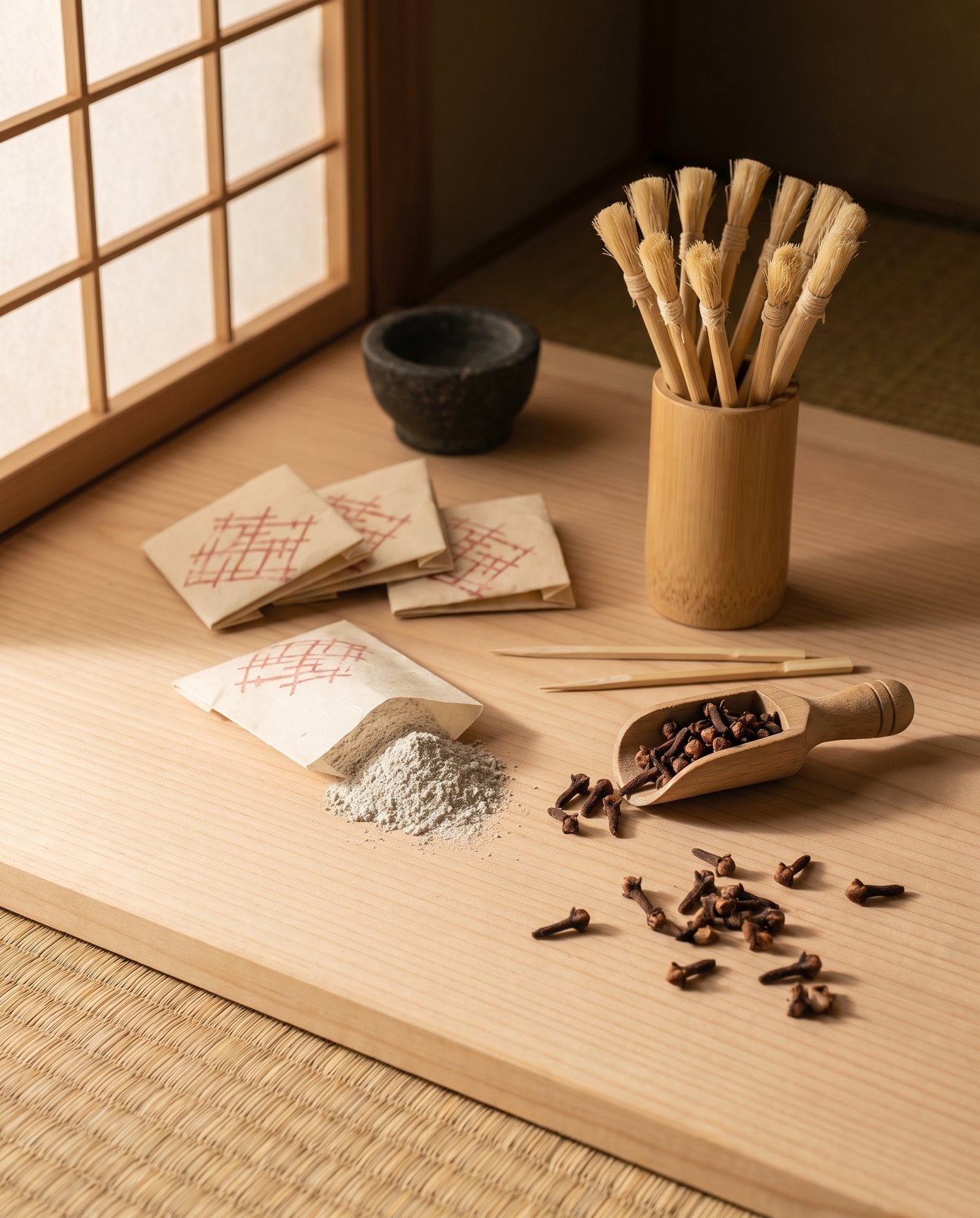
The stall stands inside the grounds of Sensō ji, in Asakusa, and the man behind it sells one thing: a grey powder folded into paper packets. It is 1625. The buyer wets a finger, presses it into the packet, and puts the finger in his mouth.
The first sensation is grit, chalk, fine and dry, scraping along the enamel. Then the cold arrives, a camphor cold that opens the back of the nose. And then, three or four seconds late, the heat: the slow, numbing burn of clove, which sits on the gum long after the mouth has been rinsed and does not entirely leave before noon.
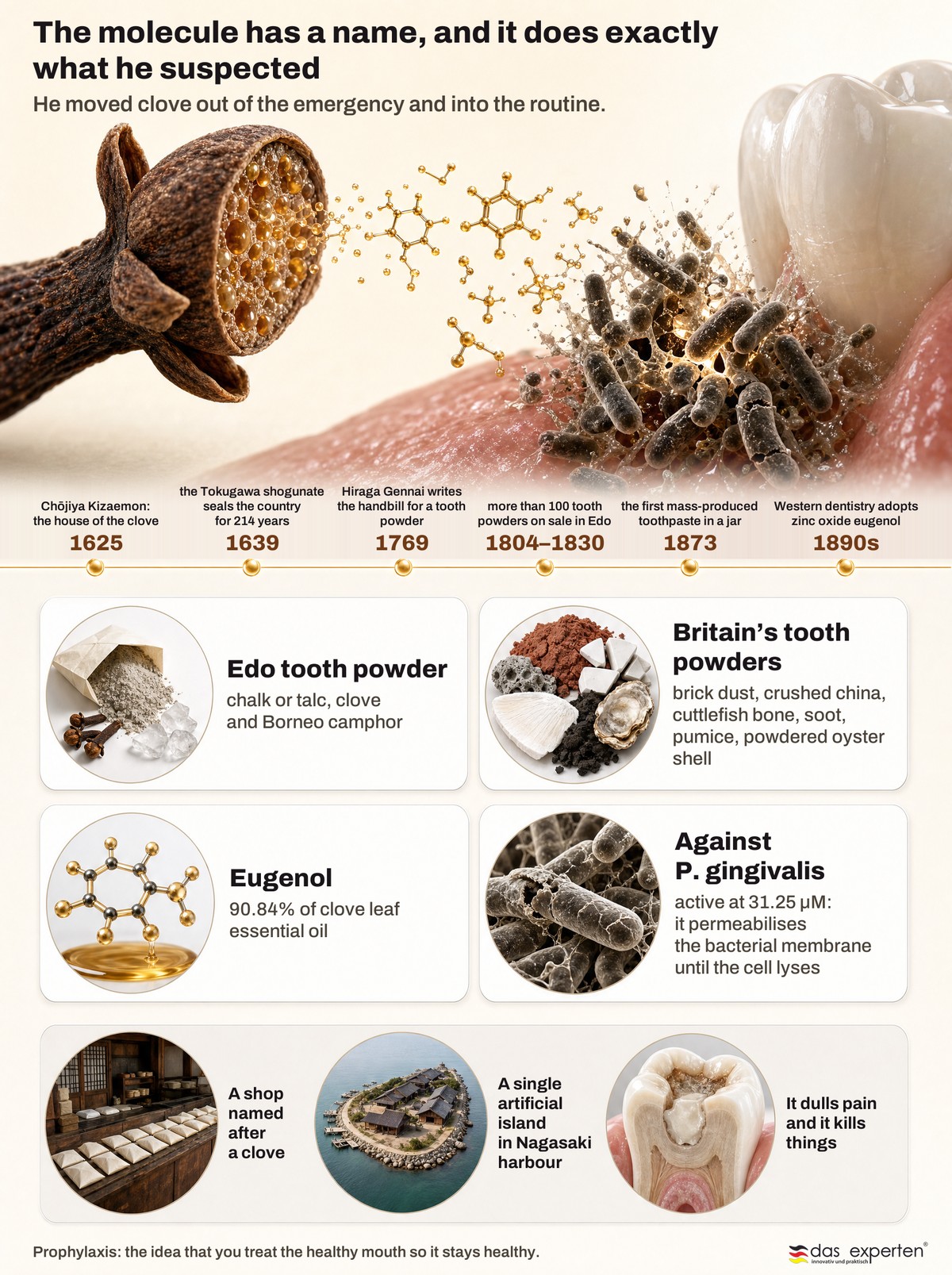
The man selling it is called Chōjiya Kizaemon. He learned the preparation from a Korean. He did not name his shop after himself, after his family, or after his district. He named it after the ingredient. Chōjiya, the house of the clove.
He has no word for bacteria, and no reason to want one. He has noticed only that the spice which stops a toothache also seems to keep a mouth in better condition when nothing hurts at all. That observation is worth a great deal more than he knows.
Put a clock on that packet
1625. Japan is fourteen years from sealing itself off from the world.
Now look at what the other end of the planet was putting on its teeth. Tooth powders were marketed in Britain through the eighteenth century, and their published ingredients include brick dust, crushed china, earthenware and cuttlefish bone. Soot. Pumice. Powdered oyster shell. These are not caricatures assembled to make a point; they are the contents list of a product sold by physicians and chemists to people who could afford it.
Colgate first mass produced toothpaste in a jar in 1873. That is 248 years after a merchant in Asakusa opened a shop named after a clove.
They were not chemists. They were shopkeepers.
This is the part that gets misread as luck.
Clove was already the toothache remedy of the region, that much was common knowledge from India to Japan, and it is common knowledge for an obvious reason: eugenol is a genuine local anaesthetic, and a numbed tooth announces itself immediately. Anyone can discover that. It takes about ten seconds.
The leap Chōjiya made was different, and much harder. He moved clove out of the emergency and into the routine. He put the painkilling spice into a powder meant for a mouth that was not in pain, to be used every morning, by well people, forever. That is not folk medicine. That is prophylaxis, the idea that you treat the healthy mouth so it stays healthy, and Western dentistry would not organise itself around that principle for another two and a half centuries.
The base of his powder was chalk or talc. The actives were clove and Borneo camphor. Strip out the marketing of the last hundred years and that is, functionally, a toothpaste.
Then the country closed, and nobody outside could read the recipe
The silence here has a precise cause and a precise date.
In 1639 the Tokugawa shogunate sealed the country. For the next 214 years Japan traded with the outside world through a single artificial island in Nagasaki harbour, and the knowledge of what Edo was doing to its teeth stayed inside, written in Japanese, held in shop ledgers and hawkers' handbills rather than in a pharmacopoeia any European physician would think to open.
And it was not a small or a marginal thing to miss. By the Bunka, Bunsei era, 1804 to 1830, more than 100 different tooth powders were on sale in Edo. A hundred competing brands, in one city, for one product category. In 1769 the polymath Hiraga Gennai wrote the handbill copy for a tooth powder called Sōsekikō, advertising copy so effective it is credited with changing the form itself, and it was written for a dentifrice.
So while eighteenth century London was rubbing crushed earthenware on its teeth, Edo had a mature consumer market with a hundred competitors and a professional copywriter. Europe did not reject this. Europe never heard about it.
The molecule has a name, and it does exactly what he suspected
The molecule is eugenol. In the essential oil of clove leaf it runs to 90.84% of the content, which is why the burn in that 1625 packet arrives late and stays: eugenol is not a flavour riding on top, it is most of the substance.
Western dentistry did eventually adopt it, formally, in the 1890s, as zinc oxide eugenol, which is still packed into deep cavities today for exactly the two properties Chōjiya was selling: it dulls pain and it kills things.
The measurements came later and they are unglamorous. Against Porphyromonas gingivalis, the anaerobe at the centre of gum disease, eugenol is active at 31.25 μM. The mechanism is blunt: it permeabilises the bacterial membrane until the cell loses integrity, shrinks and lyses, visible under a scanning electron microscope. Below that, at doses too low to kill, it still suppresses biofilm formation by downregulating the virulence genes the organism needs to build one, fimA, hagA, hagB, rgpA, rgpB, kgp.
Read that with the packet in mind. He was not perfuming a mouth. He was interfering with the adhesion machinery of the organism that dismantles the tissue holding teeth in their sockets, 265 years before anyone could name a single gene involved.
Which brings us to tomorrow morning
Tomorrow you will pick something up and hold it in your mouth for two minutes. Almost everyone reading this already owns clove oil in some form, or has been told to own it, and reaches for it the way a European reached for it in 1800, at the point where something already hurts.
Chōjiya's whole insight was that this is the wrong moment. The interesting question is not what you put in your mouth when it is in pain. It is what is in your mouth on the ordinary mornings, when nothing hurts and the biofilm is quietly organising itself.
Which is the argument for putting eugenol back where a shopkeeper in Asakusa put it four centuries ago, in the daily powder, at a dose that does something. In DETOX, the fluoride free paste from Das Experten, clove extract sits at 0.2% and cinnamon bark extract at 0.8%, both deliberately under the irritation threshold and over the clinical one. That combination suppresses P. gingivalis by 71 to 74%, and it holds enamel: calcium loss measured 17 mg/L against 53 mg/L in the control group, a reduction of 65%. Abrasion sits under RDA 49, which is the whole point, it is built for every ordinary morning, not for the morning something goes wrong.
Kizaemon could not have told you why any of it worked. You now can, which is the only thing that has actually changed since 1625.
Japan did not stumble onto a folk remedy for toothache. It worked out that the spice belonged in the mouths of people whose teeth did not hurt, and then closed the door for two centuries.