





Pregnancy Teeth Loss: Your Baby Does Not Take Calcium From Your Teeth — but Women With More Children Do Keep Fewer of Them

You have heard it from your mother, your grandmother or a woman in a waiting room: every child costs a tooth. In German it is a proverb, Jedes Kind kostet einen Zahn. Hausa women in northern Nigeria tie losing teeth to childbirth as well. And somewhere around the seventh month, the first time your gums bleed into the sink, it stops sounding like folklore.
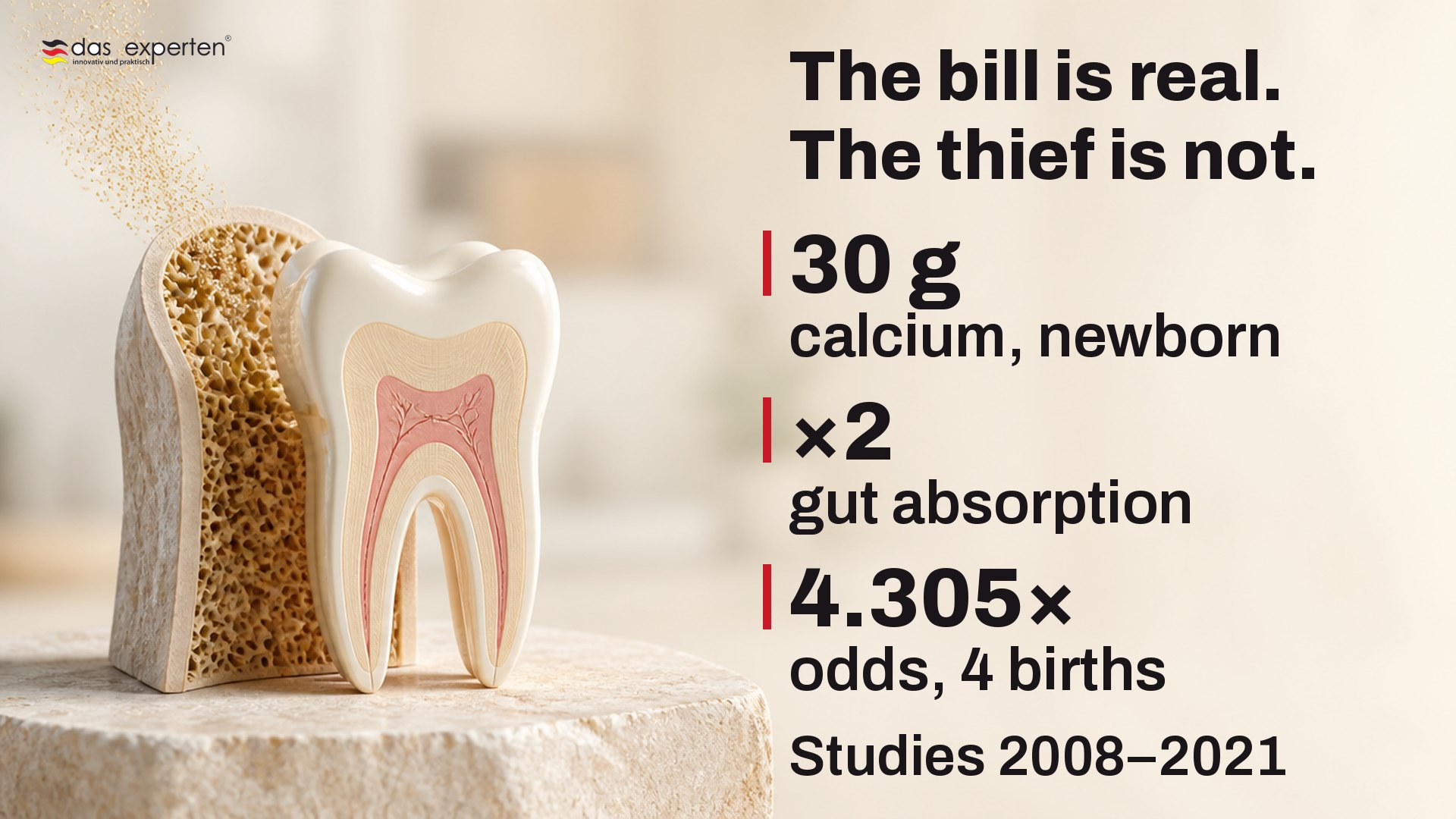
Here is the short answer before the long one. The bill in that saying is real: in four countries, women who had more children kept fewer teeth — in Japan, four births came with 4.305 times the odds of having fewer than 20 teeth. The culprit in that saying is wrong: your baby does not take calcium out of your teeth.
Pregnancy teeth loss: what the counting actually shows
Start with the counting, because it is the half people assume was made up. In the United States, 2 635 women from a national health survey showed it plainly: the more children, the more teeth lost. In north-east Germany, a population study of 4 290 adults found the same inverse line between children born and teeth left — next to an odd paradox: the women had healthier gums than the men, yet fewer teeth. In Japan, 3 854 women aged 40 and over: compared with women who never gave birth, two births came with 2.485 times the odds of having fewer than 20 teeth, three with 2.844, four with 4.305. In northern Nigeria, among 612 Hausa women, those with five children or more had lost more teeth than women of the same age with fewer.
Four countries, four diets, four dental systems, one direction. Whatever this is, it is not a superstition.
Myth: the baby takes calcium from your teeth
Now the mechanism the saying offers. A full-term baby carries about 30 g of calcium, and around 80% of it arrives in the last three months. It has to come from somewhere, and the saying assumes it comes from the most visible calcium you own.
It does not. Enamel, once formed, has no living cells in it — nothing that can take it apart and hand the mineral back to the blood. Bone is different: it is rebuilt all your life, and that is the reserve the body draws on. During pregnancy your gut doubles how efficiently it absorbs calcium from food; during breastfeeding the skeleton itself gives up mineral for milk. The physiology review that lays all this out runs to almost a hundred pages and never needs the teeth.
The myth is convincing for a reason, and the reason is timing. The baby takes most of its calcium in the last three months; the gums are at their most inflamed in the second and third trimesters. Two true things happen in the same weeks, and the mind does what it always does with two things in the same weeks: it draws an arrow between them. The arrow is the invention. The two things are not.
What happens instead: pregnancy gingivitis changes the gums, not the enamel
So why does the count come out? The most solid piece of evidence is about gums, not enamel. A 2013 systematic review pooled 33 studies: gum inflammation rises through pregnancy, is higher in the second and third trimesters than after birth or in women who are not pregnant — without a matching rise in plaque. Read that twice. The same plaque produces more inflammation. Hormones change how the gum answers, not how much there is to answer to.
And then comes the honest part, which the proverb never had. The American researchers tested whether dental visits, stress or habits explained the link; none did, and they wrote that the mechanism remains undefined. The German team tied it to faster bone turnover, to oestrogen use and to lower education and social status. A pattern repeated in four countries with no settled cause is exactly the kind of thing you should neither dismiss nor explain too confidently. We can read the bill. We cannot yet read every line on it.
Gums bleeding in pregnancy: what to do in the months the saying is about
Right now, if your gums bleed when you brush, the natural move is to brush them less. That is the move that lets a hormonal reaction settle into a lasting problem. Keep cleaning along the gum line gently, twice a day, above all in the second and third trimesters, when the review shows inflammation at its highest. Tell your dentist you are pregnant, and if the bleeding does not settle, have it checked rather than waiting it out: bleeding gums need a dental assessment, not a guess. And eat for calcium — your gut is already working twice as hard to absorb it.
If tender gums make you reach for a softer brush, our AKTIV is a soft brush with DuPont Tynex® conical filaments. That is all we claim for it here: it is soft, it treats nothing, and bleeding gums still belong to your dentist.
Tonight, when you touch that tooth and remember the saying, remember which half of it is true.
A baby does not cost you a tooth by stealing its calcium. But more children do go with fewer teeth, and the place it starts is the gum — the one part of the bill you can still do something about.