





The Natural Bad Breath Remedy Nobody Could Read for 1 428 Years

It is not yet dawn at Karnak, and the priest whose turn it is this morning has already washed twice. The second wash is for his mouth. Then he takes something out of a small clay jar, a pellet, dark and faintly sticky, about the size of a peppercorn, and puts it on his tongue.
What happens next happens in a fixed order, and he knows that order the way you know your own morning. First honey. Then wine and raisin, faintly sour underneath. Then, four or five seconds late, the heat arrives: the dry, insistent burn of cinnamon bark, which does not fade for the better part of an hour.
He is not doing this because he feels self conscious. In a few minutes he will stand close enough to the statue of the god to speak to it, and a mouth that speaks to a god may not be unclean. The pellet is not a breath mint. It is a condition of entry.
He has no word for bacteria. He will never have one. And he is, at this moment, holding one of the most effective antimicrobials anyone will put into a human mouth for the next thirty four centuries.
Put a clock on that morning
It is around 1550 BC.
There is no Rome. There is no Athens worth the name. The people who will later call themselves the civilised world are in the European Bronze Age, and the first surviving Greek recipe against foul breath is eleven centuries away. Egypt, meanwhile, is not merely using this compound. Egypt is writing it down, into a medical scroll beside some seven hundred other remedies, in a document that will survive three and a half thousand years in the ground.
The gap here is not one of intelligence. It is one of bookkeeping, and the bookkeeping turns out to be the whole story.
They were not chemists. They were embalmers.
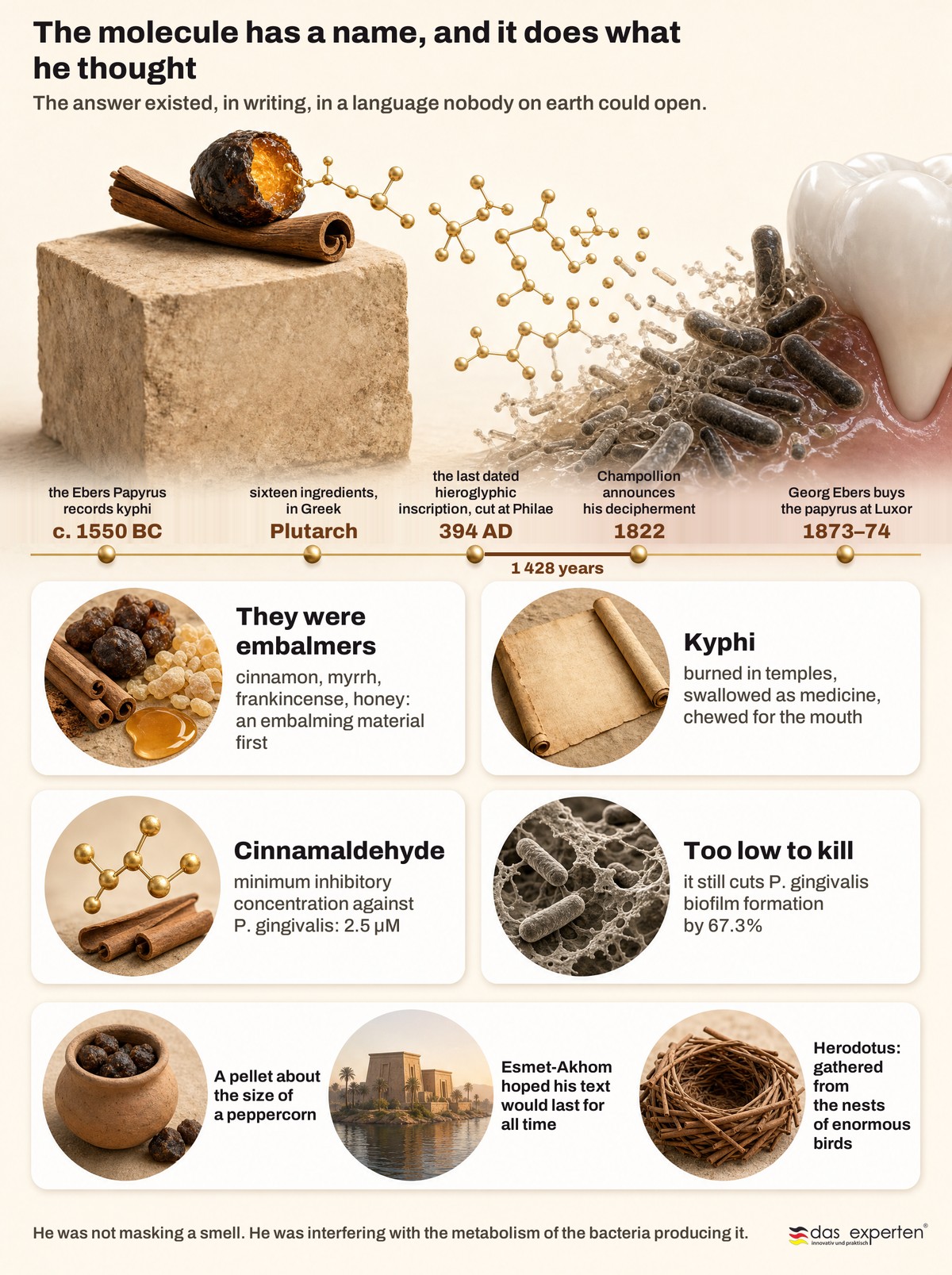
Egypt was the one civilisation on earth running a continuous, state funded, multi generational research programme into a single question: what stops organic matter from rotting? They called it mummification, they ran it for three thousand years, at national scale, with the resources of a kingdom behind it. Every substance in that breath pellet, cinnamon, myrrh, frankincense, honey, was an embalming material first.
So when an Egyptian physician looked at a foul mouth, he was not guessing. He was applying the best evidenced preservation list in the ancient world to a much smaller piece of flesh, the same problem at a smaller scale, and the larger version they had solved already.
The compound was called kyphi. The Ebers Papyrus, bought by the German Egyptologist Georg Ebers at Luxor in the winter of 1873 to 74, and dated to about 1550 BC, records it, and among its listed uses is a dento gingival fumigant to sweeten the breath. Egyptians burned kyphi in temples. They also swallowed it as medicine and chewed it for the mouth.
Then nobody said a word for fourteen centuries
Two silences follow, and they are different silences.
The first is mechanical. The Egyptians wrote the recipe in hieroglyphs, and hieroglyphs stopped. The last dated hieroglyphic inscription in history was cut at Philae on 24 August 394 AD by a priest of Isis named Esmet Akhom, who wrote that he hoped his text would last for all time and eternity. It did. It simply became unreadable. From that afternoon until Jean François Champollion announced his decipherment in 1822, not one living person could read a word of it. That is 1 428 years in which the answer existed, in writing, in a language nobody on earth could open.
The second silence is worse, because it was avoidable.
Plutarch described kyphi in detail, in Greek, a language Europe never stopped reading. Sixteen ingredients. Compounded, he notes, not at random, but while the sacred writings were read aloud to the perfumers as they mixed. Used, he says, as a potion and a salve. Europe had that passage continuously for seventeen hundred years and did nothing with it, because Europe filed it under religion. The information sat on the shelf the entire time, correctly catalogued in the wrong category.
Meanwhile the key ingredient suffered something worse than being forgotten. It became expensive. Cinnamon turned into one of the most valuable commodities in the ancient world, and the traders who controlled it protected the route by lying about where it grew, Herodotus reports, with a straight face, that it was gathered from the nests of enormous birds. When a substance becomes currency, people stop asking what it does. They ask what it costs.
The molecule has a name, and it does what he thought
The molecule is cinnamaldehyde. It is what makes cinnamon bark hot, which is why the heat in that pellet arrives late and stays.
Modern work on it is unglamorous and very specific. Against Porphyromonas gingivalis, the anaerobe at the centre of gum disease and of a good share of genuine halitosis, published work puts the minimum inhibitory concentration of cinnamaldehyde at 2.5 μM. Below that, at doses too low to kill anything at all, it still cuts P. gingivalis biofilm formation by 67.3%. Trans cinnamaldehyde goes further and suppresses the organism's metabolism directly, shutting down nitrogen metabolism and starch and sucrose metabolism genes.
Read that again with the priest in mind. He was not masking a smell. He was interfering with the metabolism of the bacteria producing it, the actual mechanism, thirty four centuries before anyone could name a single participant in it.
Which brings us to tomorrow morning
Tomorrow you will pick something up and hold it in your mouth for two minutes. That object is either a masking agent or an antimicrobial, and the difference is not marketing, it is whether anything in it acts on the organism instead of on your nose.
Most breath products are the first kind, and you have very likely been buying the first kind while believing you were buying the second. That is not your failure. It is the oldest confusion in this category, and Egypt was not confused about it.
Which is the argument for putting cinnamaldehyde back where it started, at a dose that does something. In DETOX, the fluoride free paste from Das Experten, cinnamon bark extract sits at 0.8%, deliberately under the irritation threshold and over the clinical one, with clove extract at 0.2% carrying its eugenol. In a two week clinical study that combination reduced P. gingivalis by 74%, brought inflammatory cytokines down by 87 to 98%, and lifted salivary pH from 6.2 to 7.4, which is the range in which enamel stops dissolving. Abrasion sits under RDA 49, so it is a paste for every ordinary morning rather than a course of treatment.
The priest could not have told you why it worked. You now can, and that, honestly, is the only thing that has changed since 1550 BC.
Egypt did not stumble onto a folk remedy. It found the mechanism, and then spent thirty four centuries waiting for somebody who could read.