


Is Diet Soda Bad for Your Teeth? The Sugar Is Gone, the Acid Stayed

The can is silver, the label says zero, and you feel a small private virtue every time you open one instead of the full sugar version. By four in the afternoon there are three of them on the desk. None of them fed a single cavity bacterium. All three spent the day doing something else to your teeth, and that part is not on the label.
Is diet soda bad for your teeth? The myth says no: no sugar, no damage. The evidence says the myth is half right, and the half it gets wrong is the half that cannot grow back.
The half of the myth that is true
Cavities are made by bacteria. They ferment sugar into acid next to the tooth, and the acid opens a hole. Take the sugar out of the drink and that particular factory has nothing to work with. On this point the zero on the label is honest, and if the choice is between the two cans, the diet one is the smaller risk for decay.
The trouble is that decay is only one of the ways a drink can take enamel away.
Acid does not need bacteria
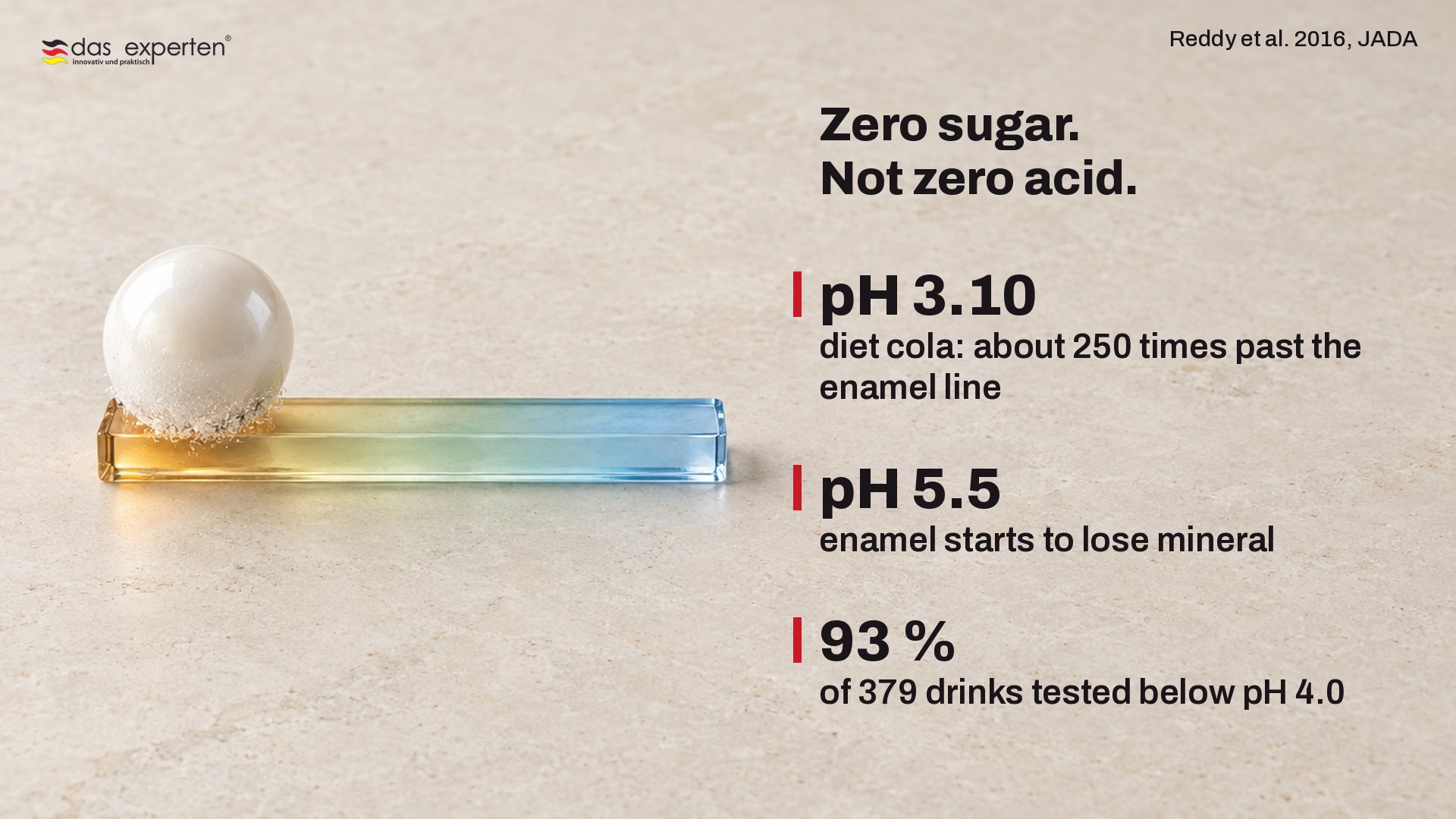
Dentists call the second way dental erosion: enamel dissolved directly by acid, with no bacteria involved. Enamel is a mineral, and it starts to lose that mineral when the liquid around it drops below about pH 5.5. In 2016 a team at the University of Alabama at Birmingham bought 379 drinks from ordinary shops and measured each one three times as soon as it was opened. 93 % of them were below pH 4.0, the level the authors call potentially damaging. A regular cola measured 2.37. Its diet version measured 3.10. The zero sugar version, 2.96. Tap water, 7.20 (Reddy et al. 2016).
The pH scale counts in powers of ten. So the diet cola is about five times less acidic than the regular one, which sounds like good news until you put it beside enamel: at 3.10 it is still roughly 250 times more acidic than the point where enamel starts to give way. Removing the sugar changed the taste and the calories. It left the acid almost where it was.
What years of it look like
In 2013 Mohamed Bassiouny of Temple University in Philadelphia published three patients side by side in General Dentistry. One had used methamphetamine. One had used crack cocaine for years. The third, a woman in her thirties, had used neither: she drank about two litres of diet soda a day for three to five years. Her teeth showed the same type and severity of erosion as the other two. These are three people, not a trial, and the beverage industry answered that soda was unlikely to be the only cause. The case does not measure a risk. It shows what the chemistry above looks like when nobody interrupts it.
The larger numbers point the same way. A 2024 review from Göttingen pooled 71 studies on what goes with erosive tooth wear: carbonated drinks raised the odds by 1.43 times (Marschner et al. 2024). A 2026 analysis of 24 studies and 21 541 teenagers found erosion in 37.6 % of them, and the odds nearly doubled among those who drank fizzy drinks (Juárez López et al. 2026). Neither review separates diet from regular, and that is the point. Enamel does not read the label.
The pattern matters more than the can
Here the risk becomes lopsided. One can with lunch gives your saliva a few acid minutes and then the rest of the afternoon to recover. The same can sipped from two o'clock to five gives your enamel three hours of acid and no recovery at all. In a laboratory study, enamel lost mineral in every drink tested, and the authors noted that shortening the time a drink stays in the mouth, through saliva or rinsing, appeared to help (von Fraunhofer and Rogers 2005).
You may have switched to diet precisely because you wanted to do the right thing for your teeth. Many people did. The switch did half the job. The other half is in how you drink it: with a meal rather than across the afternoon, without holding it in your mouth, followed by a glass of plain water.
If acid has already thinned your enamel, edges that look glassy or teeth that sting with cold, that is a question for a dentist, not for a blog. For daily brushing we make SENSITIV, a brush with DuPont Tynex bristles that its product card lists as 48 % softer than standard nylon. No study above tested it, and it does not undo erosion. Tomorrow, try one thing: drink the can with your lunch, then finish with water.
Zero sugar protects you from the bacteria. Only the clock protects you from the acid.