





How Often Should You Replace Your Toothbrush? The Bristles Answer, Not the Calendar

There is a rule on your bathroom shelf you have never questioned: a new toothbrush every three months. It sounds like maintenance, like changing the oil. Now take two real people from the same trial. One wore a brush flat in under two weeks. The other handed back brushes after three months that looked nearly new. Same instructions, same brushes. One number for both of them is not a rule. It is an average — and an average has never brushed anyone’s teeth.
So how often should you replace your toothbrush? The short answer first: when the outer tufts splay past the edge of the head, whatever the date. In the largest look at the question in these studies, 172 people each returned three brushes at three-month intervals. Those whose brushes came back badly splayed had more plaque. The age of the brush was the same for everyone; the wear was not.
The three-month rule assumes you are the average
In a six-month London trial, 107 adults had their brushes checked at two, four, twelve and twenty-four weeks and swapped whenever they were worn. 58 % turned out to be rapid wearers, 42 % slow. 18.6 % of the group needed a new brush within two weeks, half of all replacement brushes were handed out in the first four weeks, and two people went through ten brushes in six months. For every one of them the three-month rule was wrong — in opposite directions.
You have probably noticed it yourself: the brush in your cup looks like a flattened broom long before the date you set, or it looks untouched when the date arrives and you throw it out anyway. Both feel like following the rules. Only one of them is.
This is also the question our readers send us most about brushes, usually as a complaint: the bristles spread after three weeks — is the brush faulty? Sometimes a brush is. But a head that splays early is often telling you as much about how you brush as about how it was made, and the trials above suggest the answer is the same either way: the date on the calendar was never the thing to trust. What you see in the cup is. The harder part is admitting that the rule you followed was built for someone else, someone who wears a brush at exactly the speed of the average.
Does an old toothbrush really clean worse?
Here the evidence splits, and the split is the lesson. Among 34 adults in Sydney, three-month-old powered-brush heads removed 37.1 % of plaque against 38.1 % for new ones (p = 0.83), even though some heads had spread by up to 135 %. In Tehran, 93 children cleaned as well with worn brushes as with new. In Amsterdam, a professional brushing study found no clinically relevant difference — and added that the rate of wear, not the age of the brush, seemed to decide the loss.
On the other side stand trials where new brushes won: at the spaces between teeth (p = 0.033), and clearly once wear was extreme. A brush worn down by machine to imitate three months removed 13.4 % less plaque across the mouth and 17.0 % less between the teeth. Both of these trials tested one maker’s brushes, with a researcher from that maker’s laboratory among the authors. That does not make them wrong. It makes the pattern clearer: the damage lives in heavy wear, not in the calendar.
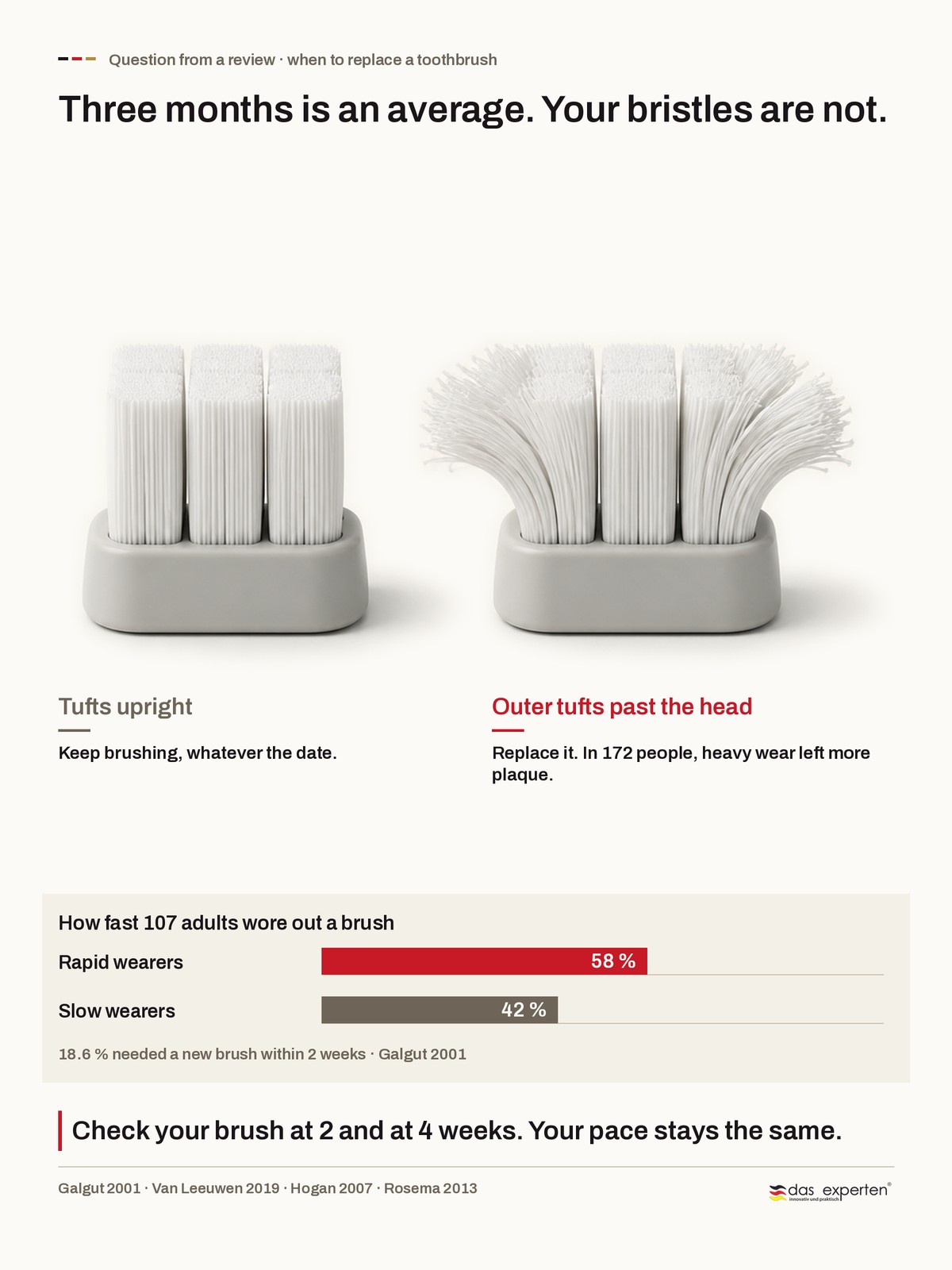
What decides when to replace your toothbrush
The 172-person analysis found one more thing that matters for you. Wear was personal and stable: the three brushes each person returned were strongly alike (rho = 0.8). A French trial saw brushes wear faster in the first month than in the second. Put together, your clock is set by your hand, it runs at the same speed every quarter, and you can read it once. A 1989 laboratory study that built the first wear index for brushes pointed the same way: the user and the time in use shaped the splay more than the design of the head. Look at your brush at two weeks and at four. The authors’ own test is simple: when the outer tufts bend out past the base of the head, it is time.
The asymmetry is what the average hides. A slow wearer who follows the calendar throws away a working brush — the cost of a brush. A rapid wearer who follows the same calendar brushes with a broken tool, twice a day, for most of those three months. One error costs a few coins. The other one costs the plaque the brush leaves behind.
What our own label says
Our MITTEL page reads: replace the brush every 3 months, or sooner once the bristles splay. After the trials above, the second half of that sentence is the one doing the work. SENSITIV is built on DuPont Tynex® filaments, 48 % softer than standard nylon and round-ended — and softness exempts it from nothing. Same test, same tufts. We cannot see the cup on your shelf. You can, twice a day.
You have been replacing your toothbrush by the date. Your teeth have been counting something else — the bristles you stopped looking at.