


Why Does Toothpaste Burn My Mouth? The Sting Is a Nerve Signal, Not Cleaning
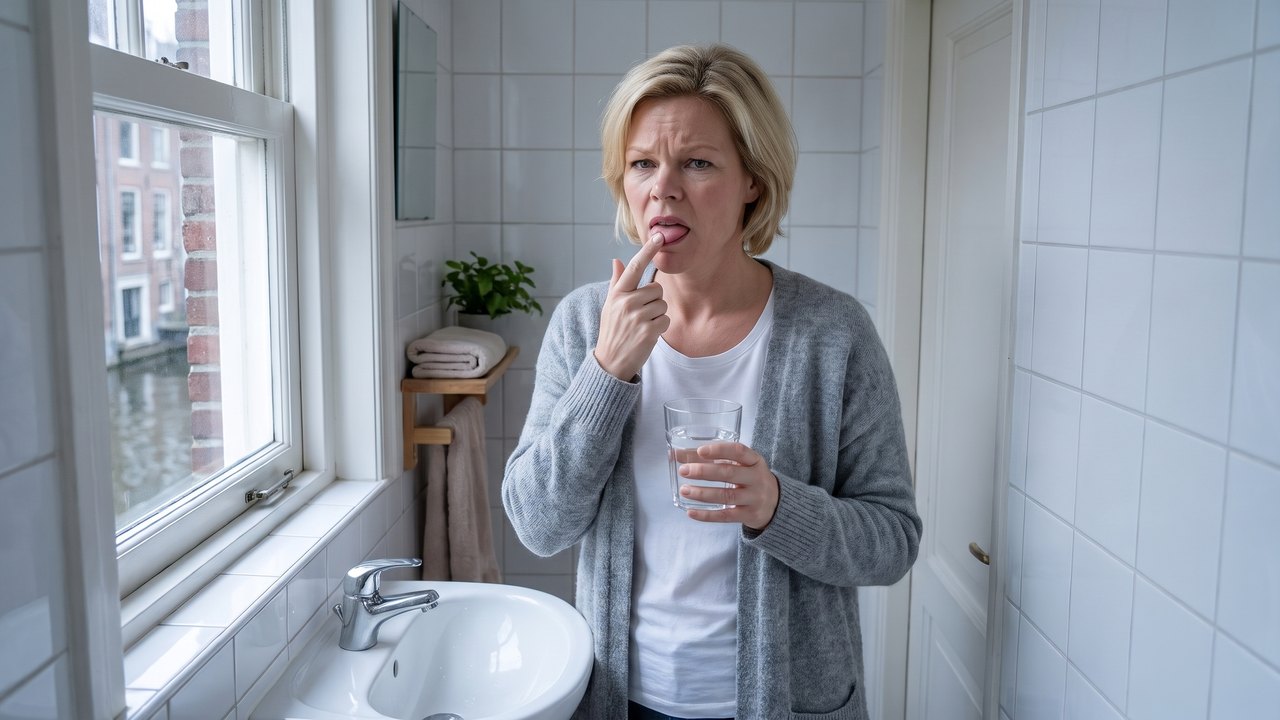
This month one of our buyers left a short review on Ozon about our TERMO 39° paste: it burns. Not a long complaint, just the word. It is a fair thing to write, and behind it sits a question millions of people ask at the sink every morning. Why does toothpaste burn my mouth, and does the burn mean it is working?
The short answer comes first. The burn is not cleaning. It is a message from your nerves, and the molecules that send it are usually in the flavour, not in whatever removes plaque.
Two receptors and a Nobel Prize
In 1997 the laboratory of David Julius in San Francisco found the receptor that makes chilli hot. It is a channel on sensory nerves, now called TRPV1, that opens to capsaicin and also to painful heat (Caterina et al. 1997). Your tongue does not tell the difference: a molecule that opens the channel feels like fire, whatever the thermometer says.
In 2004 the team of Ardem Patapoutian in San Diego showed that a second channel, TRPA1, is switched on by oils from cinnamon, clove, wintergreen, mustard and by ginger. The most specific trigger was cinnamaldehyde, the molecule that makes cinnamon taste of cinnamon. The same channel also answers painful cold, which the authors offered as a reason why cold can be felt as burning (Bandell et al. 2004). In 2021 Julius and Patapoutian shared the Nobel Prize in Physiology or Medicine for these receptors.
Now look at a tube. Its flavour is a blend of exactly such plant molecules, rubbed for two minutes into the tongue, the cheeks and the gums. A sting is the expected result. It tells you the flavour has reached your nerves. It tells you nothing about plaque, which comes off when bristles move across the tooth.
When the burn is a warning
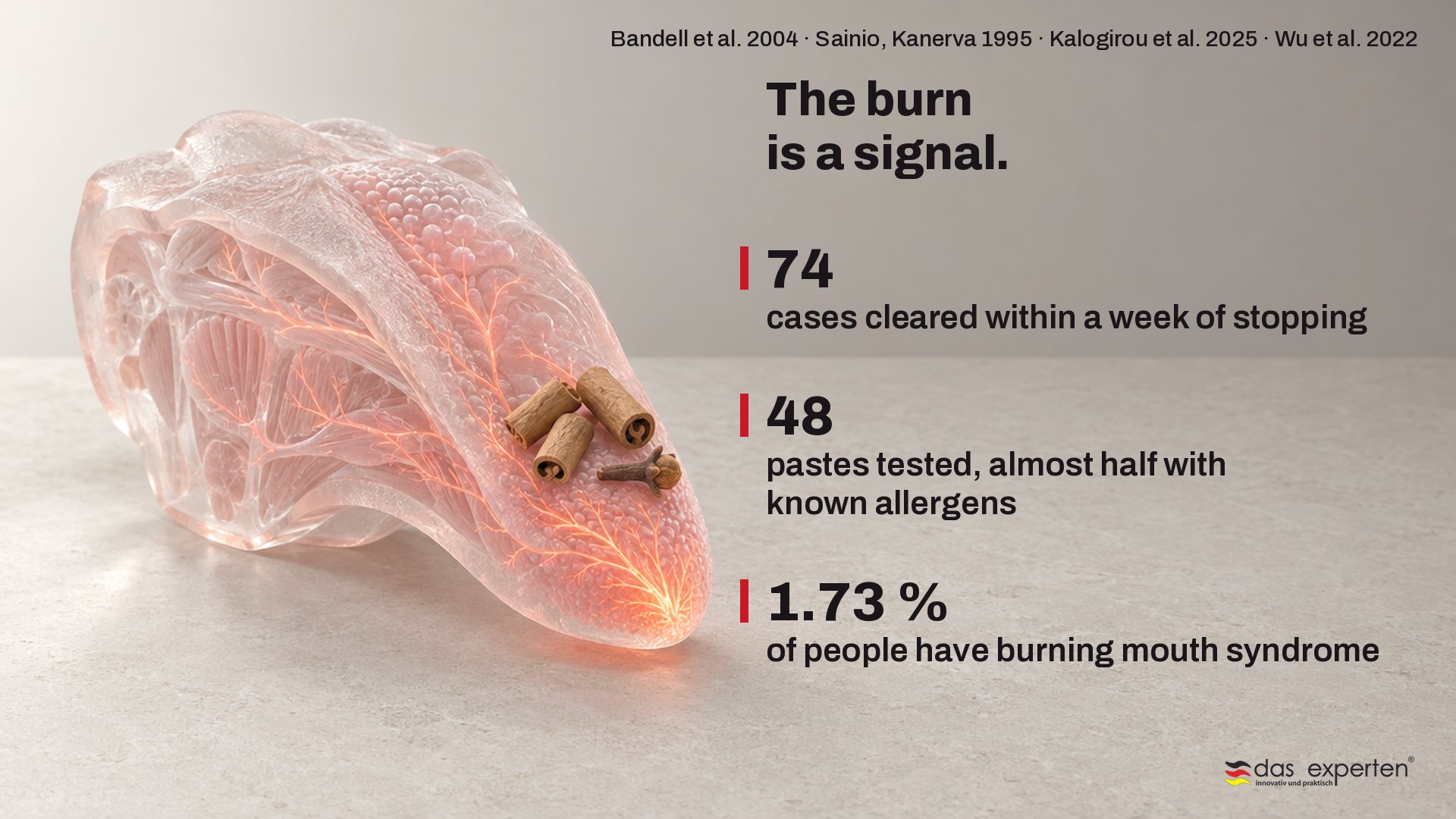
A sting that fades a minute after you rinse is a sensation. A burn that lasts, or comes with redness, white patches, peeling or sores inside the cheeks, is a reaction. In 1976 two dermatologists in California described a patient with acute inflammation of the mouth and the skin around it from a popular cinnamon flavoured toothpaste; the culprit was cassia oil (Drake and Maibach 1976). In 1995 a Finnish survey of 48 toothpastes, virtually all sold in the country, found that almost half contained some of about 30 known allergens, most often flavours such as cinnamic aldehyde, cinnamon oil and peppermint, and preservatives (Sainio and Kanerva 1995).
The good news is how fast it ends. A team in Athens collected 74 cases of mouth inflammation caused by cinnamon in chewing gum and sweets between 2010 and 2025. In every one of them, once the product was stopped, the lesions cleared within a week (Kalogirou et al. 2025).
When it is not the paste at all
Sometimes the mouth burns with no paste in it. Doctors call this burning mouth syndrome. A review of 18 studies put it at 1.73 percent of the general population and 7.72 percent of patients in clinics, more often in women and after 50 (Wu et al. 2022). If the burning stays after a week without your paste, the paste is not the cause, and a dentist or doctor should look.
What to do with a paste that burns
Stop it for a week and brush with a different, plainly flavoured paste. If the burn goes and comes back when you return to the first tube, you have found your answer, and the answer is to change paste, not to push through. Take sores, peeling or white patches to a dentist.
The paste in that review is our TERMO 39°. Its ingredient list uses sodium sarcosinate instead of sodium lauryl sulfate and has no fluoride; it also lists a proprietary thermosensitive agent and a fragrance. We do not promise that any flavoured paste feels the same in every mouth. If it burns in yours, stop it: a feeling of strength is not a measure of cleaning.
A toothpaste that burns is not working harder. It is talking to your nerves, and if it will not stop, listen.