





How Long Should You Brush Your Teeth? 75 s Buy 26%, and Then Nothing
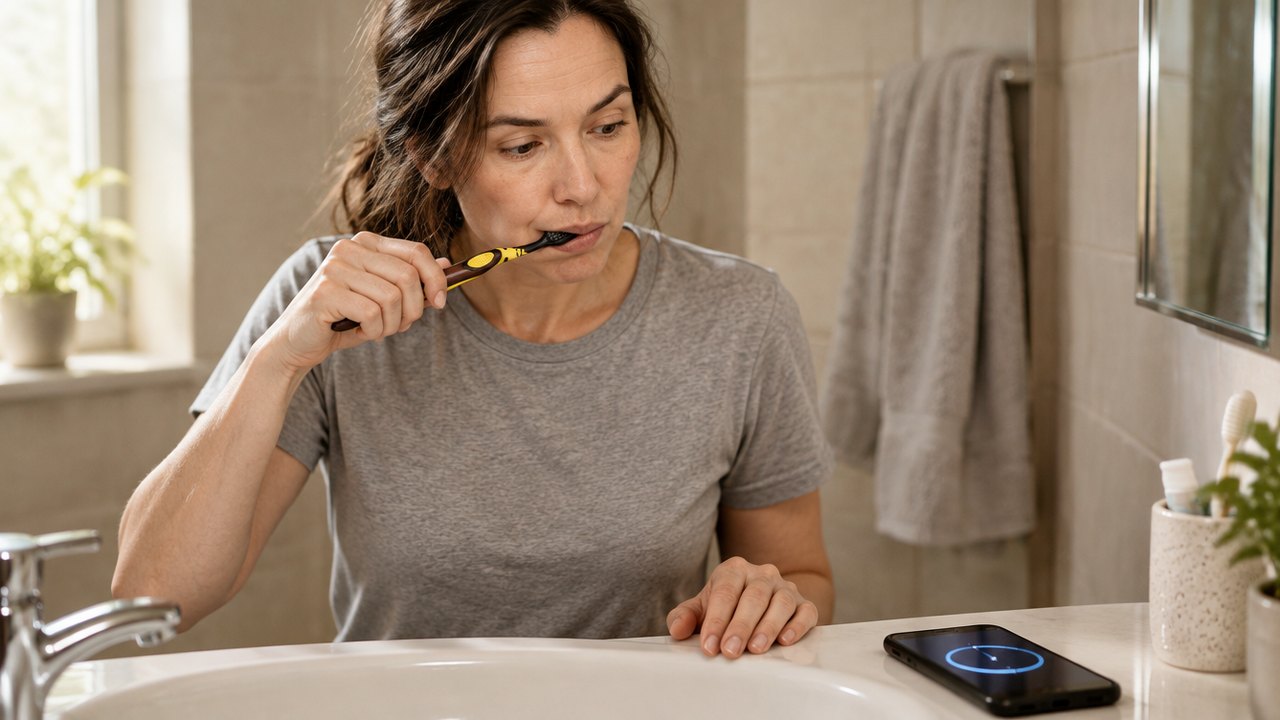
Two minutes is the most obeyed number in personal hygiene, and almost nobody who obeys it can tell you what it buys. That is not an insult. It is what happens to any number once it becomes advice: it gets repeated, it stops being measured, and the quantity it stood for disappears. The NHS prints it plainly: brush twice a day for about 2 minutes each time. The number is good. What is missing is the receipt.
So here is the receipt. People did measure it, more than once, and the answer has a shape no toothpaste box has ever shown. The clock pays extremely well for a while — the 75 seconds between what you actually do and what you are told are worth 26% more plaque gone. Then, on the exact surfaces where teeth actually rot, it stops paying at all.
Nobody has ever measured your brushing. Not even you.
Start with the embarrassing part. You hold an opinion about how long you brush, and that opinion is the only measurement in existence — no instrument has ever been pointed at your bathroom. When researchers point one at a population, the figure is not 2 minutes. The 2009 trial below puts its working baseline at closer to 45 seconds.
That is not a moral failure. It is how long the act feels complete: you do the fronts, the backs on both sides, your arm reports a job done, and you spit. There is no clock inside a mouth, and the only timer in the room is the one you have never once started.
Seventy-five extra seconds, and exactly what they bought
In 2009 Creeth and colleagues sat 47 people down with an ordinary manual brush and 1.5 g of ordinary fluoride paste and timed them at 30, 45, 60, 120 and 180 seconds. Untutored — nobody was taught a technique first: the point was to measure people, not instruction. Then they scored the plaque.
Three minutes removed 55% more plaque than 30 seconds. And the comparison that concerns you personally: 120 seconds removed 26% more plaque than 45 seconds.
Read that as a price. The distance between what you probably do and what you are told is 75 seconds of standing still, and it is worth about a quarter more of the deposit that drives decay and gum disease. Nothing else in oral care is that cheap — not a paste, not a device, not an appointment. You already own the brush and the 75 seconds.
The same trial found something else worth keeping: at 60 seconds, brushing with toothpaste removed no more plaque than brushing without it. The paste is not doing the scrubbing. Hold on to that.
One minute, two minutes, five minutes — identical between your teeth
Now the part that should bother you.
In 2008 Terézhalmy and colleagues ran 40 adults through a crossover trial at three durations: 1 minute, 2 minutes and 5 minutes. Five minutes won decisively across the whole mouth and along the gum margin — significantly more plaque removed than either shorter time, at P < 0.001 for both.
And on the approximal surfaces — the flanks that face each other, where two teeth touch — there was no significant difference between any of the three. One minute, two minutes, five minutes: the same result.
Five times the time. Zero improvement where two teeth touch.
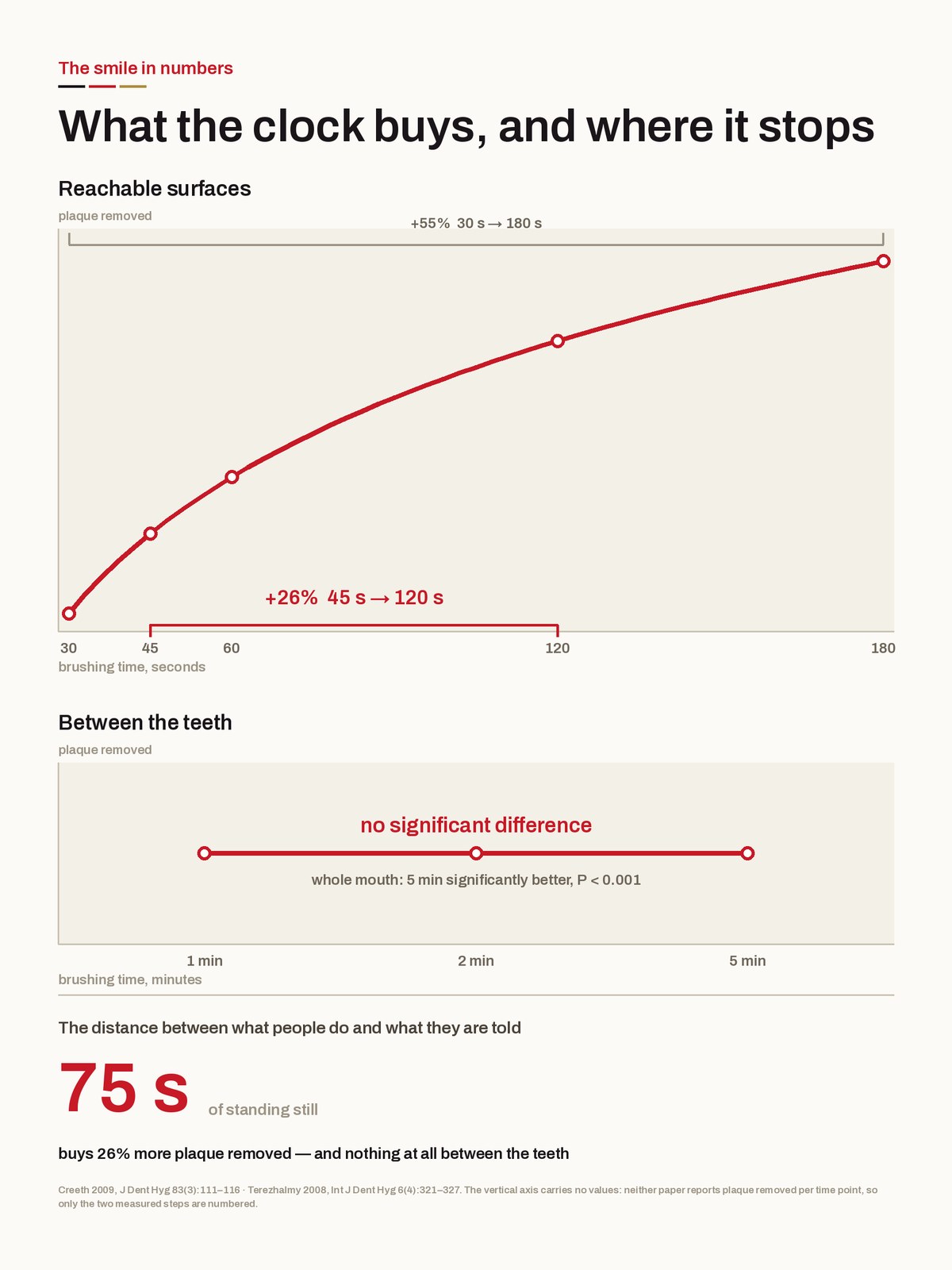
That is the whole lesson of the clock, and it is a lesson about geometry rather than discipline. Brushing time is a proxy for coverage: more seconds mean more strokes across surfaces the bristles can physically land on. On a surface they cannot reach, more seconds multiply zero. Stand at that sink for a quarter of an hour and the arithmetic does not move.
The clock is not only scrubbing. It is dosing.
Remember: the paste added nothing at 60 seconds. Its work is elsewhere, and time is how it gets delivered.
In a 2013 crossover study, Newby and colleagues brushed the back teeth of 4- and 5-year-olds with a pea-sized 0.25 g of fluoride toothpaste — 40 seconds in one arm, 2 minutes in the other — then sampled saliva and the fluid inside the dental biofilm at 5, 15, 30 and 60 minutes. Two minutes put significantly more fluoride into both, as area under the curve across that hour.
So the second minute is not merely a longer scrub. It is a larger dose, held longer, in the fluid that sits against your enamel. Which is also why the NHS tells you to spit and not rinse: four seconds of water undoes the part of the ritual that took the longest.
A robot brushed for seven minutes and kept getting cleaner
If time works on reachable surfaces, where does it stop? In 2023 Saghiri and colleagues bolted a powered brush to a robotic arm and ran it across a model jaw coated in artificial plaque, from 0 to 420 seconds. Removal kept improving across the entire range, and the authors placed efficient removal at 240 seconds — 4 minutes — concluding that 2 minutes is not sufficient. Take that for what it is: a typodont on a bench, not a mouth. They say so themselves and ask for clinical work before anyone rewrites the advice. What it establishes is the shape of the curve — on reachable surfaces the ceiling sits well above 2 minutes.
What actually moves the number, and it is not willpower
The most useful finding here is not about time at all. In 2018 Erbe and colleagues gave 60 adolescents either an ordinary manual brush or a powered brush that showed them, live, where they were and were not brushing. Over 2 weeks the manual group's plaque fell by 1.7% — statistically nothing. The feedback group's fell by 34%, and their brushing time rose by 34 seconds. The manual group's did not move at all.
Nobody talked those teenagers into brushing longer. They were shown what they were doing, and the seconds arrived on their own. Brushing time is not a virtue you summon; it is a measurement you lack. Put a stopwatch face-up on the edge of the basin tomorrow and you will collect those 34 seconds for free.
The number worth changing is not on the clock
Put the findings together and the advice writes itself, in an order almost nobody gives it in. Get to 2 minutes, because those 75 seconds are the cheapest 26% available to you, and time them rather than feel them — feeling them is how you arrived at 45. Spit, do not rinse: the dose you just spent 2 minutes delivering washes out in four seconds.
And then stop asking the clock to solve a problem it has already demonstrated it cannot. Between your teeth, 1 minute and 5 minutes scored the same, and no amount of standing at the sink will change it. Those surfaces need a different instrument, not a longer session. Our WAXED MINT floss is built for tight contacts, implants and retainers; INTERDENTAL S for crowns, implants, braces and narrow embrasures. Not because a brush is a poor tool, but because in a controlled trial five minutes of one proved worth exactly one.
You are not brushing too briefly because you lack discipline. You are brushing too briefly because nothing in your bathroom has ever told you the truth — and the one place where the clock is powerless is the one place you have never cleaned at all.