





Brushing Teeth Too Hard: The Gain Disappears When You Hold the Brush
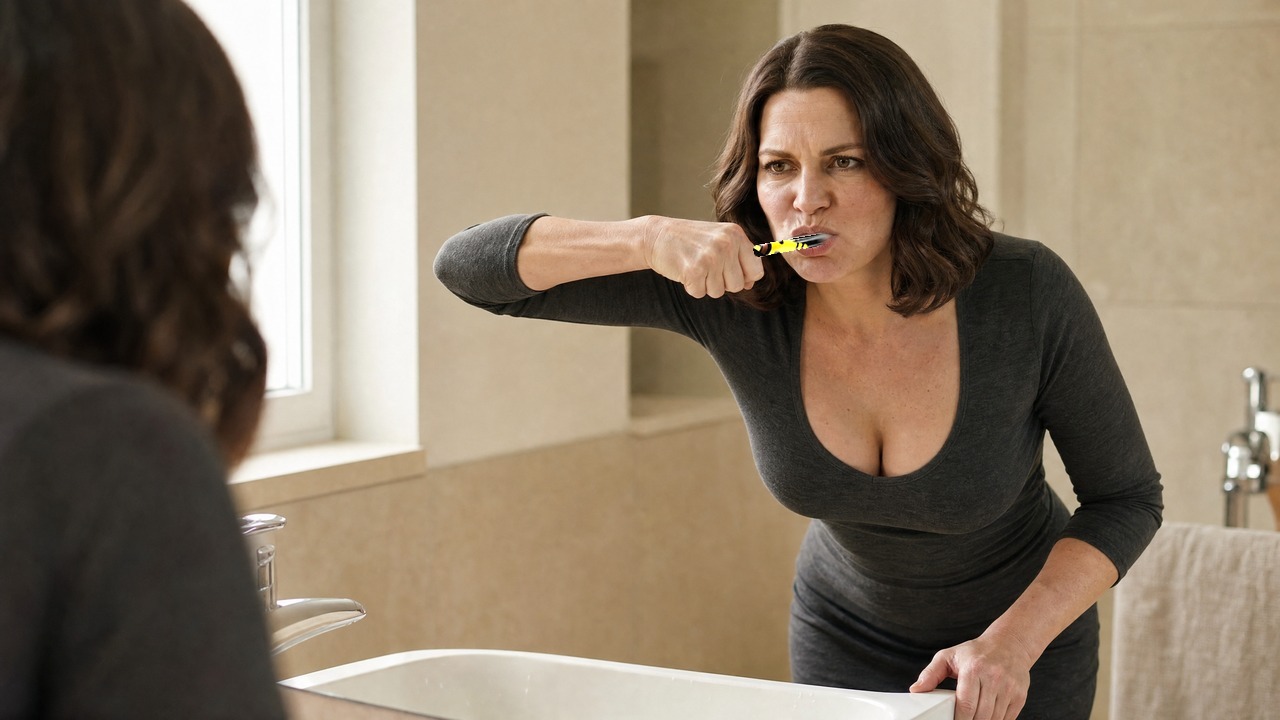
There is a category of error that never announces itself. It does not hurt. It does not show up on the day you commit it. And — this is what makes it durable — it feels like diligence.
You lean into the brush. The wrist locks, the shoulder joins, and for forty seconds you are working. Afterwards the teeth are smooth, the mouth is cold and clean, and the whole episode has the unmistakable texture of a job done properly. None of that is a lie. It is simply unrelated to the question of whether the extra force accomplished anything.
Start with the number your own arm produces
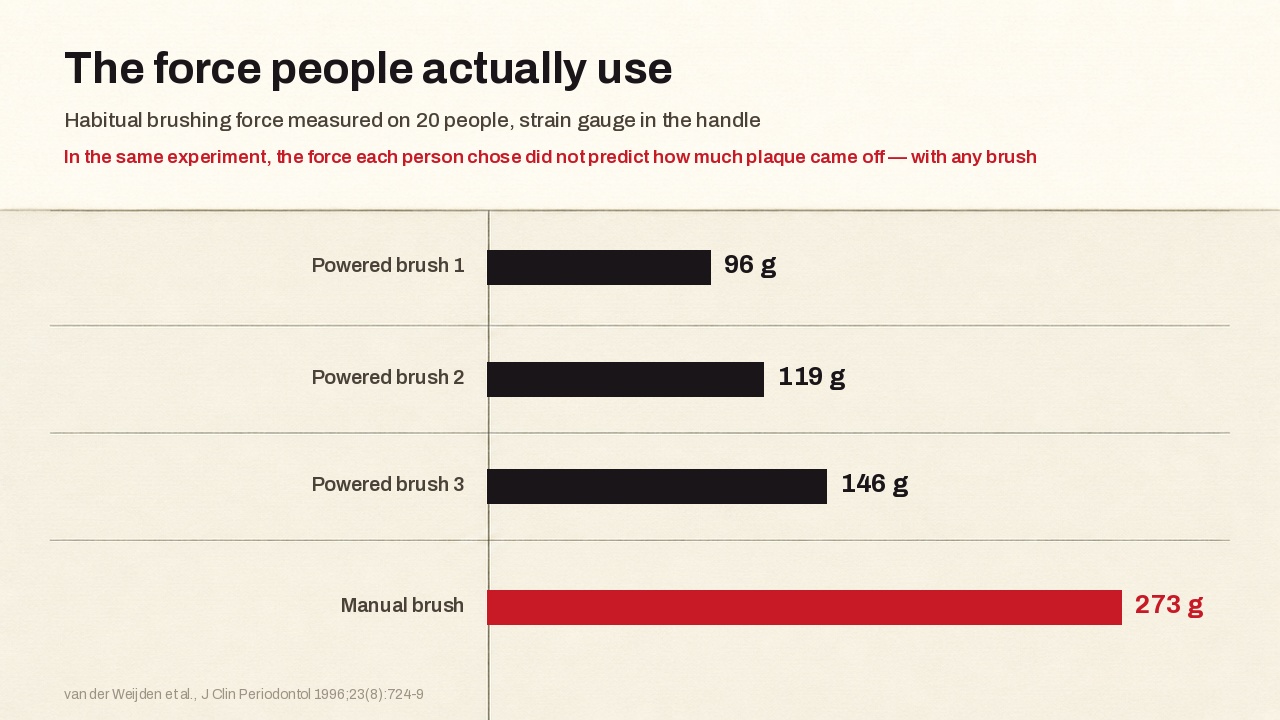
In 1996 a group at ACTA in Amsterdam wired toothbrushes to strain gauges and sampled the force a hundred times a second while twenty people brushed. Not what those people believed they were doing. What they did. With three powered brushes the mean force came in at 96, 119 and 146 grams. With a manual brush, the same twenty people pushed at 273 grams.
Read the spread again. The manual brush is not pressed slightly harder. It is pressed at roughly twice the force of the powered ones, by the same hands, in the same mouths, in the same weeks. Hold that number — it is the only one here you are personally responsible for.
The uncomfortable part: in the laboratory, the myth is true
That same paper had a first half, and it does not say what a myth-busting article would like it to say. There a dental hygienist did the brushing, at forces fixed in advance: 100, 150, 200, 250 and 300 grams. The result is plain. As force went up, more plaque came off — with the manual brush and with the electric one alike.
So the belief is not stupid. In that range, with someone else holding the handle and a dial deciding the pressure, harder did clean better. Any honest account has to concede that first, because what happens next is the interesting part.
And then it evaporates
The second half of the study handed the brush back. Twenty people, screened as good brushers, cleaned their own teeth with a strain gauge in the handle. The force each of them chose was recorded. So was the plaque that came off.
No significant relation between brushing force and plaque removal was demonstrated — for any of the brushes.
Sit with the shape of that. An effect that is real when a hygienist sets the dial cannot be found at all when you set it yourself. The paper does not say why, and I am not going to invent a mechanism: angle, duration, coverage, where the bristles actually land — none of it was separated out. What the study establishes is narrower and more useful. In the range where real people operate, the quantity you control is not the quantity that pays.
One further measurement, and it needs its label worn openly. In 2003 a Newcastle team crossed forces of 75, 150, 225 and 300 grams with brushing times of 30, 60, 120 and 180 seconds and found that at two minutes the improvement above 150 grams was negligible. That plateau was measured on a powered toothbrush and belongs to powered toothbrushes. It is not a ceiling anyone has established for the manual brush in your hand, and I am not going to lend it to one.
The other side of the ledger, which never appears in the mirror
In 2005 a Unilever group brushed polished enamel and dentine blocks in a machine under a constant 375-gram load, with pastes across a range of abrasivity, and measured the step with interference microscopy. Enamel barely moved: wear across every product ran from 0.05 to 0.40 microns. Dentine was the other story. With the load held fixed and only the paste changing, abrasivity accounted for about nine tenths of the variation in dentine lost — the coefficient of determination was 0.897, and 0.930 on medians.
Read what that experiment does and does not show. It varied the paste and held the force constant, so it establishes that which paste you use matters a great deal to dentine. It does not isolate the bristle, and it does not tell you force is harmless; nobody in these sources ran that experiment. A 2013 review is blunt on the point: an RDA value alone does not certify clinical safety, because wear is multifactorial and people brush nothing like machines.
Which leaves two variables under your hand each morning. One is a figure you can look up before you buy. The other you have never measured, cannot feel, and have been calibrating since childhood against the sensation of a job done properly.
The evidence for harm is thinner than you would like, and that is the trap
Here an honest piece slows down. A 2007 systematic review pooled eighteen papers on brushing and non-inflammatory gum recession. Eight found a positive association with brushing frequency. Two found none. The authors closed with the word the internet always drops: inconclusive. The data can neither support nor refute the link.
The reflex is to read that as permission. It is the opposite.
Look at the two sides. On the benefit side, in the one condition that actually describes you — your hand, your habitual force — the relationship between how hard you push and how clean you get could not be detected. On the cost side sits a quantity nobody has pinned down: possibly small, possibly not, varying with gum type, exposed dentine, technique and whatever is loaded on the brush, and accumulating twice a day for thirty-five years, which is about 25,000 repetitions of the same unmeasured extra.
Paying an unquantified premium for a return that could not be found is not a gamble. A gamble has an upside.
The correction is subtraction, which is why nobody sells it
Notice what the fix is not. Not a device, a routine, a supplement, a fourteen-step protocol. It is doing less of one thing, and the market has no mechanism for selling you less.
What it leaves is the variable you can actually read: the number, not the effort. RDA is a laboratory measure of how aggressively a paste abrades dentine, and the 2013 caveat cuts both ways — a published figure is not a guarantee, but an unpublished one is not a comfort either, and a charcoal paste is exactly where the number most deserves to be asked for. The SCHWARZ paste from Das Experten runs a calibrated silica abrasive at RDA 79, described by the people who make it as delicate charcoal care rather than anything more dramatic. The tube declares its number. That is the whole ask — a figure you can look up before you buy, in place of a force you cannot feel.
Tomorrow morning, before the shoulder engages, there is a decision available that takes no time and costs nothing.
You are not brushing harder because it works. You are brushing harder because easing off feels like doing less — and in the one experiment that watched people choose for themselves, that feeling was the only thing the extra force reliably produced.