


What Is Xanthan Gum? Your Toothpaste Is Held Together by the Slime of a Cabbage Disease; and Holding It Is the Only Job It Has

Squeeze a line of toothpaste onto your brush and watch what it does not do. It does not slump. It does not run between the bristles and drip into the sink. It sits there, a small ridge, as if it were solid. Then you start brushing, and within two seconds the same paste flows like a liquid into every gap between your teeth. You have done this ten thousand times and never asked who arranged it.
The arrangement has a name you have probably skipped on the back of the tube: xanthan gum. Its origin is not a mineral, a plant or a petrochemical. It is a bacterium, Xanthomonas campestris, the species behind black rot of cabbage, the disease that blackens the veins of a leaf from the edge inward.
What is xanthan gum, and where does it come from?
In the 1950s, at the US Department of Agriculture’s Northern Regional Research Laboratory in Peoria, Illinois, a chemist named Allene Jeanes was looking for useful things that microbes make from sugar. Her work showed that Xanthomonas campestris turns glucose into large amounts of a thick, slippery polysaccharide, the bacterium’s own slime. Industry found a use for it almost everywhere: dressings that do not separate, ice cream without ice crystals, sauces, cosmetics, and toothpaste. The Lemelson MIT program calls xanthan gum the most mass produced polysaccharide in existence. Jeanes was inducted into the National Inventors Hall of Fame in 2017.
Before you reach for the bin: the US food regulation for xanthan gum requires the production strain to be nonpathogenic and nontoxic, and the finished gum to be free of viable cells. What arrives in your tube is the slime, not the bacterium. Still, notice the asymmetry. A microbe that ruins a crop became the thing that holds your morning together, and nobody designed it that way. It simply did one physical trick better than the alternatives.
What xanthan gum does in toothpaste
The trick has a dull name: shear thinning. At rest, the long xanthan chains tangle and hold water, so the paste behaves like a soft solid. It stands on the brush, and it keeps the grains of abrasive silica suspended instead of letting them sink to the bottom of the tube. Under force, the squeeze of the tube, the scrub of the bristles, the tangle lines up and the paste thins and flows. Stop moving, and it thickens again. Rheology studies of xanthan solutions describe exactly this: strong shear thinning, a yield stress above a critical concentration, and fast recovery of structure once the force stops.
That is the whole job. Xanthan gum does not whiten, does not kill bacteria and does not repair enamel. It is the stage, not the actor. Its value lies in the fact that you never notice it: a paste that separates into a puddle of liquid and a cake of grit is a paste nobody finishes, and a tube left in the drawer protects nothing.
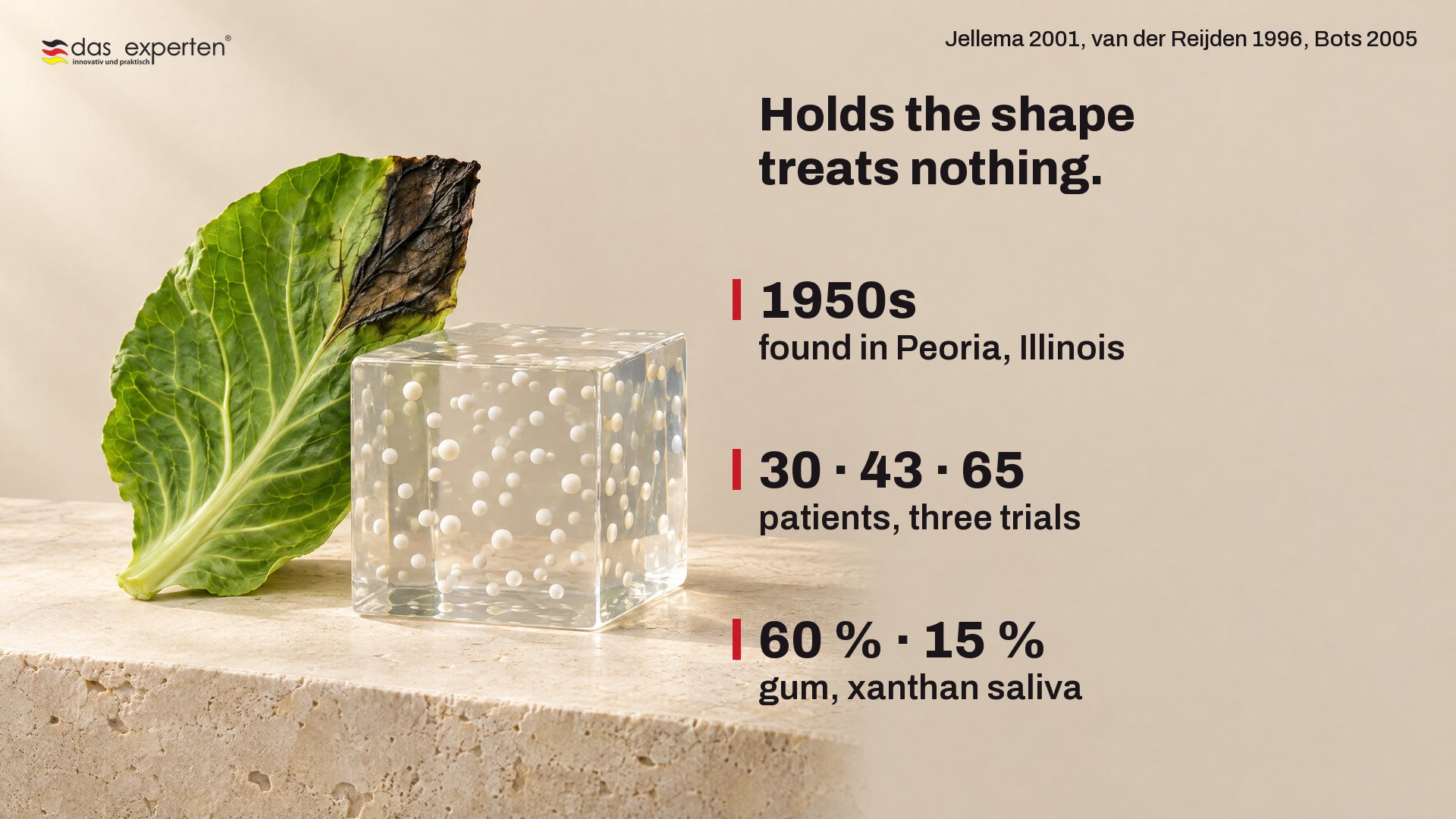
Can xanthan gum help a dry mouth?
Here the story turns, and here honesty costs something. Xanthan gum makes water feel thick and slippery, a little like saliva. So medicine tried it as artificial saliva for people whose glands no longer keep the mouth wet. The trials were small, and the results were humbling.
In Amsterdam, 30 patients with dry mouth after radiotherapy for head and neck cancer used a xanthan based saliva substitute and a placebo in turn; dryness eased with both, to almost the same degree (Jellema 2001). An earlier double blind trial in 43 people with Sjögren’s syndrome found that neither the polymer substitutes nor the placebo was truly effective (van der Reijden 1996). And when 65 dialysis patients compared a xanthan saliva substitute with sugar free chewing gum for six weeks, 60 % preferred the gum and 15 % the substitute (Bots 2005).
The lesson is not that xanthan is useless. It is that structure is not function. A gel can imitate the feel of saliva without doing what saliva does, and chewing, which makes your own glands work, beat it. If your mouth is dry, the thickener in your toothpaste is not treating it, whatever the packaging around it seems to promise.
Now look at your own tube. Turn it over and find xanthan gum in the list. It is probably somewhere in the middle, between the sweetener and the flavour, saying nothing. That silence is the point. What matters for your teeth is what touches the tooth: the abrasive, the actives, how long and how gently you brush. The gum only makes sure they reach the brush in one piece.
Xanthan gum stands in the ingredient list of nine Das Experten toothpastes, from SCHWARZ to INNOWEISS, for the same reason it is in almost every tube: to hold the paste together. We do not claim that it treats dry mouth, gums or enamel, and nothing in this article says more about our pastes than that one line of the formula.
A bacterium that blackens cabbage keeps your toothpaste in shape. It is a perfect stagehand, and the trials are clear that it should never be mistaken for the actor.