





Oil Pulling for Teeth Is Not a Trend. It Is Chapter Five, Verse 78.
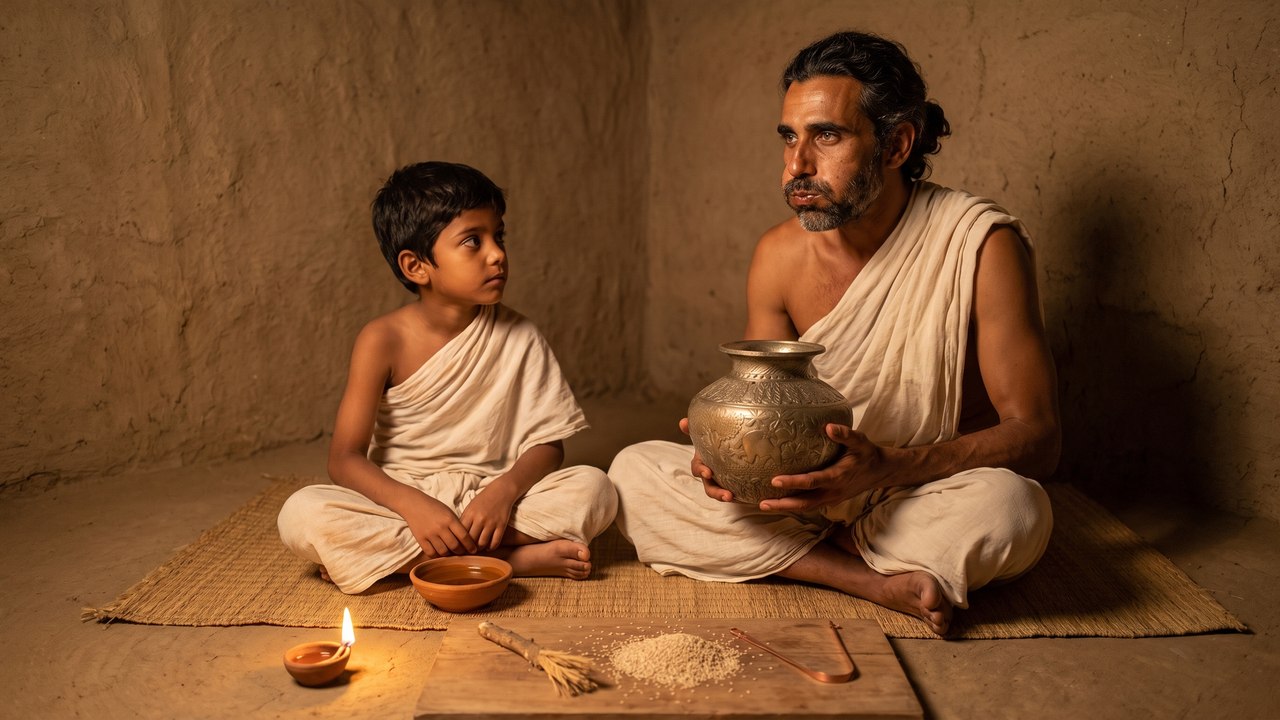
It is still dark, and the first thing the householder does with his mouth is not speak.
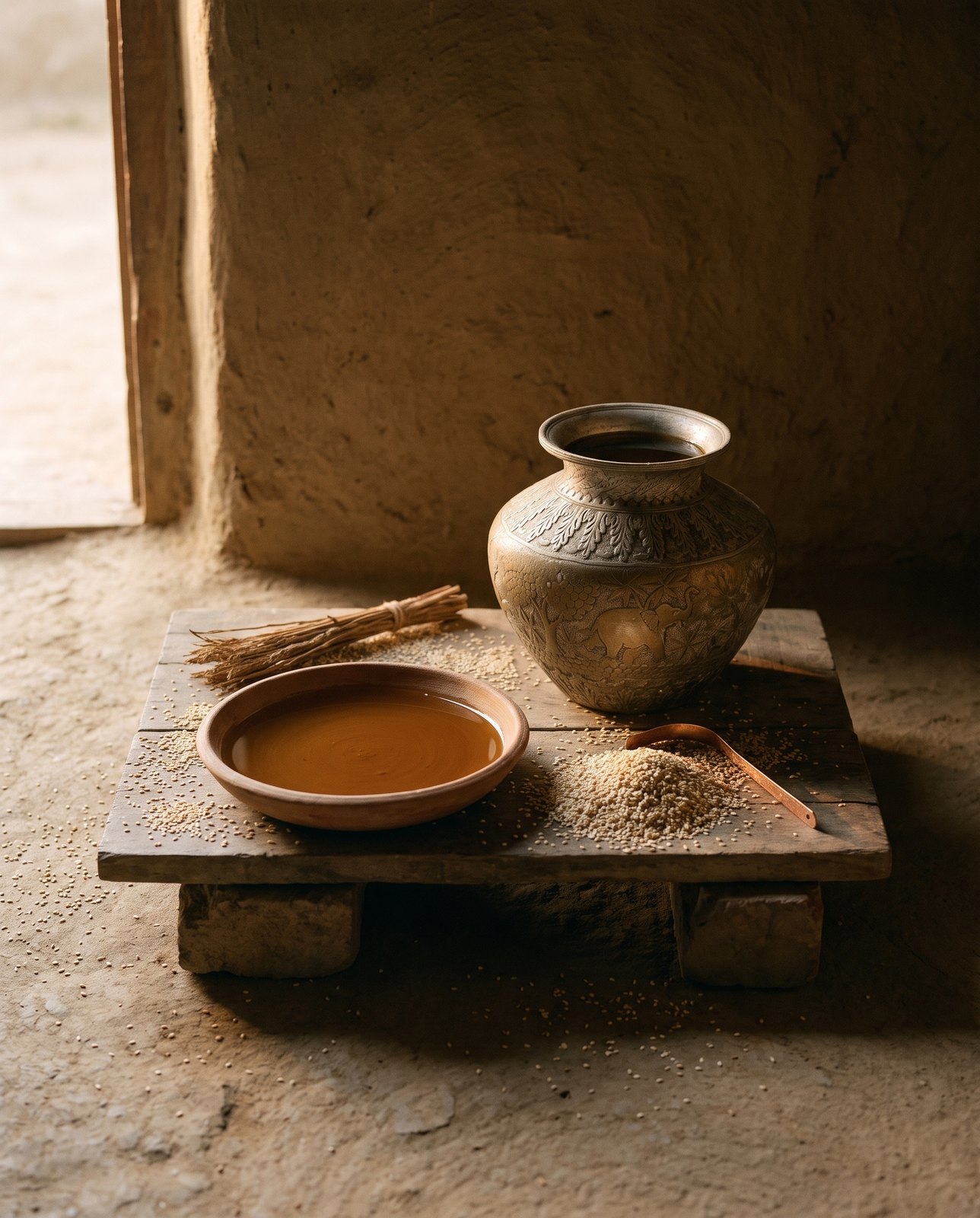
He sits with a small vessel in front of him. In it is sesame oil, unroasted, thick, faintly nutty, at the temperature of the room. He takes a mouthful. Not a sip: a mouthful, enough that his cheeks stand out. He does not swallow it and he does not spit it. He holds it, and it coats the tongue, then the palate, then the spaces between the teeth. Sesame oil is heavy. It does not thin out the way water does, and after a minute the mouth feels lined rather than wet.
His eyes water slightly. The text he is following says that they will.
He has already scraped his tongue, and before that he chewed the end of a twig until the fibres opened into a brush. The oil is the third step, not the first. It is not there to clean anything, the cleaning has already happened. It is there for the gums, the jaw and the voice, and, the text claims, for some thirty complaints that have nothing to do with the mouth at all.
He has no word for bacteria. He has a procedure instead, and he will perform it again tomorrow, as will his son.
Chapter five, verses 78 to 80
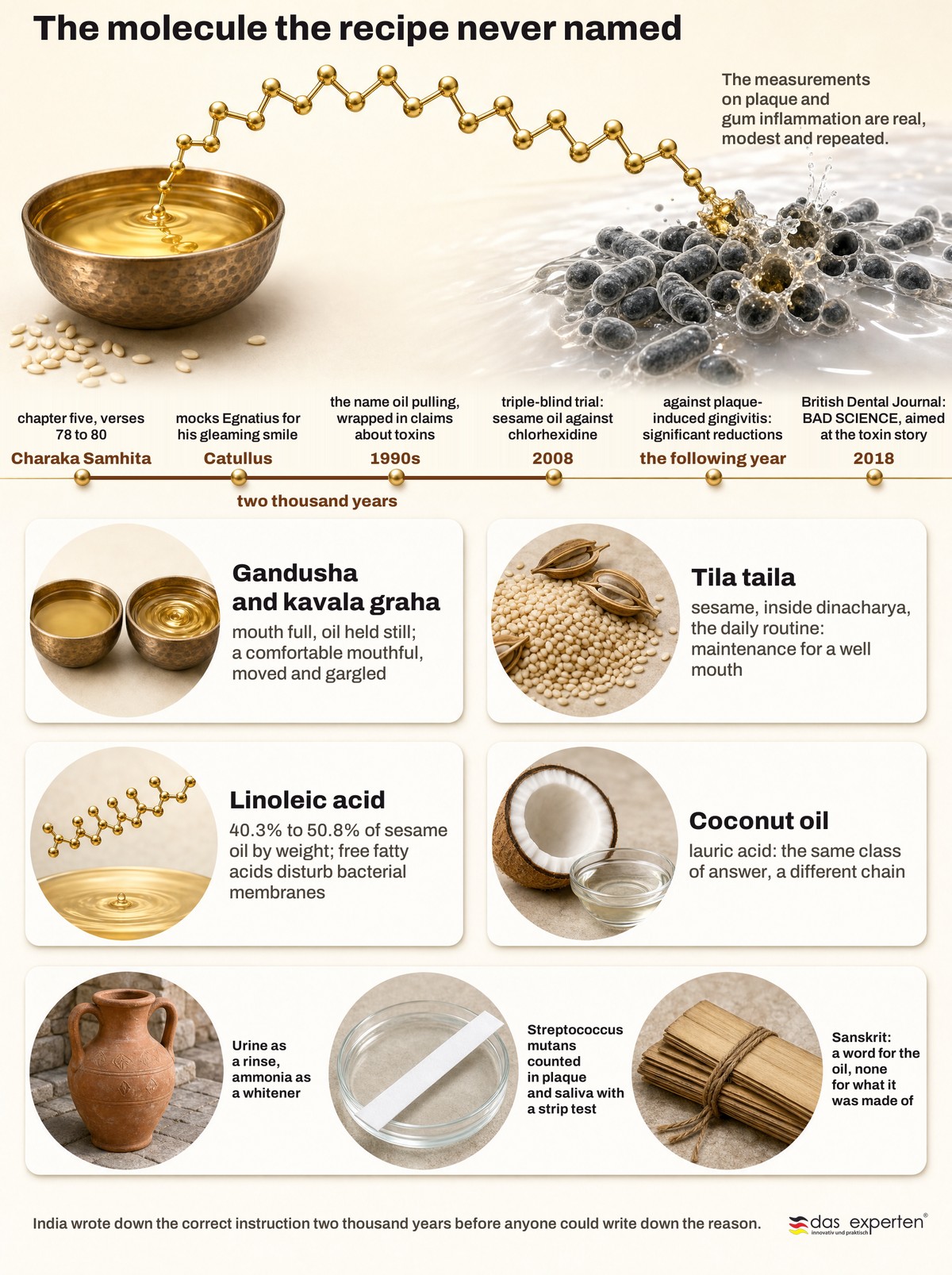
This is not folklore handed down by grandmothers. It is written, numbered and filed inside a medical compendium, the Charaka Samhita, in the section called Sutrasthana, chapter five. And the verses separate two techniques under two different names, which is the detail that gives the whole thing away.
Gandusha: the mouth filled completely, the oil held still, no movement at all. Kavala graha: a comfortable mouthful, moved around and gargled. The same oil, two protocols, two names, because somebody had run both and found they were not the same thing.
The oil named first is tila taila. Sesame. And the whole sequence sits inside dinacharya, the daily routine, next to waking before sunrise and eating at fixed hours. Not a treatment for a sick mouth. Maintenance for a well one.
Meanwhile, in the civilised world
Rome, give or take the same centuries. Catullus writes a poem mocking a man called Egnatius for his gleaming smile, and the joke is what he uses to get it: imported Iberian urine, with which he scrubs his teeth every morning. Not a joke about one strange individual: a joke about a recognised habit, urine as a rinse, ammonia as a whitener, which outlived the poem in Europe by centuries.
Both civilisations were guessing, and both were wrong about why. Only one of them wrote the guess down as a numbered daily instruction and then kept it for two thousand years.
They kept the instruction and lost the reason
Ayurveda did not discover a molecule. It discovered a repeatable result and built a habit around it, which is a different kind of knowledge, and in the ancient world a far more durable one. That is exactly why the practice survived. It is also exactly why it never improved.
A mechanism can be argued with, tested, corrected and carried into another language. A protocol can only be obeyed or abandoned. Sanskrit had a word for the oil and no word for what the oil was made of, because nobody anywhere had one, the concept of a fatty acid is nineteenth century equipment. So the knowledge was preserved in the only form available to it, as behaviour; and when European medicine finally read the text, it read a recipe with no reason attached, and filed it under ritual.
Nothing was suppressed and nothing burned. The instruction sat in an open book for two millennia, in front of anyone who could read Sanskrit. It simply arrived without the one sentence that would have made a physician test it.
Two thousand years, and then a strip test
The practice reached the West late and badly. In the 1990s it surfaced in English under the name oil pulling, a name that translates nothing, wrapped in claims about drawing toxins out of the bloodstream. The old text never makes that claim, and nothing supports it.
Then, in 2008, somebody finally measured it. A randomised, controlled, triple blind trial ran sesame oil against chlorhexidine mouthwash and counted Streptococcus mutans in the plaque and saliva of adolescents using the Dentocult SM Strip mutans test. The following year the same group put the practice against plaque induced gingivitis and reported significant reductions in the plaque index, the modified gingival index and the total aerobic colony count.
The honest reading is a good deal smaller than the internet's. In 2018 the British Dental Journal ran a piece on oil pulling under the heading BAD SCIENCE, and it was aimed squarely at the toxin story and the cure everything list. Both things are true at the same time: the extravagant claims are nonsense, and the measurements on plaque and gum inflammation are real, modest and repeated.
What neither camp tends to mention is the part that actually matters, which molecule is doing the work.
The molecule the recipe never named
Linoleic acid. Sesame oil runs 40.3% to 50.8% linoleic acid by weight, and fatty acids at that chain length are not inert lubricants. Free fatty acids disturb bacterial membranes, and an oil held in the mouth for minutes changes the surface a biofilm is trying to organise itself on. Coconut oil, the version most people have heard of, works through a different member of the same family, lauric acid. The same class of answer, a different chain.
That is the whole bridge. Not a tradition, not a philosophy: a chain of carbon atoms sitting in a vessel in the dark, which nobody in that room could have named.
Which brings us to tomorrow morning
Tomorrow you will put something in your mouth and keep it there for about two minutes. The choice is not ancient wisdom against modern science. It is the archaic delivery against the current one. Twenty minutes of swishing an unmeasured kitchen oil is the two thousand year old version of the idea; the useful question is whether the molecule is already in what you use every morning, at a dose somebody has measured.
Which is the argument for COCOCANNABIS, the fluoride free paste from Das Experten built on hemp seed oil at 3%. Hemp seed oil is the richest of the three in the bridge molecule, linoleic acid at 55.4% to 56.9%, against sesame's 40.3% to 50.8%, and against common oral pathogens it measures a 28 mm inhibition zone. It is SLS free and it sits under RDA 64, which is the entire point: it is built for the ordinary morning, which is the morning the Charaka Samhita was describing too.
The householder in the dark could not have told you why it worked. You can. That is the only thing that has changed in two thousand years.
India did not stumble onto a folk remedy for the mouth. It wrote down the correct instruction two thousand years before anyone could write down the reason, and the West imported the ritual and left the chemistry behind.