





Is Vaping Bad for Your Teeth? Four New Studies Say Your Gums Look Calmer Than They Are
There is a comparison that sounds like good news and is not. Someone quits cigarettes, picks up a vape, and a few months later the gums look calmer. Less red. The dentist glances in and nods. The mistake is not in the eyes. It is in the question. “Better than smoking” and “fine” are two different claims, and almost everyone who vapes has quietly swapped one for the other.
So, is vaping bad for your teeth? Four studies published between 13 August and this week give the most current answer, and it is not the one either side of the argument wants. Here is what is new, with the source and the date on every line.
What is new: four papers, one uncomfortable pattern
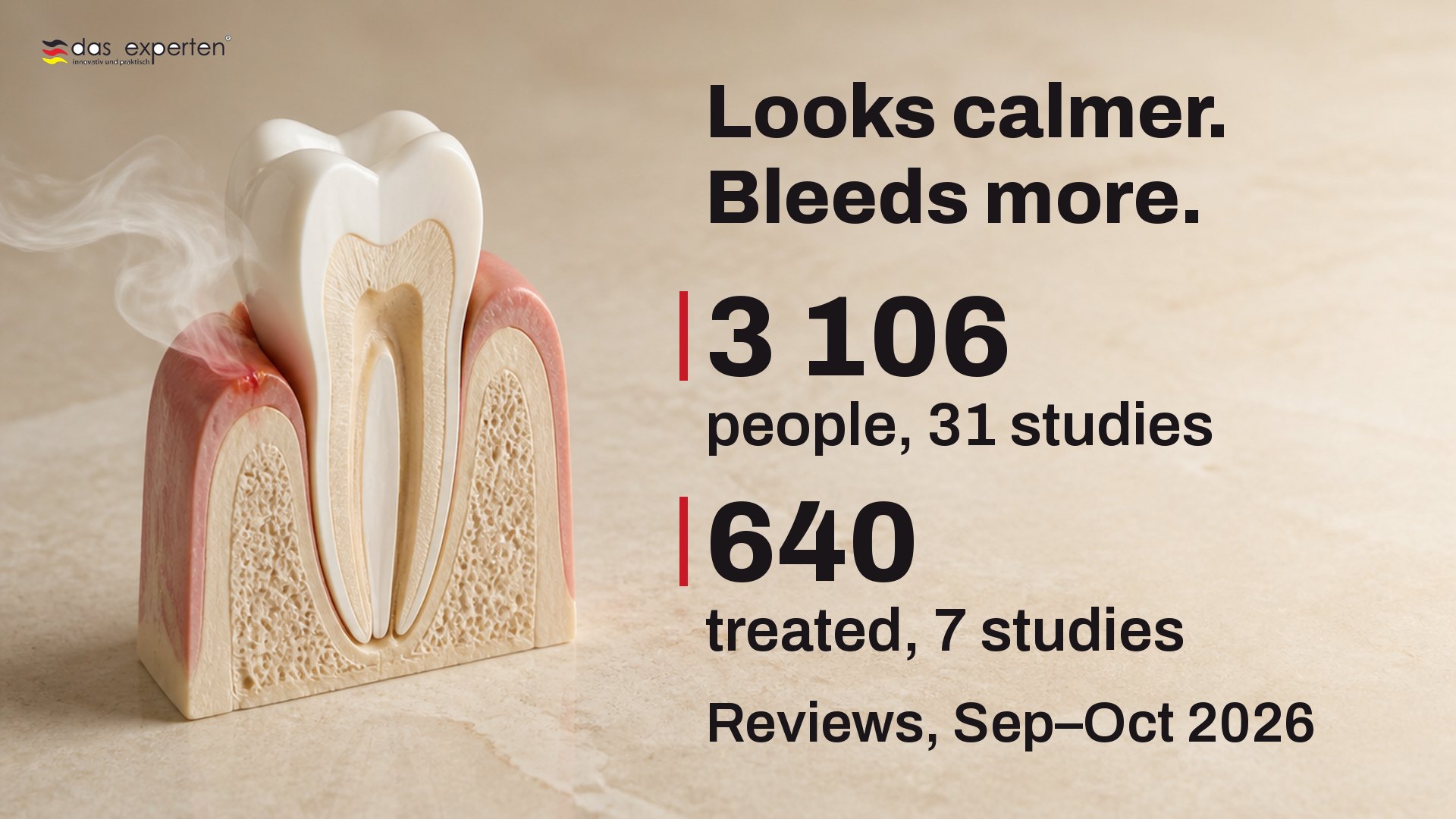
3 September 2026, Dentistry Journal. A systematic review by Di Palo and colleagues pooled 31 studies and 3 106 people published from April 2022 to December 2025. Cigarettes produced the worst gums overall, and waterpipe users looked much the same. E-cigarette users sat in the middle — but with deeper pockets and more lost attachment (the gum letting go of the tooth) than non-smokers, and with more bleeding when the gum was probed, despite a lower score for visible inflammation. Around implants, bone loss in vapers was the highest of every group, cigarettes included. The authors’ verdict: less harmful, “not risk-free”.
October 2026 issue, Clinical and Experimental Dental Research. Gould and colleagues searched to 30 June 2026 for one narrow question: does vaping change how gums respond to treatment? Seven studies, 640 people: 168 vapers, 138 smokers, 334 non-smokers. Response to gum and implant therapy did not differ significantly between vapers and smokers, and both did worse than non-smokers. One inflammatory messenger, TNF-α, ran higher in vapers.
5 September 2026, Ecotoxicology and Environmental Safety. In a laboratory, Ganapathy and colleagues exposed human oral lining cells for two weeks to vape aerosol extract at 30 ng/mL nicotine — the level measured in users’ blood. The cells switched on their stress defences (NRF2) and TGF-β1 signalling, and began to behave more like stem cells. That is cells in a dish, not people, and the authors call it an early signal that needs follow-up.
13 August 2026, BMC Oral Health. The counterweight. Li, Tan and Han followed 328 patients with 452 implants for a year. Smokers ended with deeper pockets than vapers, 3.72 mm against 3.18 mm, and more bone change, 1.01 mm against 0.68 mm. A point for the vape — until you read the small print: the vapers had used their devices for a median of 3 years, the smokers for 12, and there was no group that had never smoked at all.
Less harmful is not harmless
Notice what every comparison above is measured against. Vaping is graded against cigarettes — the worst thing a mouth can do to itself — and it passes, the way anything passes when the bar is on the floor. The one reference that matters for you is the gum you would have with neither. Against that gum, every paper this summer says the same thing: deeper pockets, more bleeding, worse response to treatment.
The two bone results disagree, and that is worth saying out loud rather than smoothing over. One review found the most bone loss around implants in vapers; one cohort found less than in smokers. The cohort’s vapers had a quarter of the smokers’ exposure. Gum disease is slow; damage is counted in years. A habit that is three years old has not yet had time to send its bill.
There is a second blind spot, and the implant authors name it themselves: previous smoking was not measured. Many vapers are former smokers, so a vaper’s gum often carries years of cigarettes the study cannot see. That cuts both ways — it can make vaping look worse than it is, or hide how much of the “improvement” is simply time since the last cigarette. Either way, nobody yet has the clean comparison you would want.
The strangest line is the quietest one. Vapers’ gums scored lower on visible inflammation and still bled more when a probe went in. If you switched from cigarettes and noticed your gums looked pinker, you probably took that as the verdict. It may only be the part of the verdict you can see in a mirror.
What to do with this on Monday morning
Tell your dentist you vape, in the same sentence you would use for cigarettes: the treatment review found vapers respond like smokers, and the plan should know it. Ask to have your pockets measured rather than looked at, because the look is exactly what vaping seems to flatter. And give the gumline the attention you would give it if you still smoked.
If you want a paste for that routine, our GINGER FORCE carries 1 % ginger root extract, sodium pyrophosphate against tartar, no fluoride and no SLS, and its product card names smokers among the people it is made for. It does not undo a vape. Nothing in a tube does. It keeps the daily part of the job honest while the dentist does the measuring.
The vape did not make your gums healthy; it may only have made them quieter — and a quiet gum is the one you stop checking.