





How Many People Have Cavities? Children’s Fall, Yours Rise
In the tables of the Global Burden of Disease study there is a line that ought to stop anyone who reads it and stops almost no one. The most common health condition on earth is not an infection, a cancer or a disease of the heart. It is a hole in a tooth. Untreated decay in the permanent teeth of adults was carried by 2.24 billion people in 2021, and it has held first place for so long that the researchers who count it no longer remark on the fact. Somewhere along the way a condition affecting more than a quarter of the species stopped being news. That is the part worth explaining — not how many mouths are damaged, but how a number this large became this quiet.
Almost every second person alive, and nobody has called it an epidemic
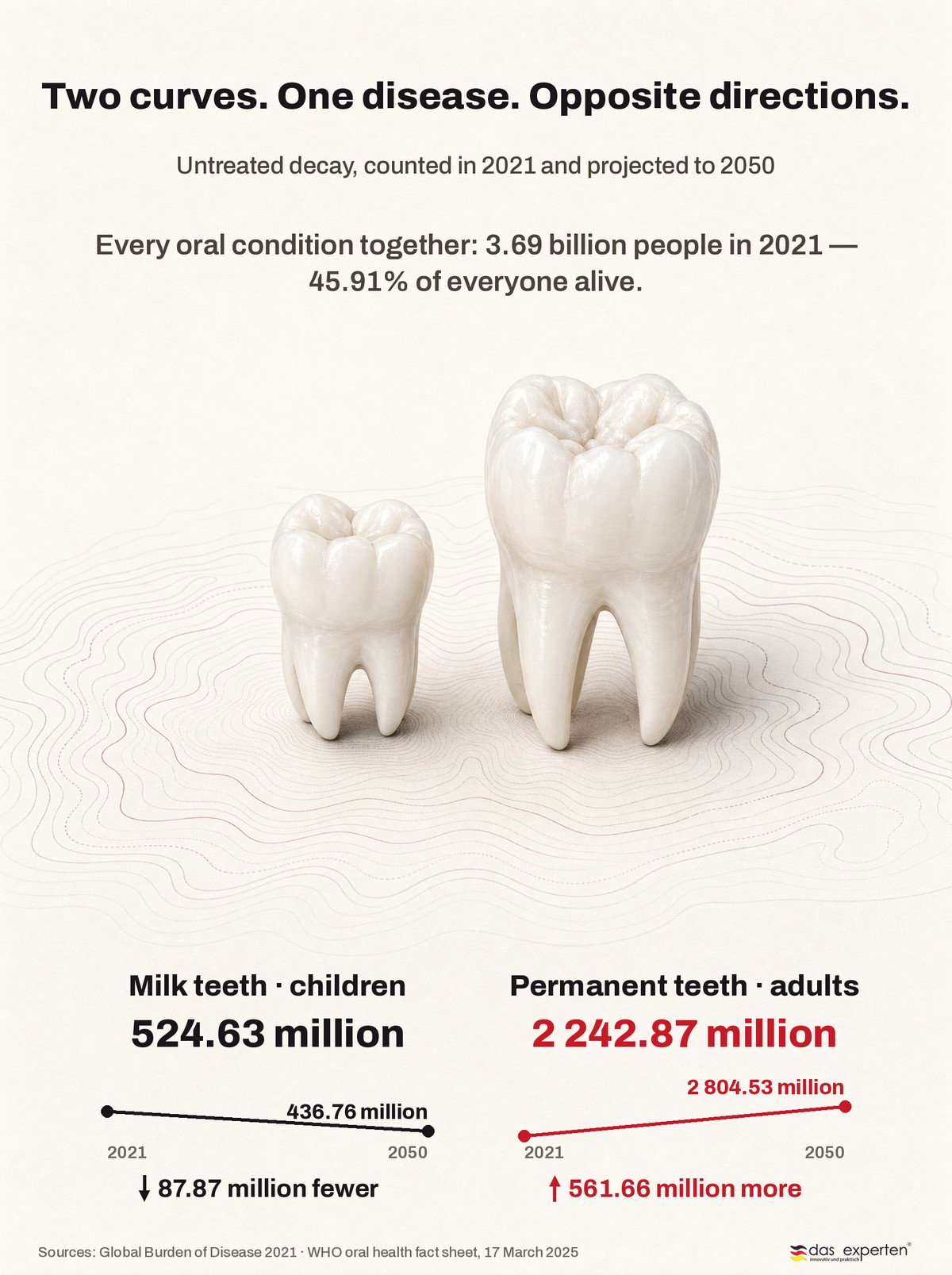
Widen the lens from decay to every oral condition at once — decay, gum disease, the teeth already gone — and the 2021 count reaches 3.69 billion people. The World Health Organization, in its fact sheet of March 2025, rounds that to nearly 3.7 billion. The age-standardised prevalence behind the figure is 45.91 percent, and the wording matters: this is not a population at risk, not a tendency, not a projection. It is a count of mouths in which something is wrong now. Close to every second human being alive is one of them. If any other organ failed at that rate, the failure would carry the organ’s name and have a ministry of its own.
The rest of the ledger reads the same way. More than 1 billion cases of severe gum disease. Complete tooth loss in almost 7 percent of everyone past twenty, rising to 23 percent of everyone past sixty — which is to say that by retirement roughly one person in four is eating without teeth of their own. Oral cancer accounted for 389 846 new cases and 188 438 deaths in 2022. And noma, a disease most physicians in wealthy countries will never see, is still estimated to begin in 140 000 children a year. None of this belongs to the medieval part of the story. It is this decade.
Two curves left the same page, and they are moving apart
Here the data does something nobody expects. Carry the 2021 figures forward to 2050 and the two halves of the same disease travel in opposite directions. Untreated decay in children’s milk teeth — 524.63 million cases in 2021 — is projected to fall to 436.76 million. Untreated decay in adult permanent teeth is projected to rise to 2.80 billion. One curve down, one curve up, the same disease, the same species, the same fifty years. Whatever it was that worked, we did it to children and not to ourselves.
And it is no mystery what we did. Fluoride in the water and in the tube. Screening at school. Sealants. Paediatric dentistry as a specialty. A parent in the bathroom doorway saying do the back ones. Every one of those interventions shares a structure that has nothing to do with chemistry: somebody other than the patient was made responsible for the patient’s mouth, and somebody checked. The milk-teeth curve is bending because a child’s mouth is supervised. The adult curve is not bending because the supervision simply stops — and it stops at an age when the person it is handed to has not yet had the disease it was preventing.
Try to remember the last time another human being watched you brush your teeth and told you that you had missed a spot. For most people reading this the honest answer is somewhere around the age of seven. You have since been trusted, without a single review, with the daily maintenance of the organ that fails more often than any other in the body. The responsibility was handed over on the assumption that two minutes is a simple thing and that anyone can do it unsupervised for the next seventy years. The statistics are the audit of that assumption, and it did not pass.
The bill does not arrive when the hole does
Money keeps the same secret. Oral conditions cost the world US$710 billion in 2019 — US$387 billion in direct treatment and US$323 billion in lost productivity. The interesting figure is inside that second half. Of the productivity losses, decay in permanent teeth accounted for US$22.46 billion. Total tooth loss accounted for US$167.29 billion, more than seven times as much. The condition that leads every prevalence table in the world is not the one that costs the most. The expensive line is the end state, thirty and forty years downstream, which means the world is not paying for cavities. It is paying for cavities that were left alone long enough to finish.
That gap between the cheap early state and the expensive late one is where a personal decision actually sits, including for someone who has never once framed it as a decision. Every morning you are settling, without deliberating, which end of that curve your own mouth will be on in forty years — and the settling is done by habit, which is the most powerful way a choice can be made and the least examined. It is also why the specification of an ordinary tube matters more than its marketing: what the formulation is built to do, how abrasive it is, whether it suits the surface it meets twice a day. Brands that are organised around that question rather than around flavour, Das Experten among them, are answering a maintenance problem and not a cosmetic one. Still, nothing on a shelf moves these numbers by itself. What moves them is that the two minutes happen, and happen properly, for decades after the last person who checked stopped checking.
What the count is really measuring
Read the whole table again and it stops being an account of disease and becomes an account of attention. Almost nothing inside those 3.69 billion is caused by a missing molecule or an unsolved scientific problem. The chemistry was settled decades ago, and the countries with the best numbers are not the ones with the cleverest pastes but the ones that kept somebody watching for longest. The most common condition on earth is, underneath, a maintenance failure at civilisational scale — the arithmetic of handing every adult a small daily task and then never mentioning it again. The species did not fail to find the cure. It found one, gave it to its children, and then let go of the handle.
You are already inside this data. The only open question is which of the two curves your mouth is on, and the answer is being written two minutes at a time, by you, unsupervised, starting tomorrow morning.