





Whitening Toothpaste for Veneers: Your Enamel Heals, Ceramic Does Not
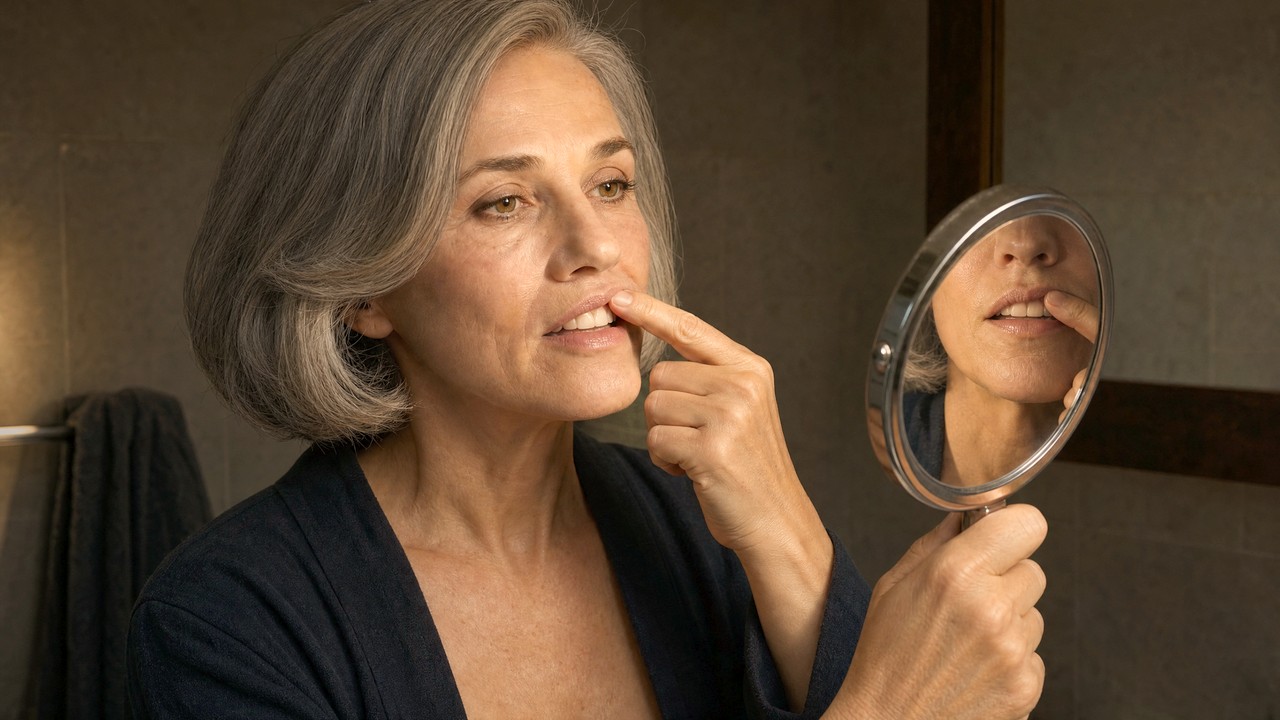
There is a class of damage with no pain receptor attached. Enamel at least has one — not for wear, but for the cold that arrives once the surface is thin enough. A crown has nothing. A veneer has nothing. A denture base has nothing. You can degrade all three at the rate of two minutes a day for ten years and receive no signal whatsoever. The absence of a signal is not the absence of damage. It is the absence of a signal.
Six times in one month, the same question, and no straight answer
It reached our review queue on six separate days inside a single month, dressed in different words each time: is this paste all right for crowns and implants, can I use it on ceramic teeth and acrylic dentures, what about zirconia veneers. Nobody asks the same thing six times out of idle curiosity. They ask because they paid for something they cannot casually replace, because the tube says nothing useful, and because the person best placed to answer them sees them for twenty minutes once a year. You have probably stood at a mirror with that exact doubt and then brushed anyway, on the grounds that brushing is virtuous. Virtue is not a material property.
Somebody measured the line, and it is a very small number
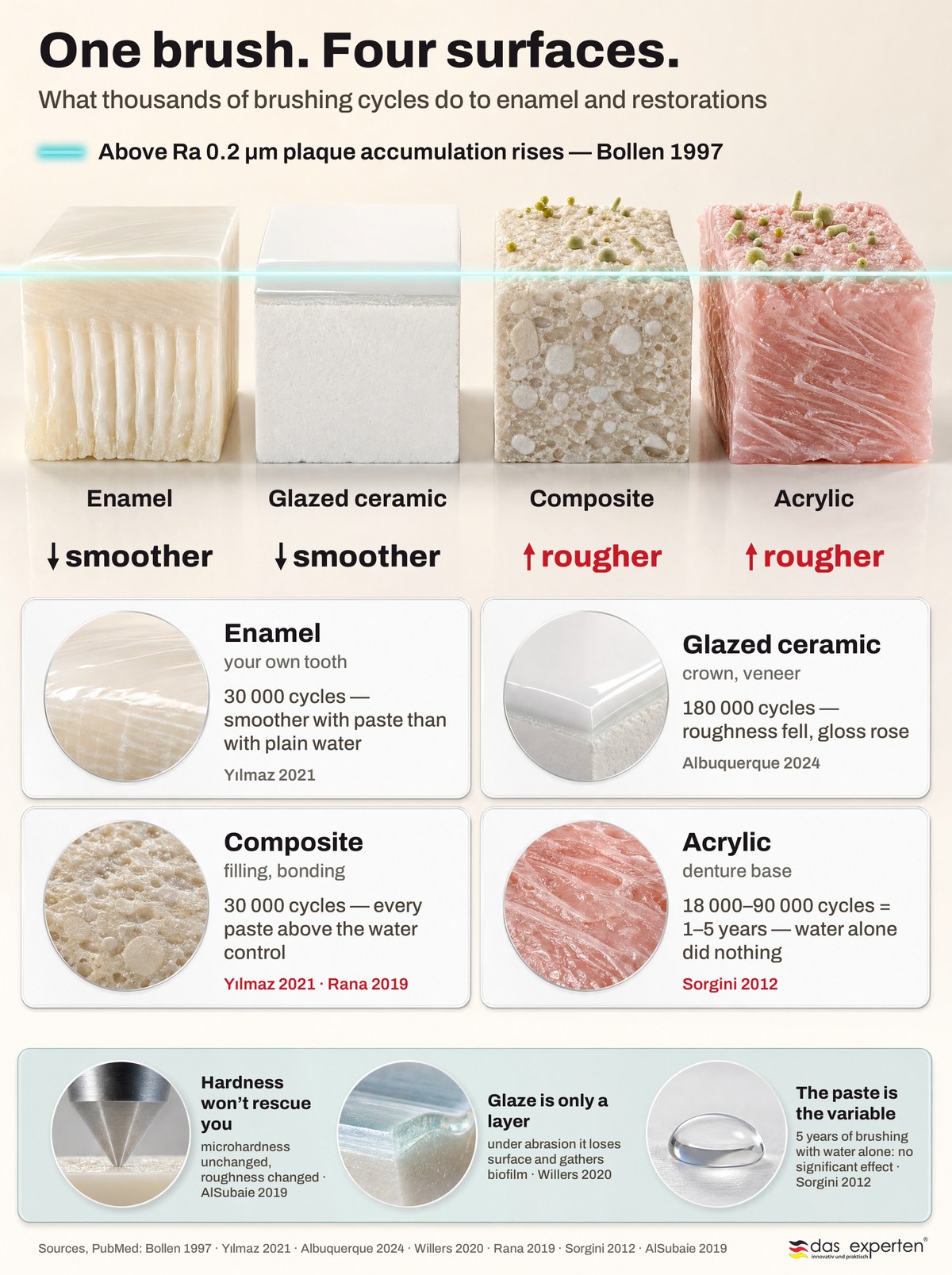
The line is roughness, and it was drawn in 1997. Reviewing the hard surfaces that live in a human mouth, Bollen, Lambrechts and Quirynen identified a threshold of Ra 0.2 µm: below it, making a surface smoother buys no further reduction in bacterial accumulation; above it, plaque accumulation rises, and with it the risk of both caries and periodontal inflammation. Two tenths of a micrometre. You cannot see it, you cannot find it with your tongue, and no product on any shelf will tell you which side of it you are on. That same review ends on a sentence that belongs on every tube: every dental material needs its own treatment in order to obtain and maintain a surface as smooth as possible.
Then the ceramic did the opposite of what everyone expects
Here the intuition fails, and it fails in the direction nobody plans for. Glazed CAD/CAM ceramics — lithium disilicate, zirconia-reinforced lithium silicate, partially stabilised zirconia, which is to say the materials your crown and your veneer are actually made of — were brushed for 180 000 cycles in 2024 by de Castro Albuquerque and colleagues. Surface roughness did not rise. It fell significantly, and gloss rose: the brushing polished them. Long-term toothbrushing, the authors concluded, did not jeopardise the glazed surface at all. If you have spent years brushing your crown timidly, you have been solving the wrong problem.
The catch sits inside the word glazed. A glaze is a layer, and a layer has a thickness. In 2020 Willers and colleagues went at that layer directly and found it is the fragile part of the arrangement: abrasion, and erosion combined with abrasion, produced significantly greater surface roughness, greater surface loss and greater biofilm deposition than erosion alone — and roughness and biofilm deposition were significantly correlated. The glaze on monolithic zirconia fared worse than the glaze on lithium disilicate. So the body of the ceramic is close to indestructible and the skin on it is not, and it is the skin that decides how much plaque your gum line has to live beside.
One tube, two minutes, two results in opposite directions
Now the part that ought to end the argument. In 2021 Yılmaz and Kanık brushed human enamel and three composites for 30 000 cycles with a whitening paste built on blue covarine. The composites came out rougher. Human enamel came out smoother brushed with the paste than brushed with distilled water. Same paste, same machine, same two minutes — one surface improved and the other degraded, and the only variable was what the surface was made of. Rana and colleagues found the same asymmetry from the other side in 2019: on nanofilled composite, every one of five household dentifrices produced significantly more roughness than plain water, and a tooth powder produced the most of all.
Acrylic is the clearest case, because somebody ran the clock out. In 2012 Sorgini and colleagues brushed a PMMA surface for 18 000, 36 000, 72 000 and 90 000 cycles — calculated as one, two, four and five years of regular brushing. At every interval the effect of distilled water was insignificant. The dentifrices differed from water significantly. Read that twice: across five simulated years the brush by itself did essentially nothing. The paste was the entire variable. Hardness will not rescue you either — AlSubaie and colleagues found the microhardness of restorative materials essentially unchanged before and after, while roughness changed significantly. What fails is the finish, not the substance.
So stop asking how hard you brush. Ask what is doing the cleaning.
Every one of those studies measures the same thing from a different angle. An abrasive removes material, and removed material comes back nowhere in your mouth except on living enamel, which remineralises. Your crown has no such mechanism. Your composite has none. Your denture base has none. That makes brushing a restored mouth an asymmetric bet: a small daily gain in cleanliness, paid for with a small daily loss that only ever accumulates in one direction. The sane response to an asymmetric bet is not to brush less. It is to change the instrument, so that the cleaning is done by chemistry rather than by grinding, and the number to ask a manufacturer for is RDA. The INNOWEISS paste from Das Experten is built on a five-enzyme cascade — dextranase, invertase, glucose oxidase, papain and bromelain — on a silica base measured at RDA below 30; it removes 52–69% of dental biofilm through the dextranase mechanism and whitens with zero peroxide and zero abrasive action.
You will never feel the moment a restoration crosses 0.2 µm. You will not catch it in the mirror, and the mouth that pays for it is not the one you have tonight but the one you have in five years. The question is not whether your toothpaste is gentle enough for your teeth. It is whether it is gentle enough for the parts of your mouth that can no longer heal.