





When Was the Toothbrush Invented? Long After the First Dental Drill

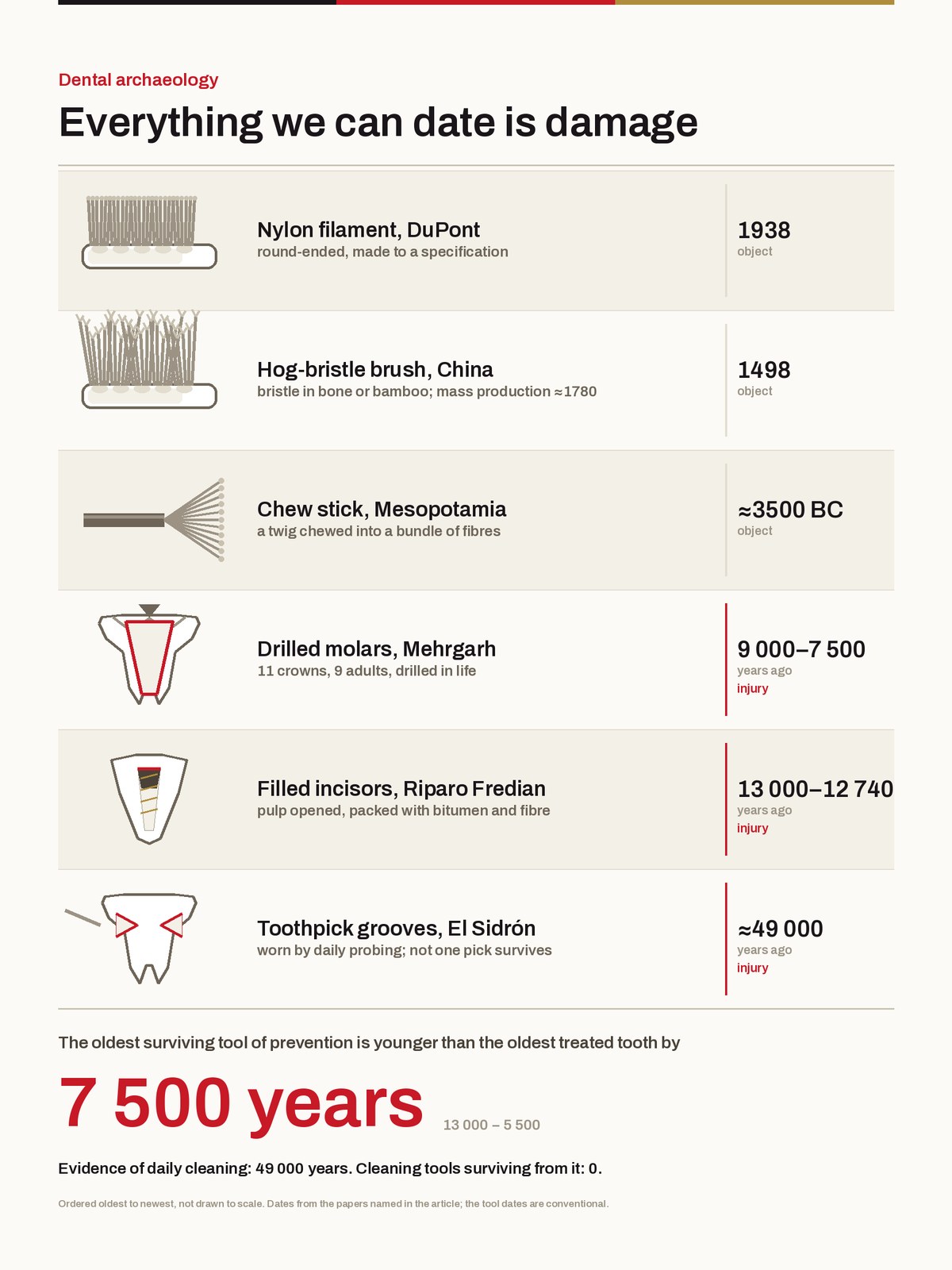
There is a tooth in Tuscany with a hole in it, and the hole was made on purpose. Not by decay — by a person, with a tool, on someone who was alive at the time and presumably not enjoying it. Direct radiocarbon dating puts the owner of that tooth between 13 000 and 12 740 years ago. Both upper first incisors had their pulp chambers opened and widened before he died. Under the microscope, stuck to the inside walls of the cavities, sits a conglomerate of bitumen, vegetal fibres and what the authors carefully call probable hairs. A filling. Thirteen thousand years ago somebody in the Apennines cleaned out an infected pulp and packed the hole with what was to hand.
Hold that date for a moment, because the question people actually type is a different one: when was the toothbrush invented? The answer takes an uncomfortable route. The brush arrives late. Very late. And the reason it arrives late is not the one you would guess.
The drill is older than the alphabet
The Tuscan tooth is not one eccentric. In 2006 a team published eleven drilled molar crowns from nine adults in a Neolithic graveyard at Mehrgarh, in what is now Pakistan, dated between 7 500 and 9 000 years ago. Drilled in life, on chewing surfaces, with flint-tipped tools of the kind the site was already using to make beads. Some of the holes show wear inside them, which means the owners went on chewing for years afterwards. That is the part that should stop you. One clever individual is an anecdote. Eleven teeth across nine people over roughly fifteen centuries at a single site is a profession.
Now go and find the brush
Search the same record for the object that would have prevented all of it, and the trail goes cold immediately. The oldest cleaning implement you can actually hold is a chew stick: a twig five or six inches long, one end chewed until the fibres splay into a bundle. The conventional date for those is around 3500 BC in Mesopotamia — roughly five and a half thousand years ago, which makes it some seven and a half thousand years younger than the Tuscan filling. The bristle brush you would recognise appears in China in 1498: hog bristle set into a handle of bone or bamboo. Mass production waits for William Addis in England around 1780. The nylon filament actually in your hand arrives from DuPont in 1938, sold as Doctor West’s Miracle Tuft. So the drill beats the brush by thousands of years, and you are invited to conclude that our ancestors repaired teeth they never bothered to clean.
That conclusion is wrong, and the way it is wrong is the whole point.
The oldest cleaning we know about is a scar
In 2016 three researchers examined 204 isolated Neandertal teeth — from El Sidrón in Spain, a group dated to about 49 000 years ago, and from Hortus in France. Near the neck of the teeth, on the sides that face their neighbours, they found fine parallel microstriations, and they reproduced the same marks experimentally using grass stalks. Toothpick grooves. Eight of the nine Hortus individuals carried them; nine of eleven at El Sidrón. They turned up on 21 incisors and canines as well as the back teeth. Forty-nine thousand years ago, people were cleaning between their teeth — routinely, for long enough, and with enough force, to wear a channel into the hardest tissue the body makes. Not one of their picks survives. We know the habit happened only because it left a wound.
Everything we can date is a failure
This is the shape of the entire record, and once you see it you cannot stop seeing it. A drilled molar survives because it is a hole. A filling survives because it is a foreign body rammed into enamel. A toothpick groove survives because it is wear. Meanwhile the grass stalk rots, the twig rots, the hog bristle rots — and, far more importantly, a tooth that was simply kept clean looks exactly like a tooth that was never in any trouble. It enters no catalogue. It carries no date. It is indistinguishable from luck.
Notice what that does to the precision. Archaeology can tell you, inside a window of 260 years, when a man in the Apennines had his incisors opened. It cannot tell you within a decade when the modern toothbrush went into production — the English sources give 1770 and 1780 for the same man in the same prison, and nobody much minds, because a brush that works is not an event. The object with the sharp date is thirteen thousand years old. The object with the blurred date is two hundred and fifty.
Your own mouth keeps exactly the same books
Try it on yourself. You can name your fillings. You can probably name the bad one — the year, the chair, the sound. Now try to name one single morning that prevented the others. You have had something like fifteen thousand of them and not one is available to you. The two minutes leave no memory for the same reason the twig leaves no artefact: nothing happened. And a thing that reliably produces nothing is very easy to abandon, because abandoning it also produces nothing — for a while.
Which is the asymmetry, and it does not lean your way. The cost of the two minutes is small, certain, paid daily and forgotten within the hour. The cost of skipping them is large, uncertain, delayed by years, and finally arrives as a dated object in your jaw that you will remember for the rest of your life. You are not choosing between two outcomes. You are choosing between one you will never notice and one you will never forget. Right now, whichever way you lean, you are already choosing.
What actually changed in five hundred years
Almost nothing about the idea. The brush in your bathroom is a 1938 object carrying a 1498 idea: a bundle of stiff fibres on a stick, pushed along the place where tooth meets gum. What changed is the fibre. Hog bristle held water, softened unevenly, split at the tip and could not be made to a specification; nylon could. That is why the shelf in front of you offers stiffness as a choice at all. Our own SENSITIV is built on DuPont Tynex® filament and is rated 48% softer than standard nylon, round-ended — a number that simply could not exist while the bristle was still an animal. Pick along that axis the way the record suggests: by the surface you are protecting, not by how thoroughly it feels you have scrubbed.
The Neandertal at Hortus pushed a grass stalk between two molars every day for years, and the only monument to it is a groove worn into the tooth by the effort. Nothing in your mouth will ever commemorate the mornings you got right, either. The archaeology of teeth is written entirely in damage, and the only chapter you control is the one that will leave no trace at all.