


Toddler Refuses to Brush Teeth: Win the Routine, Not the Fight
This week a mother wrote to us on Wildberries about our gel for small children. Her complaint was not the tube. It was the evening: her child had been frightened at the sink, and brushing had turned into a fight. Behind that review sits one of the most common questions parents never quite ask a dentist out loud. My toddler refuses to brush teeth. Clamps the mouth shut, turns away, cries. What do I actually do?
The honest answer is that you are not failing at something other parents find easy. And the research points somewhere unexpected: the outcome depends far less on how cooperative the child is than on what the adult does with the brush.
Who holds the brush matters more than who resists
In 2016 a team at the University of Washington filmed 100 children aged 18 to 60 months brushing at home with a parent and coded every second of it. Children whose parents brushed for longer and handled the child's behaviour with more skill had fewer decayed, missing or filled tooth surfaces, less gum inflammation and fewer dental treatments under general anaesthesia. The link with the child's own behaviour was modest. At this age, the authors concluded, the parent is the one doing the work.
An earlier study by the same group, in 2010, interviewed 44 parents. Only 24 of them, 55 %, brushed their child's teeth twice a day. What set those parents apart was not an easier child. They could name specific tricks for getting past the difficult moments, and they held themselves to the habit. The others more often believed twice a day did not really matter.
Habits also set early. In a Finnish birth cohort of 506 families published in 2025, more than one parent in four brushed a 2 year old's teeth less than twice a day. The strongest predictor was simple: the same family had already been brushing less than twice a day at 12 months. Parents who brushed their own teeth less often were more likely to do the same for their child.
What parents try, and the line about force
In 2024 two researchers at the University of Sheffield read 204 discussion threads about toothbrushing resistance on the British parenting forum Mumsnet. They counted 37 different strategies parents swapped with one another. The sharpest argument in those threads was about one of them: whether it is acceptable to hold a child still. Many parents described brushing as not negotiable; others were troubled by pinning a crying toddler down.
Dentists have their own old answer to a frightened child. In 1959 the American dentist H. K. Addelston described a method still taught in paediatric dentistry today: tell, show, do. First say what will happen in simple words, then show it, on a toy, on your own teeth, on the child's finger, and only then do it. At home that becomes a routine with no surprises.
How to brush toddler teeth when they say no
Keep the same time and the same place every day: brushing is part of the evening, like pyjamas, not a negotiation. Sit or stand behind your child, or sit on the floor at their height, so you can see the teeth and cradle the chin. Tell, show, do: brush a teddy first, then your own teeth, then theirs. Let your child brush your teeth while you brush theirs; children copy what they see, and the Finnish data show the habit runs in families. Give them their own small brush to hold, and offer a choice that does not change the outcome: this brush or that one, the song or the timer. The NHS suggests an egg timer to reach about 2 minutes.
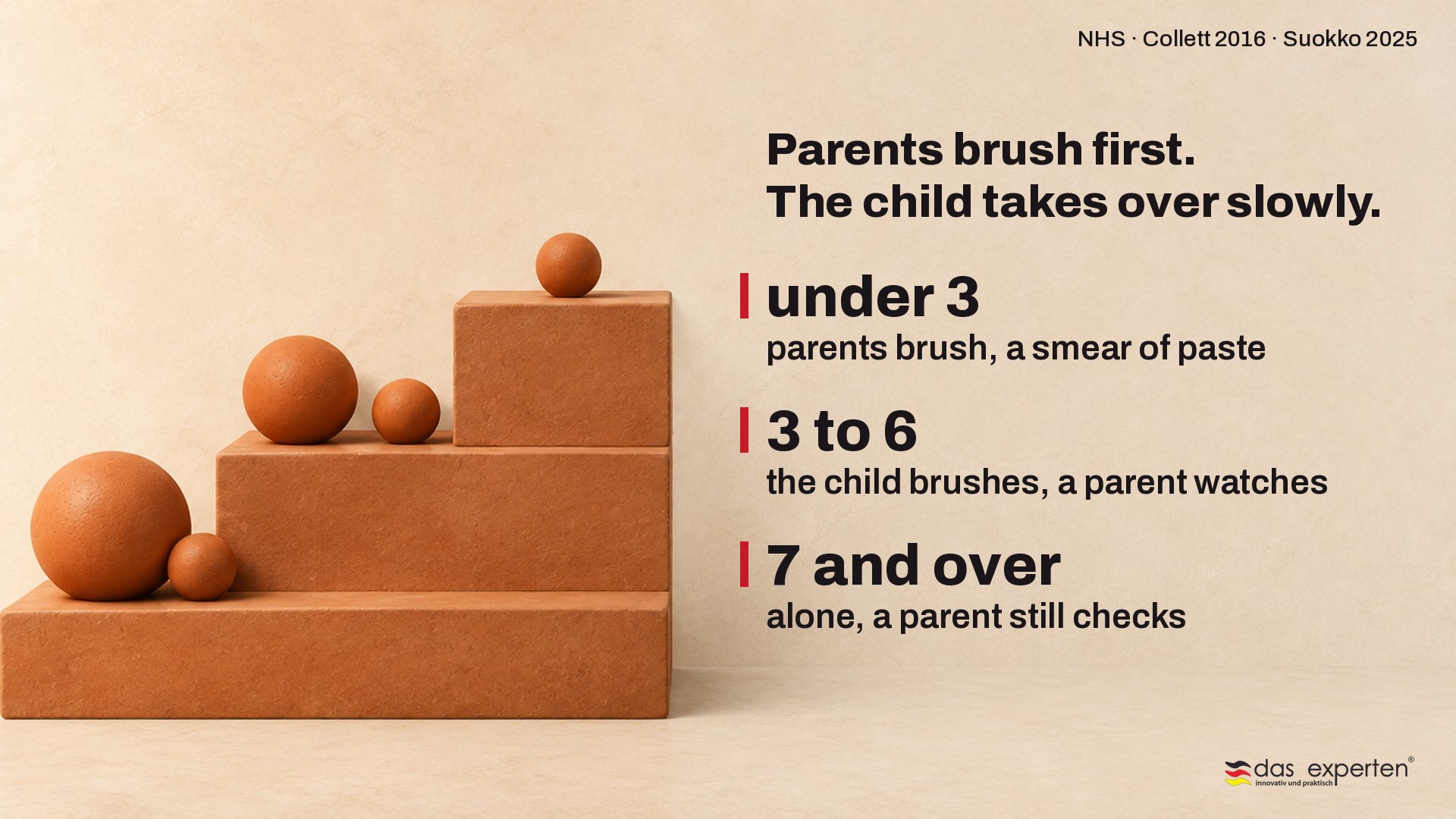
For children under 3, the NHS asks parents to do the brushing, with a smear of toothpaste, last thing at night and at one other time. From 3 to 6 the child brushes with a parent watching and a pea sized amount; from 7 most children can brush alone, though a parent should still check. On a bad night, a short calm clean is better than a long battle. Stop when the teeth are clean, praise the effort, and try again tomorrow at the same time.
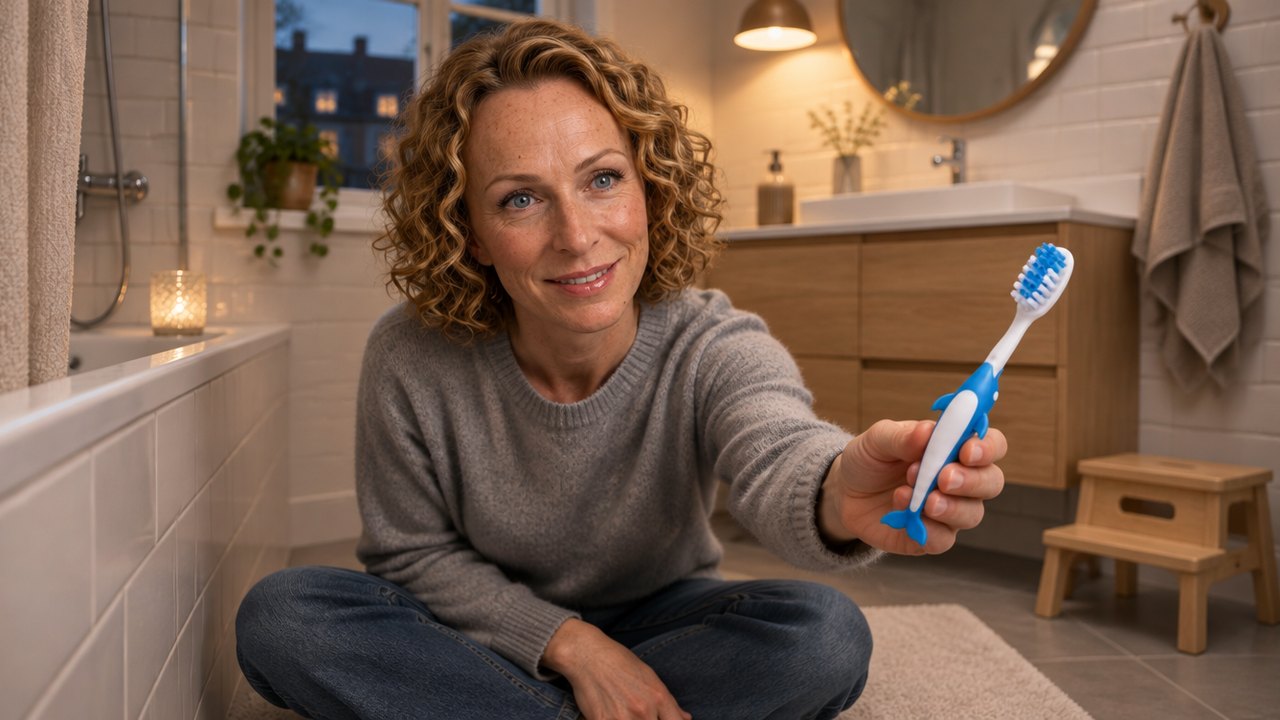
Sometimes the trigger is the paste itself: foam, a strong mint, a taste that surprises. Our BUDDY MICROBIES 0+ is a strawberry flavoured gel that does not foam and contains no fluoride. Health services such as the NHS advise fluoride toothpaste from the first tooth, so ask your dentist which paste suits your child. The small brush in the photograph is our DOLPHIN KINDER 1+, made for toddlers from age 1. For the exact amount on the brush, read how much toothpaste to use.
If your child is in pain, has a swollen gum or a tooth that looks dark, the refusal may have a reason. See a dentist.
A toddler who refuses to brush is not a battle to win tonight. It is a routine to win over months, with the parent holding the brush.