


Miswak: The Twig From Arabia That Matched Your Toothbrush in Nine Trials

Medina, June 632. In a small room beside the mosque a man in his early sixties lies with his head against the chest of his wife, Aisha. He is very weak. Her brother Abd al Rahman comes in holding a fresh stick cut from the root of a desert shrub, and the sick man's eyes follow it. Aisha understands. She takes the stick, finds the end too stiff, softens it with her own teeth and hands it to him, and he cleans his teeth with it. It is one of the last things he does. The man is the Prophet Muhammad, and the scene is recorded, in Aisha's own words, in the collection of al Bukhari.
The stick is a miswak, also called siwak: a twig of the arak tree, Salvadora persica, which grows across the dry belt from Arabia to East Africa and India. Chew the end and the wood splits into soft fibres, a small brush of its own. It tastes sharp and peppery, a little like garden cress, and it leaves the mouth feeling scrubbed. Long before Islam, Arabian poets already took it for granted. In the sixth century Imru' al Qais, the wandering prince whose ode was among the most celebrated poems of pre Islamic Arabia, compared the fingers of the woman he loved to the tooth sticks of the ishil tree.
Then the stakes rose. Another saying in the same collection, narrated by Abu Hurairah, has the Prophet say that if it would not be too hard on his people, he would have ordered them to use the siwak before every prayer. He stopped short of a law. He did not need one. A twig became part of the daily routine of millions of people, from Morocco to Indonesia, and it still is.
Meanwhile, in Europe
In the same centuries most of Europe cleaned its teeth, when it cleaned them at all, with a rag, a finger, salt or soot. The bristle toothbrush reached England as a mass product only around 1780, when William Addis began selling brushes of bone and pig bristle in London. By then the arak twig had been in Arabian mouths for well over a thousand years. Europe was not ahead. It was late, and it called its lateness an invention.
How did Arabia get there first?
Not through a laboratory. Through use. People who chewed the arak twig every day noticed what it did: firmer gums, fresher breath, cleaner teeth. The habit spread along trade routes because it worked and because it cost nothing; across the world, scientists have since counted 182 plant species used as chewing sticks, from neem in India to other twigs across Africa. Arabia was not alone. It simply wrote the habit into its daily life more firmly than anyone else.
And here is the paradox of silence. Generations of users praised the miswak, and none of them could say why it worked. The answer was invisible. It was not in the fibres, which any twig has, but in a smell and a taste: that peppery bite on the tongue. Without the idea of bacteria, without a microscope, without a word for a molecule, a whole civilisation was describing a chemical weapon as a matter of good manners. The knowledge lived in the habit, not on the page.
The long road back
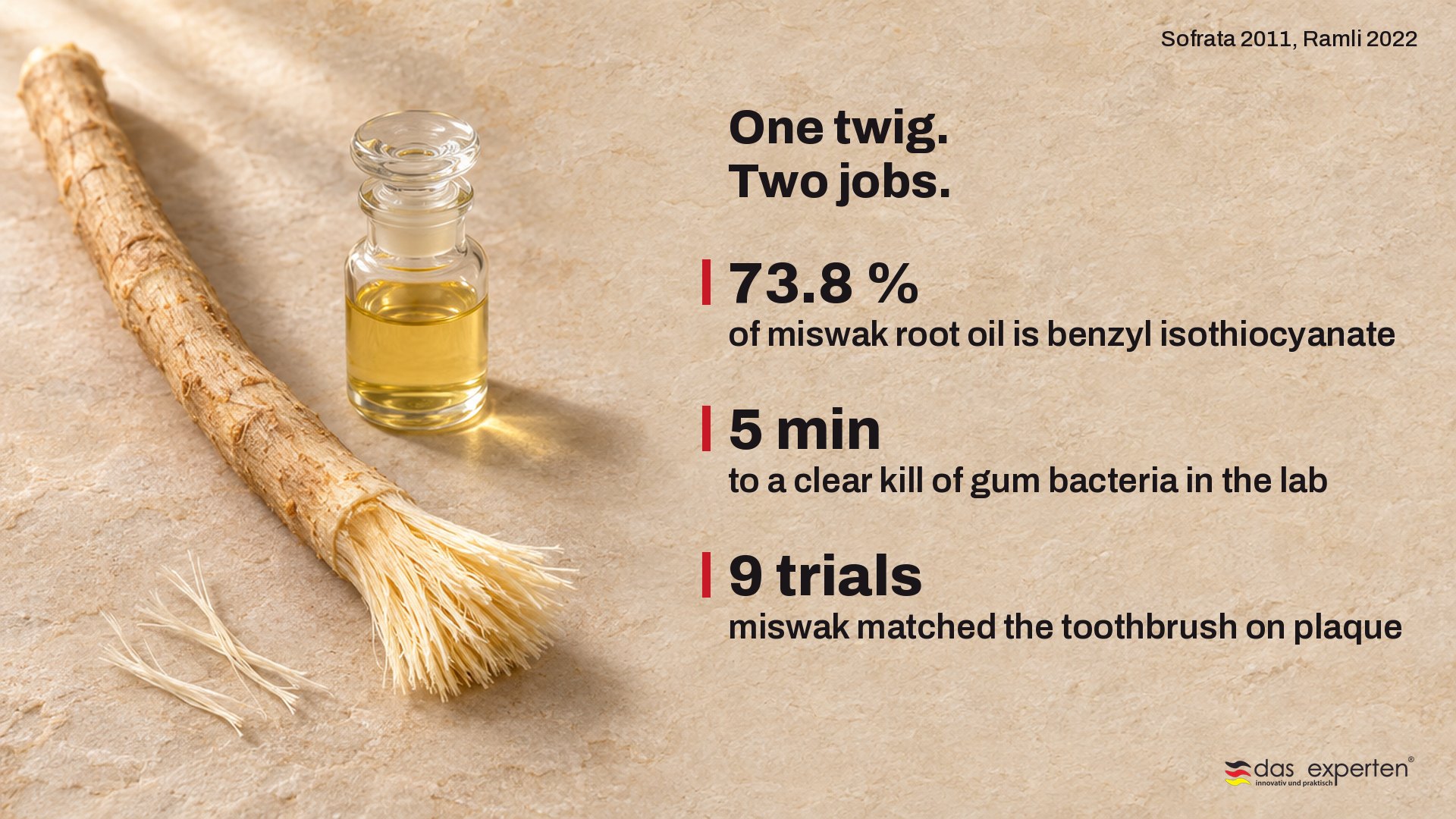
Modern dentistry spent most of the twentieth century looking at the miswak with polite suspicion: a folk tool, charming, probably no match for a nylon brush. Then the trials came. In 2022 researchers in Malaysia pooled the randomised trials on miswak in adults: of ten eligible studies, nine could be combined, and miswak used on its own came out comparable to the toothbrush for both plaque and gum inflammation. Used in addition to a toothbrush, it did better than the brush alone. In 2026 a wider review of natural and biodegradable tools against plastic toothbrushes, five trials and 408 people, again found no clear difference, while warning that the certainty of the evidence was very low. Honest science, then: not a miracle, but not folklore either.
But a trial says whether something works, not why. For the why, chemists had an awkward starting point: the published reports on the arak root disagreed about which of its substances was active at all, and about which bacteria it touched. Some pointed to salts and silica in the wood, others to resins or tannins. The twig that Arabia had trusted for fourteen centuries arrived in the laboratory as a puzzle with too many suspects. Someone had to follow the smell.
What the science says now
The single molecule that bridges Medina and the modern laboratory is benzyl isothiocyanate. In 2011 a team at the Karolinska Institutet in Stockholm, led by Abier Sofrata, distilled the oil of the arak root and analysed it: 73.8 % of the oil was benzyl isothiocyanate, and in the vapour from fresh root it was more than 98 %. That is the peppery bite; the same family of compounds, the isothiocyanates, gives mustard and horseradish their burn. Tested on bacteria, it killed the Gram negative germs that drive gum disease, among them Porphyromonas gingivalis and Aggregatibacter actinomycetemcomitans. The effect was clear within 5 minutes, and by 10 minutes the surviving bacteria had fallen a thousandfold. Gram positive bacteria such as Streptococcus mutans, the classic cavity germ, were mostly left alone. The twig was built for the gums, not for cavities.
And now the part that concerns you personally. Tomorrow morning you will squeeze something onto your brush. It will be either a paste that only foams and tastes of mint, or one that works against the same gum bacteria the arak root was fighting fourteen centuries ago. That is not a question of fashion. It is a question of which century your bathroom shelf belongs to.
Our Das Experten DETOX does not contain miswak, and it does not pretend to. It goes after the same enemy with two other plants: cinnamon at 0.8 % and clove at 0.2 %, a blend made for inflamed, bleeding gums. In the product's clinical dossier, Porphyromonas gingivalis, the gum bacterium the arak root kills in the laboratory, falls by 74 %. Different molecules, the same target, and a tube that fits next to the brush you already own. Check what is on your brush this week.
Arabia was cleaning its gums with a chemical weapon fourteen centuries ago; Europe called the toothbrush an invention a thousand years later.