


How to Remove Tartar From Teeth: Córdoba Knew, Europe Ignored It
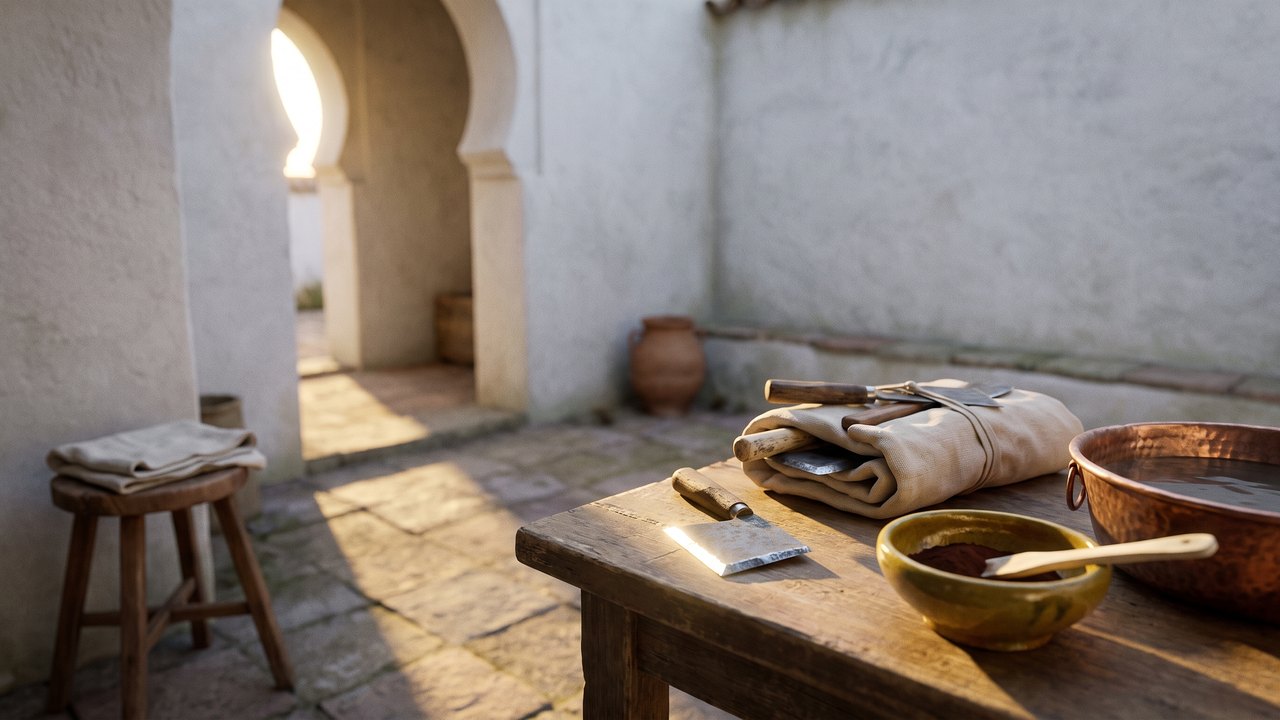
The man on the low stool has his head in another man's lap, and he is doing his best not to move. That is not affection. That is the position, and it is written down: the patient sits before you and puts his head in your lap, so that he cannot pull away from the blade.
It is first light in Córdoba. The courtyard is still cold. The physician is holding a thin steel scraper he designed and had forged himself, and he is working at a hard grey crust where the tooth meets the gum, the outer face first, then the inner, then a narrower tool for the gaps between. He does not stop when the tooth looks better. He stops, in his own words, when nothing of the substance remains, and if one morning is not enough the man comes back and it is done again.
Afterwards there is a powder to rub on. Clove, cinnamon, nutmeg and fennel, five parts of each, ground and sieved.
The physician is Abu al Qasim al Zahrawi. In two hundred years Europe will be reading him in Latin and calling him Abulcasis. In a thousand years the question how to remove tartar from teeth will be typed into a search box several thousand times a month, and the answers will be worse than his.
The mouth was beneath a doctor
Around the year 1000, in Córdoba and in Christian Europe alike, everything to do with the mouth and the teeth was considered a secondary matter, beneath medicine proper, and handed to barbers and to bleeders. A physician set fractures and cut for stone. Somebody else, with a razor and no theory, dealt with your teeth.
Al Zahrawi refused the division. He was personal physician to the caliph Abd al Rahman III and to al Mansur, and he gave seven consecutive chapters of his surgical volume to the mouth: inflamed gums, growths on the gum, splinting loose teeth with gold and silver wire, putting a knocked out tooth back in its socket. He is the first person in the written record to do that.
The rest of the continent kept the barber.
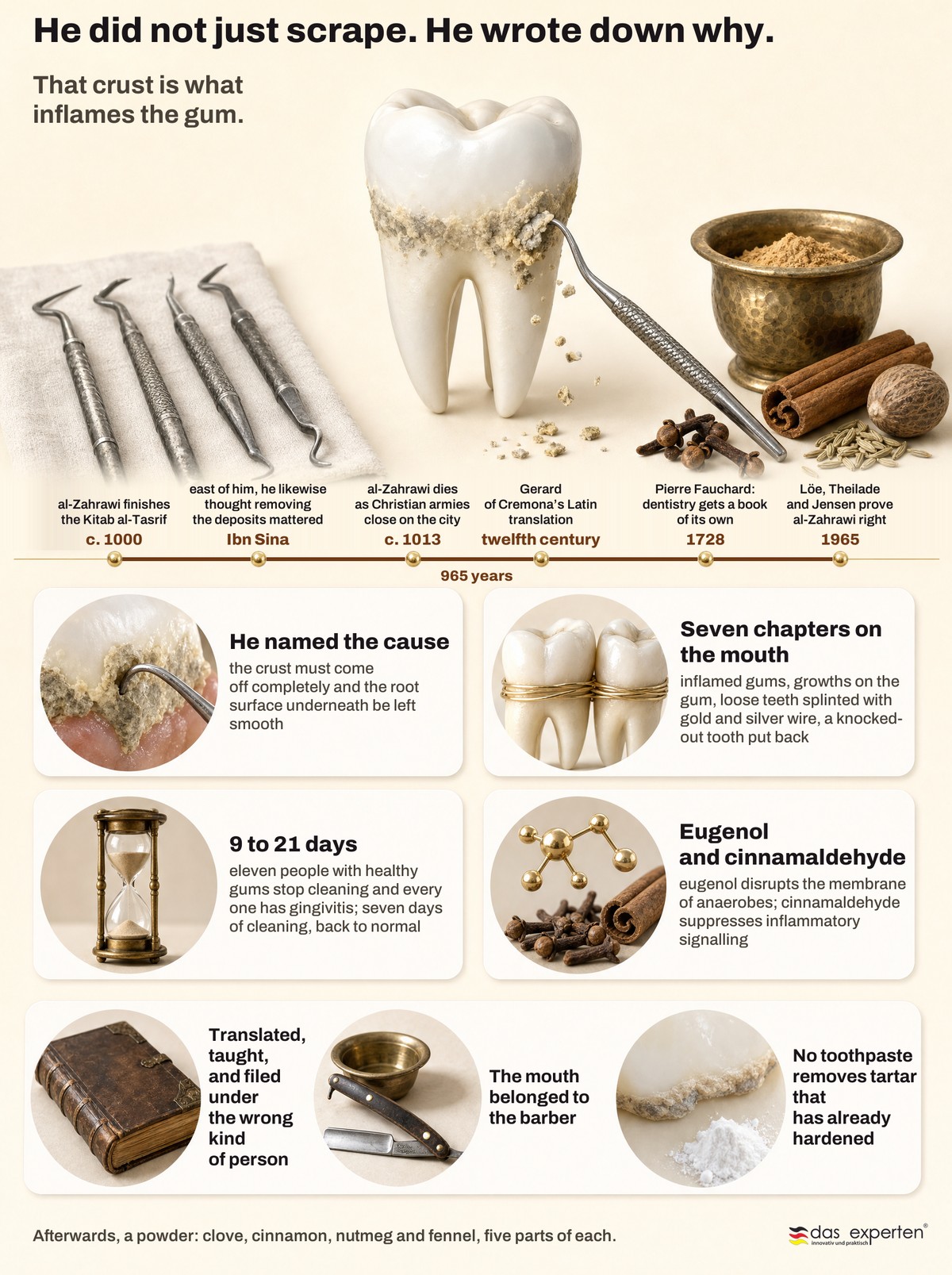
He did not just scrape. He wrote down why.
This is the part that separates the story from every other old remedy. Al Zahrawi named the cause.
Sometimes, he writes, there are collections upon the inner and outer surfaces of the teeth and between the gums, which spoil chewing and make the mouth foul. And, this is the sentence that matters, that crust is what inflames the gum. So it has to come off, completely, and the root surface underneath has to be left smooth. He built a set of scrapers himself for exactly that job, with separate ones thin enough to reach between the teeth, and he drew them in the margin so the next man could have them made.
He had no microscope and no word for bacteria. What he had was a thing he could see, a thing he could feel with a blade, and a swollen gum that settled down after he took the thing away. That is the entire method, and it produced a correct answer nine centuries before anyone could explain it.
He was careful about the rest of it, too. On pulling teeth: treat the pain by every device and be reluctant to extract, because nothing can replace a tooth once it has been taken out. Ibn Sina, working east of him, likewise thought removing the deposits mattered. This was not one man's eccentricity. It was the standard of care in a language Europe was about to translate.
The book Europe taught for six hundred years
Usually the next paragraph explains that the knowledge burned, or was suppressed, or died with its author. None of that happened here, and that is what makes this the strangest gap in the series.
Al Zahrawi finished his thirty part encyclopaedia, the Kitab al Tasrif, around the year 1000, and died around 1013 as Christian armies closed on the city where he had spent his life. The book did not die with him. In the twelfth century Gerard of Cremona, working in Toledo, translated the surgical volume into Latin. From there it went into the curriculum at Salerno and Montpellier and stayed there. For roughly six hundred years it was the main practical guide to surgery in Christian Europe.
Europe read him. Europe examined students on him. Europe took the cautery, the forceps, the fracture work, and left the mouth exactly where it had found it, with the barber, because the mouth was still beneath a physician. The answer was not lost in translation. It was translated, printed, taught, and filed under the wrong kind of person.
Dentistry only got a book of its own in 1728, when Pierre Fauchard published Le Chirurgien Dentiste. And the experiment that finally proved al Zahrawi right was run in 1965. Löe, Theilade and Jensen asked eleven people with healthy gums to stop cleaning their teeth. Within 9 to 21 days every one of them had heavy deposits and gingivitis, and the speed at which the gums inflamed tracked the speed at which the deposit built up. Seven days of cleaning again and the gums went back to normal. That is 965 years between writing it down and checking it.
What the powder was doing. and the half it cannot do
Clove is Syzygium aromaticum, and the molecule in it is eugenol. It is not a flavour: eugenol disrupts the membrane of the anaerobes that live on and under a deposit, which is why the powder rubbed on after the scraping was doing more than making the mouth smell better. Cinnamon carries cinnamaldehyde, which suppresses the inflammatory signalling, the interleukins and prostaglandins that make a gum swell and bleed. Al Zahrawi put both in the same dish and could not have told you either name.
DETOX from Das Experten is that dish, measured. Clove extract at 0.2% and Ceylon cinnamon bark extract at 0.8%, the pair suppresses Porphyromonas gingivalis, the principal gum pathogen, by 71 to 74%, cuts IL 1β, TNF α and PGE 2 by 87 to 98%, and lifts salivary pH from 6.2 to 7.4, which is the range where enamel stops dissolving. Measured enamel calcium loss falls to 17 mg/L against 53 mg/L for the control. It polishes at RDA under 49, very low abrasion, and it is fluoride free and SLS free. The one thing in the tube al Zahrawi had no equivalent for is sodium pyrophosphate, which interferes with calcium phosphate crystallising on enamel, that is, it slows the soft deposit turning into the hard crust in the first place.
Which brings the honest half, the one the home remedy pages will not give you. No toothpaste removes tartar that has already hardened. Not this one, not any of them, and not baking soda or vinegar either, those take enamel off, which does not grow back. Hardened calculus comes off with an instrument, exactly as it did in that courtyard. What is actually in your hands is the other job: whether the next crust forms at all.
You have probably already had this conversation with yourself, standing at the mirror, deciding whether the pink in the sink is worth a phone call. It is the same signal al Zahrawi was reading with a blade.
Tomorrow morning you will stand at a sink and pick one of those two jobs, and only one of them is yours. A surgeon in Córdoba told you which, and put it in writing, and Europe had the book on the shelf the whole time.
This knowledge was never lost. It was translated, printed and taught for six hundred years, and skipped, because the mouth belonged to the barber.