


Does Whitening Toothpaste Work? 7 Promises Against the Evidence
The whitest promise on the toothpaste shelf is often a little blue pigment and a good polish. That is not a scandal; both do something real. But neither changes the colour your teeth were born with, and the box rarely says so.
You have probably bought a whitening tube, brushed for a fortnight and then stood at the mirror trying to decide whether anything happened. Most of us have. So does whitening toothpaste work? Yes, at one job, and that job is smaller than the box suggests. Below are the seven promises a whitening paste usually makes, each checked against a review, a trial or the law. We name no brands; the checks work on every tube, ours included.
1. Removes stains: only from the surface
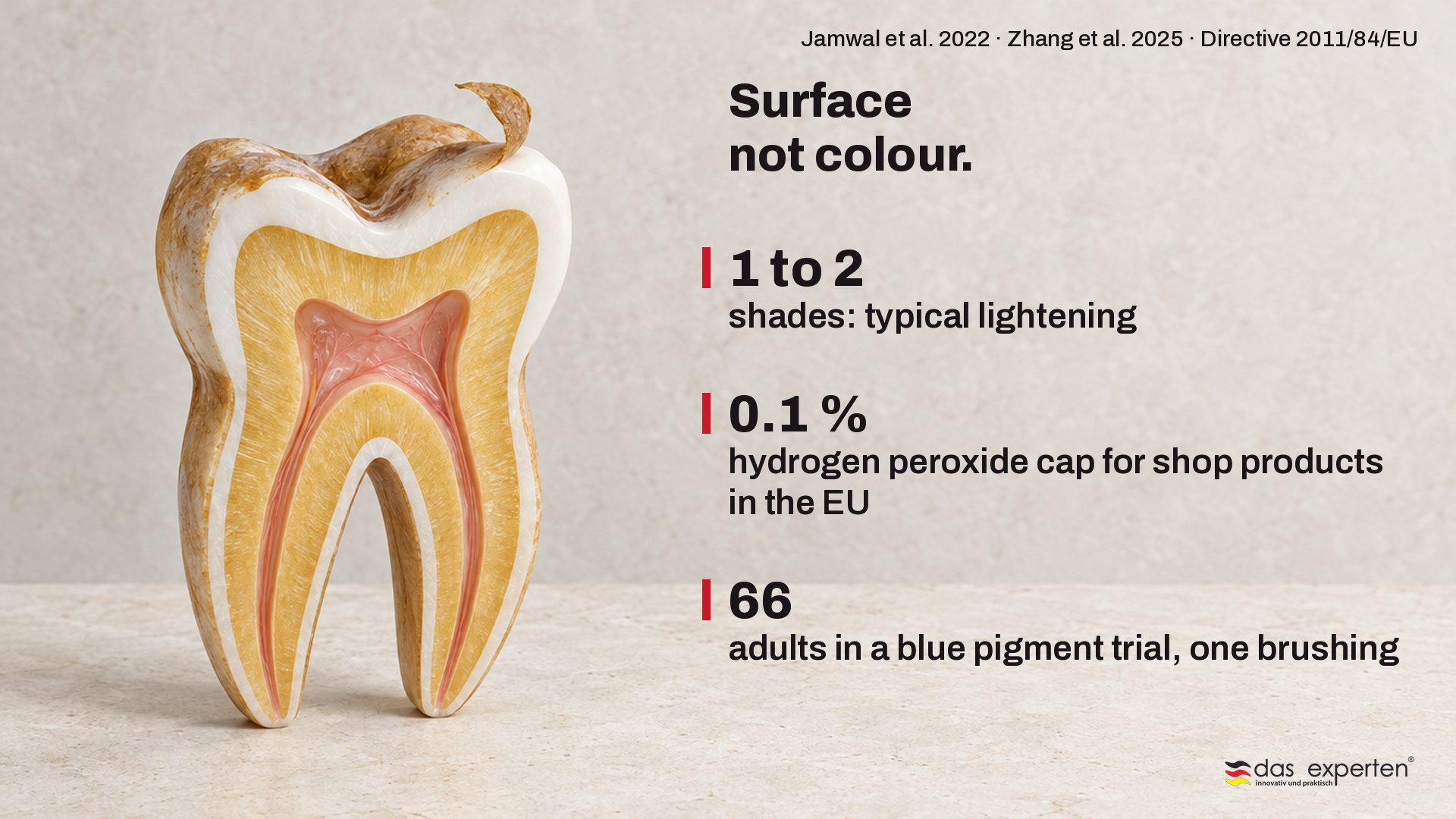
The American Dental Association puts it plainly. Whitening toothpastes rely mainly on abrasives that physically remove extrinsic stains, the coffee, tea, wine and tobacco film on the outside of the enamel. Some add a low level of peroxide. And over the counter whiteners, toothpaste included, will not have a significant impact on intrinsic stains or on the intrinsic colour of the tooth. If your teeth were never stained, there is little for the paste to lift.
2. Shades whiter: about one or two
Shade claims are counted against a dentist’s shade guide, a fan of sixteen porcelain tabs. A 2022 systematic review in F1000Research summed up the field in one line: whitening toothpastes typically lighten tooth colour by about one or two shades. That is a visible change on a stained tooth and nearly nothing on a clean one. When a promise is much bigger than two shades, ask what was measured, on whom and against what.
3. Whiter after one brush: that is optics
The fastest results come from blue covarine, a blue pigment that sticks to the enamel for a while and makes yellow look less yellow. In a 2025 randomised, double blind crossover trial with 66 adults, pastes with blue covarine raised a whiteness index more than an ordinary silica paste immediately after a single brushing. Real, measurable, and an effect of colour on the surface rather than a change in the tooth. The trial was run by scientists of a company that makes such pastes. That does not make it wrong; it is worth knowing.
4. Peroxide whitening: in a tiny dose
Peroxide is what actually bleaches teeth, and the law keeps it out of the shop in strength. Under EU Directive 2011/84/EU, products sold directly to consumers may contain or release no more than 0.1 % hydrogen peroxide; from 0.1 up to 6 % the product belongs to a dentist. A paste stays on your teeth for the two minutes of brushing. A 2024 cost effectiveness analysis of 8 randomised trials found that in the US market the higher price of peroxide and blue covarine pastes bought no whitening benefit over an ordinary paste; a home bleaching gel with 10 % carbamide peroxide was the most cost effective choice.
5. Safe for enamel: polish has a price
If the work is done by abrasion, the abrasion touches the tooth as well. The same 2022 review pooled studies on human teeth, mostly in the laboratory: of 7 trials included, 4 went into the meta analysis, and surfaces brushed with whitening pastes came out rougher and less hard than controls. A rougher surface picks up the next stain faster. Ask for the abrasivity figure, RDA, before you believe a gentle promise; on exposed roots it matters most.
6. Natural charcoal whitening: weakest in the test
Black paste photographs beautifully against white teeth. In a 2019 laboratory study, 90 tea stained bovine teeth were brushed with five whitening technologies and an ordinary paste. Blue covarine and microbeads whitened after the first brushing; after simulated continuous use blue covarine led, followed by peroxide and microbeads. Activated charcoal was not among the leaders, and the plain paste did not whiten at all. We covered the wider charcoal evidence in our guide to harmful toothpaste ingredients.
7. Whiter in days: the real bleach needs weeks
Even true bleaching takes time. A 2018 Cochrane review of home whitening gathered 71 randomised trials of gels in trays, strips, paint on gels and rinses. Against placebo they did whiten teeth over periods from two weeks to six months, yet the certainty of that evidence was rated low to very low. Most of those products hold far more peroxide, for far longer, than a paste. A promise of whiter in a few days from a tube is, at best, a promise about surface stain.
What a whitening paste can honestly do
It can keep the surface clean, lift the film of yesterday’s coffee, and with pigment make the first glance in the mirror a little brighter. It cannot change the colour inside the tooth. For that the evidence points to peroxide applied for weeks, ideally with a dentist. If you want a paste for surface stain without heavy polishing, compare formulas by abrasivity on our guide to whitening toothpaste that spares enamel.
Das Experten makes such a paste, so the checks apply to us too. Our INNOWEISS lists silica as its abrasive with RDA below 30 in its product record, no colourant and no fluoride; a low figure is not zero abrasion, and we print no shade number on it, because a shade number needs a study of the finished paste. Every ingredient is listed on our product pages.
Next time a tube promises a whiter smile by Friday, ask which of the seven promises it is making. Most of the time it is the first one, and that one is true.