




Cinnamon for Teeth: Ceylon Brushed With It. Europe Killed for It.
The light is not up yet, and the man walking into the cinnamon garden carries two tools and no lamp. Six centuries before anyone would think to write the phrase cinnamon for teeth, this household already had a use for the bark that had nothing to do with cooking.
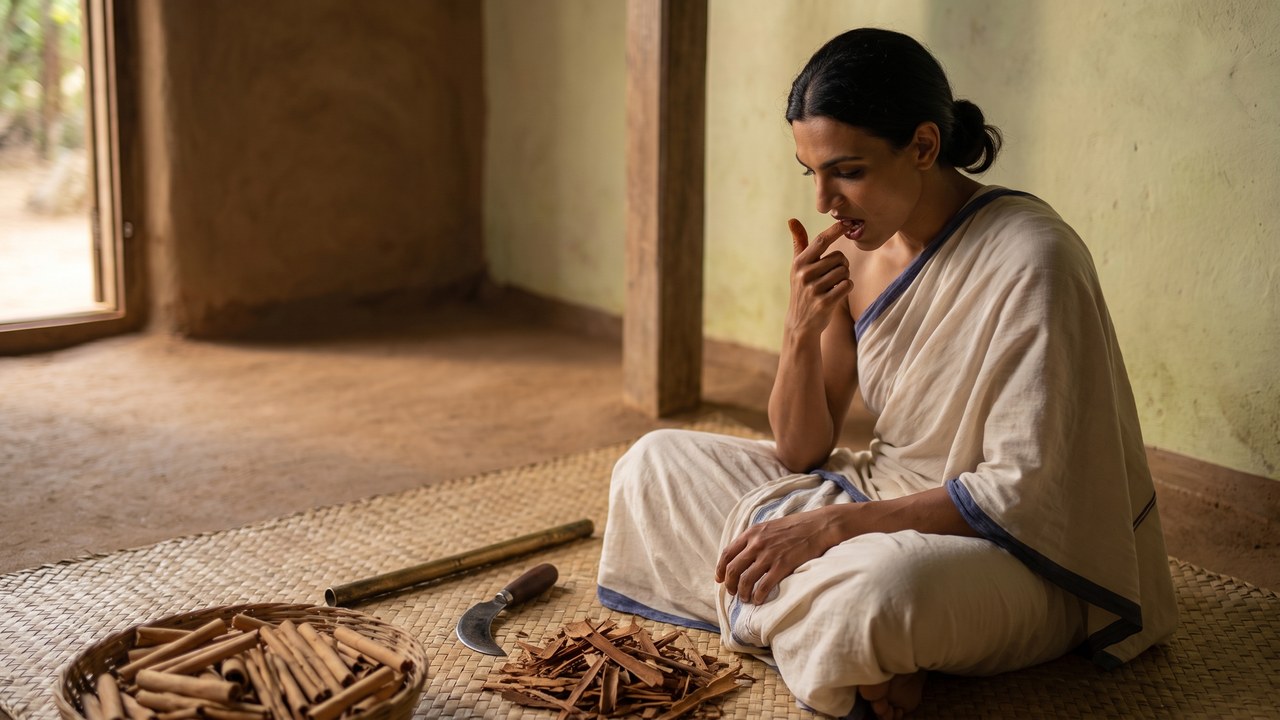
The first is a curved knife. The second is a brass rod, worn smooth. He works before sunrise because the damp has not lifted, and damp bark comes off the wood in one clean sheet; by noon it will tear. He cuts a shoot no thicker than his thumb, scrapes the corky skin from it, bruises what is left with the rod, and slits it lengthwise. What comes away is a sheet of inner bark the colour of weak tea, so thin it curls before he can lay it down. He nests the small curls inside the larger ones until each roll is a quill. A full day of this gives him about four kilograms.
Inside the house, his mother is doing something else with the same bark. A piece too short to roll, a scrap, worth nothing to anyone counting quills, has been dried hard and ground to powder. She takes it on a fingertip and works it along the gums of a child who has been awake half the night with a bad tooth. The powder is hot on the tongue, and then, oddly, it is not. The ache goes quiet underneath it.
She has no word for inflammation. She has a powder, and whatever her own mother told her about it.
The year the bark stopped being a plant
Sri Lankan historians put a date on the moment the island's cinnamon changed category: 1406, when the king of Kotte compelled part of a weaving community, the Salagama, into peeling it. They had arrived generations earlier as weavers. From that point their work, their taxes and eventually their name were tied to a tree.
Two economies now ran through the same bark and never met. One was a ledger: quills counted, graded, baled, taxed. The other was a household: a scrap on a fingertip, a gum, a child. The ledger is the one that got written down, because it was the one somebody was paying for.
Meanwhile, Europe was brushing with rubble
At the same hour, cinnamon in Europe was among the most expensive things a person could own. It was sold by the ounce, kept locked, burned at rich men's funerals, and worn the way a watch is worn now, to say something about the owner.
What Europeans put on their teeth was a different substance entirely. Tooth powders of the period ran to ground brick, pumice and cuttlefish bone, sometimes wetted with vinegar: abrasives, applied hard, which took the stain off by taking the enamel with it.
Europe had the bark. Europe eventually had more of it than Ceylon kept for itself. And Europe brushed with rubble.
Nobody wrote it down, because nobody was buying that
It is tempting to look for a villain here, a text burned, a healer silenced. There is nothing of the kind. The knowledge was never hidden. It was never interesting to the only people who could have carried it abroad.
A Portuguese factor arrived with a quota. A Dutch one arrived with a quota, a grade and a price. Their questions about the bark were fixed, and there were four: how thin, how pale, how many quills to the bale, and what did the last convoy fetch in Amsterdam. Not one of those has an answer that involves a gum. A buyer does not ask what a thing does; he asks what it costs.
So the answer stayed where it had always been, in a house, in Sinhala, held by a caste the traders had already filed as labour. This is how most old knowledge is lost. Not by suppression. By irrelevance to the ledger.
Two thousand tons, burned in Amsterdam
What happened next is among the more violent things ever done over a flavouring. The Portuguese, who fortified Colombo in the sixteenth century, made damaging a cinnamon grove a capital offence. The Dutch East India Company took Colombo in 1656 and by the mid 1660s held effectively every growing region on the coast. Under the company a peeler who sold a single quill outside its channels could be beheaded for it; peelers short of quota had their ears cut off, were held in chains and were whipped.
In 1760 the company burned roughly 2 000 tons of cinnamon on the Amsterdam quays. Not because it had spoiled. Because there was too much of it, and scarcity was the product.
The British took the island in 1796 and the monopoly came apart within a generation. Cheaper cassia flooded the market, the price collapsed, and the most guarded substance in the Indian Ocean became the cheapest jar on a European shelf. At no point in that fall did anyone with a laboratory test what the bark did to a mouth.
The molecule the ledger never priced
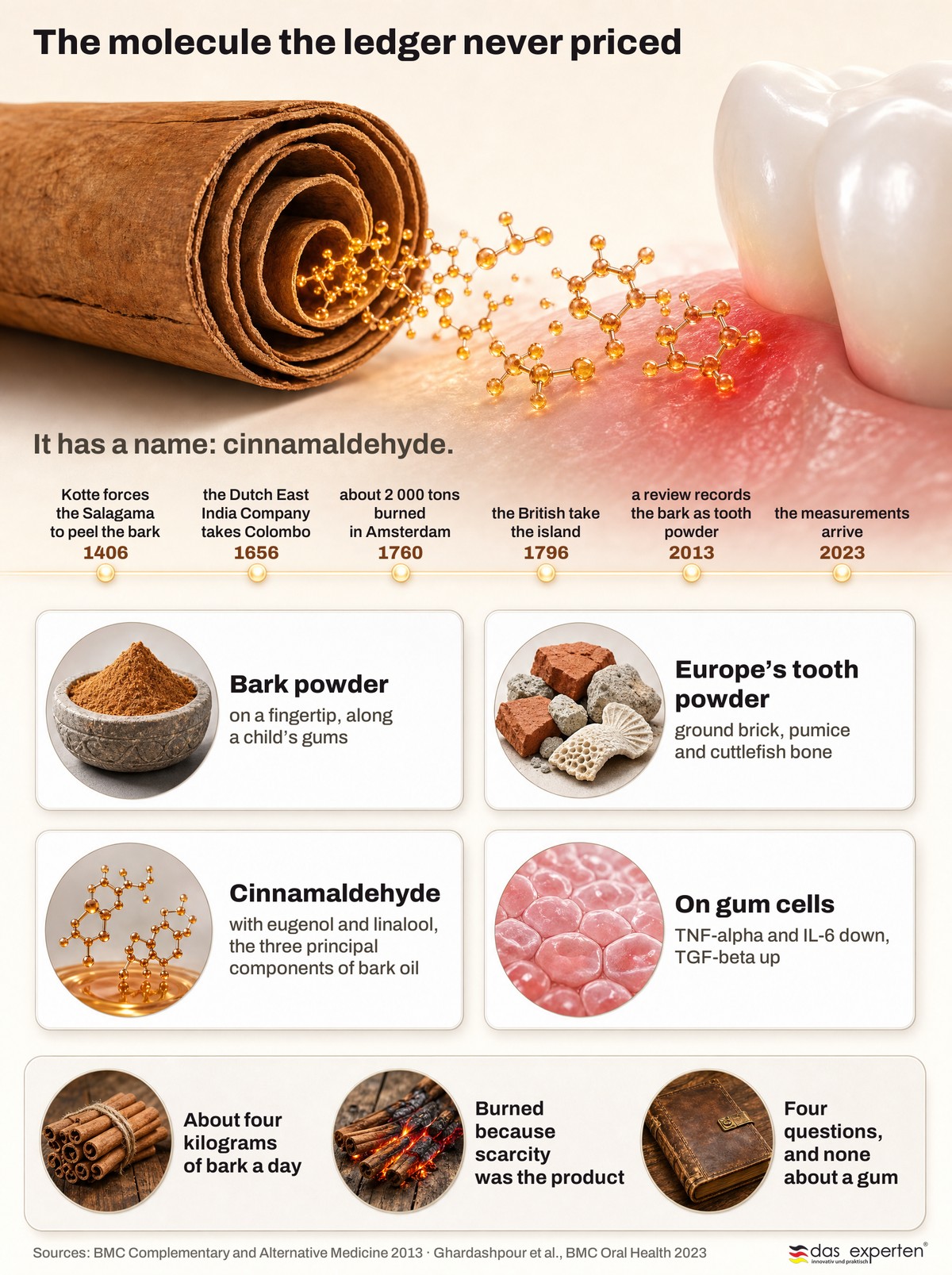
It has a name: cinnamaldehyde. Trans cinnamaldehyde, eugenol and linalool are the three principal components of cinnamon bark oil, and the first of them does most of the work.
In 2013 a systematic review of Cinnamomum zeylanicum in BMC Complementary and Alternative Medicine recorded the traditional use plainly: the bark, as a tooth powder, for toothache, dental complaints, oral microbiota and bad breath. That is the woman with the powder on her fingertip, described six centuries later, in a journal.
Ten years later the measurements arrived. In 2023 BMC Oral Health published work by Ghardashpour and colleagues who put cinnamaldehyde onto human gingival fibroblasts and onto macrophages: the inflammatory signals TNF α and IL 6 went down, and TGF β, the signal tissue uses to repair itself, went up.
She was not treating a tooth. She was, without any way of saying so, quieting the gum around it.
Which brings us to tomorrow morning
Pick up the tube by your sink and read the ingredient line. If cinnamon is in it, it is written in Latin, and the Latin is Cinnamomum Zeylanicum. Zeylanicum. Ceylon. The bark is still formally named after the island that was taken in order to own it.
Which is the argument for DETOX from Das Experten, built on Cinnamomum Zeylanicum bark extract at 0.8% with clove at 0.2%. Cinnamon at that concentration measures a 15 to 25 mm inhibition zone against oral pathogens and lifts salivary pH from 6.2 to 7.4, which matters because acid, not bacteria in the abstract, is what actually dissolves enamel. The clove alongside it carries eugenol at a 20 to 30 mm zone and suppresses P. gingivalis by 71 to 74%. Together the pair reduce the inflammatory cytokines IL 1β, TNF α and PGE 2 by 87 to 98%. It is fluoride free, SLS free and sits under RDA 49, the opposite of ground brick, and built for the ordinary morning, which is the morning the powder on the fingertip was for.
The woman in that house could not have told you why it worked. You can. That is the only thing six hundred years have changed.
Ceylon never lost the knowledge. Europe bought the bark, graded it, guarded it with the gallows and burned it by the ton to keep it dear, and in three centuries of owning it, never once asked what it was for.