


Toilet Plume and Your Toothbrush: The Spray Is Real, the Harm Is Unproven

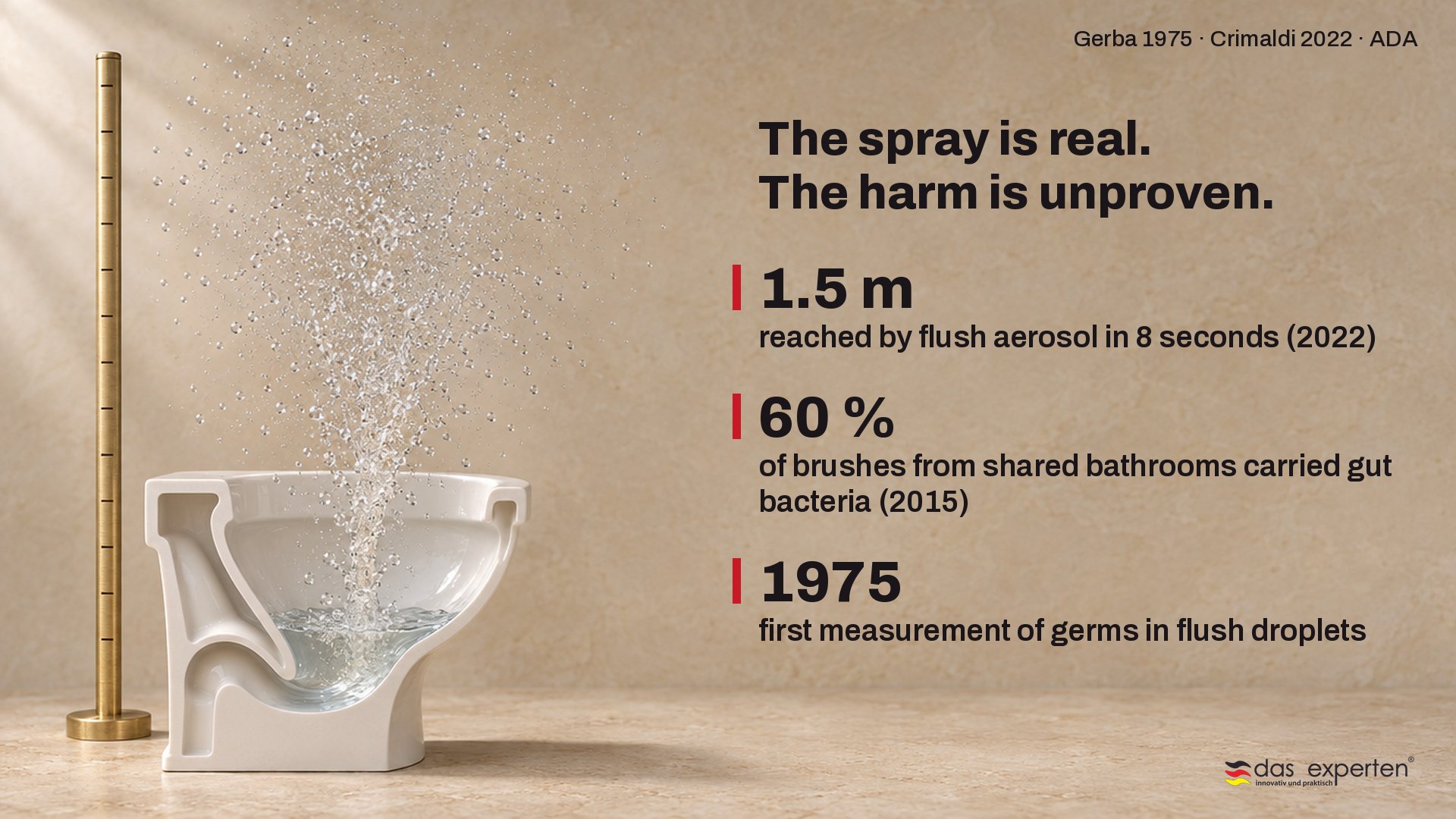
Connecticut, 2015. A team at Quinnipiac University collects toothbrushes from students who share bathrooms, on average 9.4 people to one room, and puts the bristles on culture plates. At least 60 % of the brushes carry faecal coliforms, the gut bacteria that travel wherever faeces go. The finding reaches the newspapers in one sentence: there is poop on your toothbrush. Since then a habit has spread from bathroom to bathroom. Close the lid before you flush, push the brush into a plastic cap, and hope.
Part of that story is true. The other part is a myth, and the myth is the part that changes what people do. So let us separate them.
The toilet plume is real
The spray was measured long before the headlines. In 1975 the microbiologist Charles Gerba and his colleagues seeded household toilets with bacteria and viruses, flushed, and caught the droplets. The organisms rode the droplets out of the bowl, stayed in the air long enough to drift, and settled on surfaces around the room. A stubborn fraction also stayed in the bowl, flush after flush.
In 2022 engineers at the University of Colorado Boulder made the plume visible. They lit a lidless public toilet with a thin sheet of green laser light and filmed the flush. A jet faster than 2 m per second carried fine aerosol up to 1.5 m above the floor within 8 seconds, which is the height of a basin shelf in most bathrooms. So yes: if your brush stands near the toilet, the air around it is not empty after a flush.
Where the myth begins
The myth is the next step: that the spray on the brush makes you ill. Here the evidence goes quiet, and the silence is informative. The Colorado team wrote plainly that their work does not show how the plume transmits disease. The Quinnipiac researchers said that most of the bacteria they found would have to be present in large numbers to make anyone sick. And the American Dental Association states it directly: toothbrushes have been shown to harbour bacteria, but there is no evidence that these bacteria cause adverse health effects.
In 2024 a Northwestern University team read the DNA on 34 toothbrushes and 92 shower heads. They found more than 600 different viruses, almost all of them bacteriophages, viruses that infect bacteria rather than people. The microbiologist Erica Hartmann put it simply: no cause for concern, and no reason to throw your toothbrush out. Your brush is not sterile. It never was. Your mouth is not sterile either, and the brush mostly carries what it found there.
The two fixes that do not fix it
Now the uncomfortable part, because the popular defences do little. The first is the closed lid. In 2024 a team in Arizona flushed toilets seeded with a harmless test virus, lid up and lid down, and swabbed the surfaces nearby. They found no statistically significant difference. The lid moved the spray around; it did not remove it. What worked was cleaning: disinfecting the bowl cut the virus on it by more than 99.99 %.
The second defence is the cap, and it backfires. In the Quinnipiac study the covered brushes were no cleaner, and the authors pointed out why: a cap keeps the bristles wet. The American Dental Association says the same in one line: a moist toothbrush stored in a closed container grows more microbes than one left in the open air. The cap protects the brush from a danger nobody has shown and gives it the one condition bacteria really like.
What actually helps
The dentists' advice is almost boring, which is usually a good sign. Rinse the brush well after use. Stand it upright and let it dry in the open air. Do not let brushes in one cup touch each other, and never share one. Replace it roughly every three months, or sooner when the bristles splay. If your bathroom is shared, a little distance between the toilet and the cup costs nothing, and cleaning the bowl does more than any lid.
The brush matters too, because a brush that keeps its shape cleans better than one that has given up. Our ETALON is an everyday brush with 360° micro spiral PBT filaments. Treat it the same way: rinse it, stand it up, let it dry, and change it with the seasons.
The flush does reach your toothbrush. What the science has never found is the illness the cap was bought to prevent, so let the brush dry in the light and put your effort into the bowl.